Thursday, October 13, 2011

Day Dreams, Night Dreams

Some dreams are day dreams,


but my dreams are night dreams . . .
. . . night dreams . . .
. . . night dreams.
*

short poem by Jaren Dahlstrom
*ellipses in original, as found in
Begin Sweet World: Poetry by Children (1976)
editing and photography by
John Pearson

P.S. 48 hours later & I must add a coda
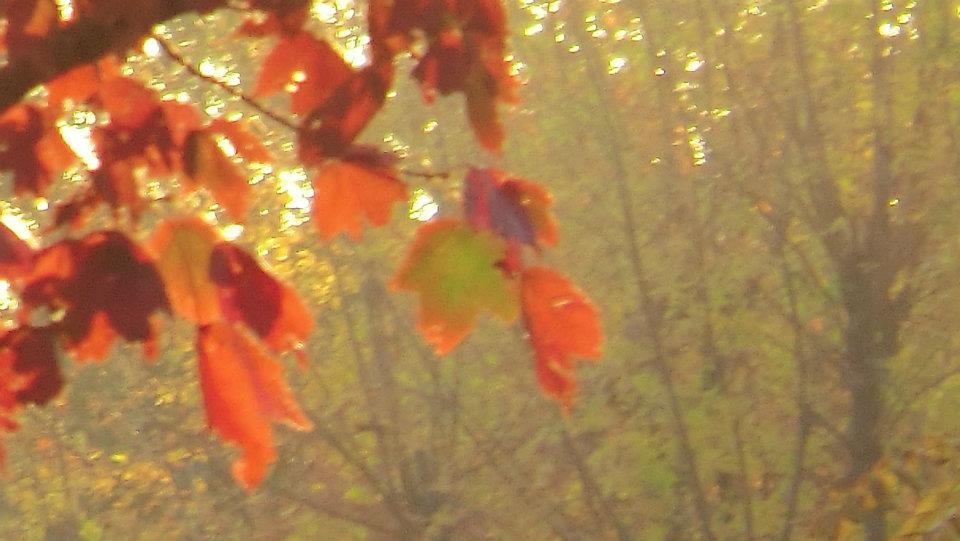
in the form of this photograph that I took
after yesterday's rain. . . not a leaf remains . . . well, maybe one or two

Tuesday, October 11, 2011

Always Autumn

Photograph by Ben McCartney

"The suspicion that even God is partial to autumn
has overwhelmed others,
including John Donne, who enthused:
"In Heaven, it is always Autumn."


comment by American Essayist,
Frank Trippett, 1926 - 98

Click to read the entirety of Trippett's excellent autumnal essay --
ranging in topic from ancient harvest legends
to the U. S. Consitition to the World Series --
"A Season for Hymning and Hawing"
from Time Magazine Archives
Monday, Sept. 19, 1977

***************

In the original words of
John Donne, 1572 - 1631
English Metaphysical Poet
from a sermon preached Christmas Day, 1624


. . . in heaven it is always autumn, his mercies are ever in their maturity. We ask panem quotidianum today if you will hear his voice Psalm 95: 7], today he he will hear you. . . . He brought light out of darkness, not out of a lesser light; he can bring thy summer out of winter, though thou have no spring, though in the ways of fortune, or understanding or conscience, thou have been benighted till now, wintered and frozen, clouded and eclipsed, damped and benumbed, smothered and stupefied til now, now God comes to thee, not as in the dawning of the day, not as in the bud of the spring, but as the sun at noon to illustrate all shadows, as the sheaves in harvest, to fill all penuries . . .
[emphasis added]

***************

and inspired by Donne's sermon,
this lovely fall reverie by American Poet
Elizabeth Spires (b 1952)


In Heaven It's Always Autumn

In heaven it is always autumn. The leaves are always near
to falling there but never fall, and pairs of souls out walking
heaven’s paths no longer feel the weight of years upon them.
Safe in heaven’s calm, they take each other’s arm,
the light shining through them, all joy and terror gone.
But we are far from heaven here, in a garden ragged and unkept
as Eden would be with the walls knocked down, the paths littered
with the unswept leaves of many years, bright keepsakes
for children of the Fall. The light is gold, the sun pulling
the long shadow soul out of each thing, disclosing an outcome.
The last roses of the year nod their frail heads,
like listeners listening to all that’s said, to ask,
"What brought us here? What seed? What rain? What light?
What forced us upward through dark earth? What made us bloom?
What wind shall take us soon, sweeping the garden bare?"
Their voiceless voices hang there, as ours might,
if we were roses, too. Their beds are blanketed with leaves,
tended by an absent gardener whose life is elsewhere.
It is the last of many last days. Is it enough?
To rest in this moment? To turn our faces to the sun?
To watch the lineaments of a world passing?
To feel the metal of a black iron bench, cool and eternal,
press against our skin? To apprehend a chill as clouds pass
overhead, turning us to shivering shade and shadow?
And then to be restored, small miracle, the sun shining brightly
as before? We go on, you leading the way, a figure
leaning on a cane that leaves its mark on the earth.
My friend, you have led me farther than I have ever been.
To a garden in autumn. To a heaven of impermanence
where the final falling off is slow, a slow and radiant happening.
The light is gold. And while we’re here, I think it must be heaven.


[See also: poem for summer]

**************************

Lastly, this elegiac concluding passage
from the novel Cold Mountain by American novelist
Charles Frazier (b. 1950)

Ada had tried to love all the year equally, with no discrimination against the greyness of winter, its smell of rotted leaves underfoot, the stillness in the woods and fields. Nevertheless, she could not get over loving autumn best, and she could not entirely overcome the sentimentality of finding poignancy in the fall of leaves, of seeing it as the conclusion to the year and therefore metaphoric, though she knew the seasons came around and around and had neither inauguration nor epilogue" (355).

Earlier in the novel, Frazier refers to
"a day so autumnal that to write anything
about it would be to engage in elegy"
(257).

Sunday, October 9, 2011

Chrysanthemums

A good day to buy
wine - colored chrysanthemums.
And wine. Beautiful!


~ Autumn Haiku by Burnetta, Karen & Kitti ~


from "The Golden Flower"
from The Complete Poetical Works
of Oliver Wendell Holmes, Sr. (1809 - 94)

Soft was the violet's vernal hue,
Fresh was the rose's morning red,
Full-orbed the stately dahlia grew,--
All gone! their short-lived splendors shed.
The shadows, lengthening, stretch at noon;
The fields are stripped, the groves are dumb;
The frost-flowers greet the icy moon,-- *
Then blooms the bright chrysanthemum.


*Coming soon to a night sky near you . . . The Full Hunter's Moon

Drink Up!

Friday, October 7, 2011

Office Sunrise

Sunrise from Office Window
photograph by Gerry McCartney, taken earlier this week

" . . . What would a blind man not give to see this glory and handiwork! And what a sight for indifferent men with two good eyes to sleep through! If there were but one sunrise in every century, no one would miss it; all beds would be empty while people waited out - of - doors to behold the flaming wonder."


American writer, Fulton Oursler, 1893 - 1952
author (along with his son Will Oursler) of the novel
Father Flanagan of Boys Town
(see also the movie Boys Town, starring Spencer Tracy)

Tuesday, October 4, 2011

The Quotidian Pillow Book

"The Pillow Book"
Sei Shonagon, painted by Hisashi Otsuka

"On the day after a fierce autumn wind
everything moves one deeply.
The garden is in a pitiful state
with all the bamboo and lattice fences knocked over
and lying next to each other on the ground.
It is bad enough if the branches of one of
the great trees have been broken by the wind;
but it is a really painful surprise
to find that the tree itself has fallen down and is
now lying flat over the bush-clover and the valerians."

On my recent book blog,
I mentioned that
Ruth L. Ozeki's novel
My Year of Meats,
is filled with numerous references to
The Pillow Book by Sei Shonagon.

Shonagon (c. 966 -1017) lived at the Japanese court during the Heian period and kept a journal -- her famous Pillow Book --

" . . . filled with odd facts, stories from the past, and all sorts of other things, often including the most trivial material. On the whole I concentrated on things and people that I found charming and splendid, my notes are also full of poems and observations on trees and plants, birds and insect. . . . it is written entirely for my own amusement, and I put things down exactly as they came to me"
(from The Pillow Book, emphasis added).

Most famous are her quirky, descriptive, insightful lists, such as Lovely Things, Hateful Things, & Things that make you feel nostalgic." One of my favorites is

Things That Pass by Rapidly:
A boat under full sail.
Age. Spring. Summer. Fall. Winter.


If you search google for images of Sei Shonagon,
this picture pops up a few times, but unfortunately
without any information on artist, title, or date

Monday, October 3, 2011

Leaves Turning

Amazing Autumnal Photography by Jay Beets

Leaves

1

Every October it becomes important, no, necessary
to see the leaves turning, to be surrounded
by leaves turning; it's not just the symbolism,
to confront in the death of the year your death,
one blazing farewell appearance, though the irony
isn't lost on you that nature is most seductive
when it's about to die, flaunting the dazzle of its
incipient exit, an ending that at least so far
the effects of human progress (pollution, acid rain)
have not yet frightened you enough to make you believe
is real; that is, you know this ending is a deception
because of course nature is always renewing itself —
the trees don't die, they just pretend,
go out in style, and return in style: a new style.

2

Is it deliberate how far they make you go
especially if you live in the city to get far
enough away from home to see not just trees
but only trees? The boring highways, roadsigns, high
speeds, 10-axle trucks passing you as if they were
in an even greater hurry than you to look at leaves:
so you drive in terror for literal hours and it looks
like rain, or snow, but it's probably just clouds
(too cloudy to see any color?) and you wonder,
given the poverty of your memory, which road had the
most color last year, but it doesn't matter since
you're probably too late anyway, or too early —
whichever road you take will be the wrong one
and you've probably come all this way for nothing.

3

You'll be driving along depressed when suddenly
a cloud will move and the sun will muscle through
and ignite the hills. It may not last. Probably
won't last. But for a moment the whole world
comes to. Wakes up. Proves it lives. It lives —
red, yellow, orange, brown, russet, ocher, vermilion,
gold. Flame and rust. Flame and rust, the permutations
of burning. You're on fire. Your eyes are on fire.
It won't last, you don't want it to last. You
can't stand any more. But you don't want it to stop.
It's what you've come for. It's what you'll
come back for. It won't stay with you, but you'll
remember that it felt like nothing else you've felt
or something you've felt that also didn't last.

by Lloyd Schwartz

Copyright © 1992 by Lloyd Schwartz
From Goodnight, Gracie
(The University of Chicago Press, 1992)

Jay Beets: Sunrise Color

Saturday, October 1, 2011

Thursday, September 29, 2011

Sad September


Badminton House, Gloucestershire, England

one of the filming locations for the movie
The Remains of the Day

I think this is what Ishiguro means by "Remains of the Day":

"But what is the sense in forever speculating what might have happened had such and such a moment turned out differently? One could presumable drive oneself to distraction in this way. In any case, while it is all very well to talk of 'turning points' one can surely only recognize such moments in retrospect. Naturally, when one looks back to such instances today, they may indeed take the appearance of being crucial, precious moments in one's life; but of course, at the time, this was not the impression one had. Rather, it was as though one had available a never - ending number of days, months, years in which to sort out the vagaries of one's relationship with Miss Kenton; an infinite number of further opportunities in which to remedy the effect of this or that misunderstanding. There was surely nothing to indicate at the time that such evidently small incidents would render whole dreams forever irredeemable" (179).

from The Remains of the Day
by Kazuo Ishiguro (b. 1954)

For more on the sinking realization
that "a dream can die,"


see my recent post Sad September

on The Fortnightly Kitti Carriker
A Fortnightly [every 14th & 28th] Literary Blog of
Connection & Coincidence; Custom & Ceremony

Tuesday, September 27, 2011

This Autumn

Autumn Mural in Philadelphia

"Even as it envelops me
it is not mine, this autumn:
that wind blowing through the pines,
I regret how it makes them fall --
the leaves, the scarlet leaves of ivy."


verse found on the back
of a Metropolitan Museum of Art greeting card
~ no name given ~

Detail from above mural
~ And ethereal fall photo from Jay Beets ~

Sunday, September 25, 2011

Delicious Autumn!

“Is not this a true autumn day?
Just the still melancholy that I love--
that makes life and nature harmonise.
The birds are consulting about their migrations,
the trees are putting on
the hectic or the pallid hues of decay,
and begin to strew the ground,
that one's very footsteps may not disturb
the repose of earth and air,
while they give us a scent
that is a perfect anodyne to the restless spirit.

Delicious autumn!
My very soul is wedded to it,
and if I were a bird
I would fly about the earth
seeking the successive autumns."


~ George Eliot ~
from a Letter to Miss Lewis, Oct. 1st, 1841

"In the village store someone says,
'I heard the geese go over,'
and there is a moment of silence.
Why this is so moving, I do not know.
But all of us feel it.


~ Gladys Taber ~

"Birds of a Feather"
by Charley Harper

Friday, September 23, 2011

Equinox: Growing Darkness


Two more seasonal favorites
from Philadelphia cartoonist Tony Auth


Lines Written in the Days of Growing Darkness

Every year we have been
witness to it: how the
world descends

into a rich mash, in order that
it may resume.
And therefore
who would cry out

to the petals on the ground
to stay,
knowing, as we must,
how the vivacity of what was is married

to the vitality of what will be?
I don’t say
it’s easy, but
what else will do

if the love one claims to have for the world
be true?
So let us go on

though the sun be swinging east,
and the ponds be cold and black,
and the sweets of the year be doomed.


by Mary Oliver (b 1935)
Contemporary American Poet
Winner of the Pulitzer Prize for Poetry, 1984
Most recently: Swan: Poems and Prose Poems, 2010

this poem found in The New York Times, 5 November 2010

Wednesday, September 21, 2011

Autumn Indefinable

". . . oh those first fall days, with the sad sharpness in the air
and the leaves bright so that our road is a line of color,
and the feeling of storing - in against the winter, and the pumpkins
. . . the indefinable sense of harvest entered the house,
of apples to be stored away,
of Christmas in the perceptible future . . . "

by Shirley Jackson, 1916 - 1965
[ best known for her dystopian short story "The Lottery"
and her ghost story The Haunting of Hill House]

the above passage is from
Life Among the Savages, 78, 160
referred to by Jackson as
"a disrespectful memoir of my children"

Beaumont says, "Go Boilers!"

See also: The Club - Burbs

Monday, September 19, 2011

Plastic Pumpkins

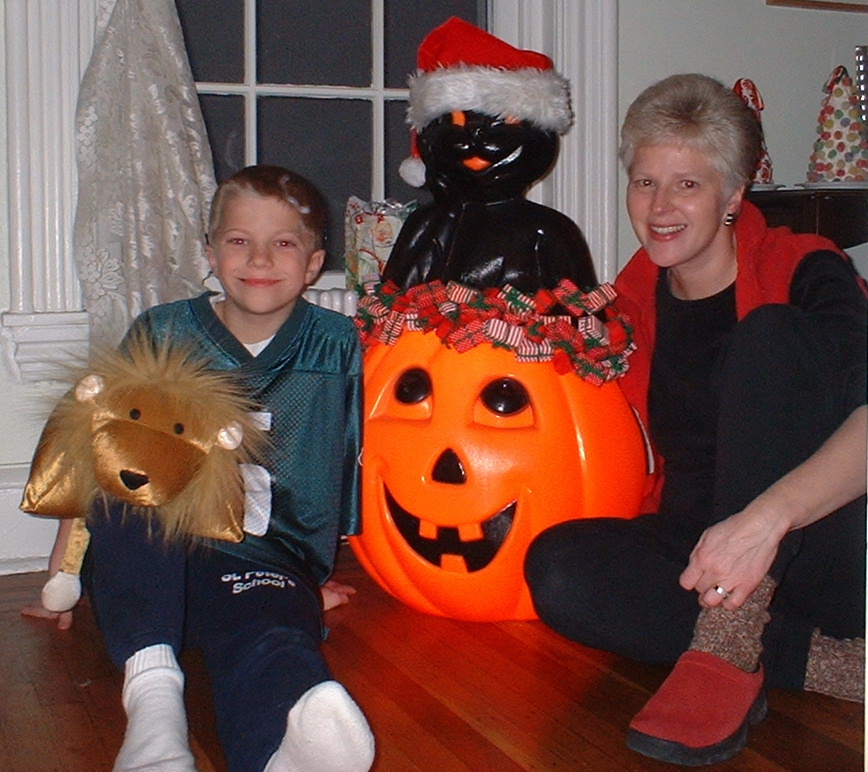
Guess who got to come up from the basement this morning, to be fitted with a new light bulb and placed near the window to brighten up a gloomy rainy overcast eerie pre-autumnal day? Yes, you guessed -- the big black and orange Halloween pumpkin - cat yard lamp that my friend Cate gave me back in 2002.

She and I and my in - laws, Ron and Rosanne, were meeting to enjoy a cup of our favorite pre-Halloween coffee (pumpkin spice!) at one of our favorite spots, the Restaurant School Coffee Shop in West Philadelphia. Cate had rescued Pumpkin - Cat from a yard sale, and brought it along to sit proudly on its own chair and draw lots of attention at the coffee shop! I wonder if whoever put that cat in a Philadelphia yard sale would be surprised to know that it now celebrates the season year after year in Indiana!

I also have some smaller plastic pumpkins that my father - in - law Ron and I were pleased to purchase at Walmart one year, on the day after Halloween for seven (7) cents each! One day last winter, I had just bought some new round cookie sheets and before taking them to the basement, where I have some pantry shelves for excess baking supplies, I piled them up with other things that needed to go downstairs -- a couple of the plastic jack - o - lanterns, Mardi Gras beads, Christmas bows. As I set them on the shelf, I thought, "Voila -- Still Life!" So many favorite holidays, all present simultaneously!


Some years Pumpkin - Cat stays out until Christmas!
Keeping watch from the Roof - top!

P.S.
~ 2011 ~

~ 2013 ~

Saturday, September 17, 2011

Songs of Autumn

Season of mists and mellow fruitfulness!
Close bosom-friend of the maturing sun . . .
. . . touch[ing] the stubble-plains with rosy hue . . .

To Autumn
Season of mists and mellow fruitfulness!
Close bosom-friend of the maturing sun;
Conspiring with him how to load and bless
With fruit the vines that round the thatch-eaves run;
To bend with apples the mossed cottage-trees,
And fill all fruit with ripeness to the core;
To swell the gourd, and plump the hazel shells
With a sweet kernel; to set budding more,
And still more, later flowers for the bees,
Until they think warm days will never cease,
For Summer has o'erbrimmed their clammy cells.

Who hath not seen thee oft amid thy store?
Sometimes whoever seeks abroad may find
Thee sitting careless on a granary floor,
Thy hair soft-lifted by the winnowing wind;
Or on a half-reaped furrow sound asleep,
Drowsed with the fume of poppies, while thy hook
Spares the next swath and all its twined flowers;
And sometimes like a gleaner thou dost keep
Steady thy laden head across a brook;
Or by a cider-press, with patient look,
Thou watchest the last oozings, hours by hours.

Where are the songs of Spring? Ay, where are they?
Think not of them, thou hast thy music too, --*
While barred clouds bloom the soft-dying day
And touch the stubble-plains with rosy hue;
Then in a wailful choir the small gnats mourn
Among the river sallows, borne aloft
Or sinking as the light wind lives or dies;
And full-grown lambs loud bleat from hilly bourn;
Hedge-crickets sing, and now with treble soft
The redbreast whistles from a garden-croft;
And gathering swallows twitter in the skies.

by John Keats, English Romantic Poet (1795 - 1821)

[*my favorite lines]

Last Oozings
This picture is from a couple of nights ago when I was out in the yard with my camera waiting for the Harvest Moon to rise. Unfortunately, I didn't get any satisfactory photographs of the moon after all -- have to wait 'til next month and try again. However, I was pleased with this view of our back deck, complete with grapevines, both artificial and real. It looks almost as if the "warm days will never cease," but no, what we have here are the "last oozings."

Note on "To Autumn"
"In a letter written to Reynolds from Winchester, in September, 1819, Keats says: 'How beautiful the season is now--How fine the air. A temperate sharpness about it. Really, without joking, chaste weather--Dian skies--I never liked stubble-fields so much as now--Aye better than the chilly green of the spring. Somehow, a stubble-field looks warm--in the same way that some pictures look warm. This struck me so much in my Sunday's walk that I composed upon it.' What he composed was the 'Ode To Autumn.' "

Thursday, September 15, 2011

Dolls in Literature

I like the American Express ad, where Tina Fey says that her "Most interesting souvenir" is "an Amish baby doll with no face." I wonder where she purchased hers? I found this pair at Reading Terminal Market in Philadelphia, and my neighbor John Woodin photographed them for my book jacket.


**********************************************

For more about my dissertation / book,

see my recent post

on The Fortnightly Kitti Carriker
A Fortnightly [every 14th & 28th] Literary Blog of
Connection & Coincidence; Custom & Ceremony


***********************************************

PREVIOUS POSTS IN REFERENCE TO
THE MINIATURE & THE GIGANTIC:

The Mystery of the Matryoshka: Within Within Within

Fun Fall Food!

The Miniature & the Gigantic

Memoirs to Read in the Summertime

And my LIST: "Dolls in Literature"


And lastly, the voice of a skeptic in this recent article
concerning the value (or not) of dissertations.

"For our very humanity is in our urge
to make magic with images
[& miniatures]."

~ Erica Jong ~
from her novel
Parachutes & Kisses (62)

Tuesday, September 13, 2011

Moonrise, Sunset

Harvest Moon

A good poem to read just before the autumn leaves start to fall:

God's World
O world, I cannot hold thee close enough!
Thy winds, thy wide grey skies!
Thy mists that roll and rise!
Thy woods this autumn day, that ache and sag
And all but cry with colour! That gaunt crag
To crush! To lift the lean of that black bluff!
World, World, I cannot get thee close enough!

Long have I known a glory in it all,
But never knew I this;
Here such a passion is
As stretcheth me apart, -- Lord, I do fear
Thou'st made the world too beautiful this year;
My soul is all but out of me, -- let fall
No burning leaf; prithee, let no bird call.


by Edna St. Vincent Millay, 1892 - 1950
American Lyrical Poet

Late Summer Sunset
Photography here and above by Jay Beets

Sunday, September 11, 2011

Alabaster City

The Hope of a Nation by J. M. Haines

In honor of the 10th anniversary of 9 / 11, here are the words to my favorite national song, including verses often omitted (or rearranged):

America the Beautiful
O beautiful for spacious skies,
For amber waves of grain,
For purple mountain majesties
Above the fruited plain!

America! America!
God shed His grace on thee,
And crown thy good with brotherhood
From sea to shining sea!

O beautiful for pilgrim feet
Whose stern impassion'd stress
A thoroughfare for freedom beat
Across the wilderness.

America! America!
God mend thine ev'ry flaw,
Confirm thy soul in self-control,
Thy liberty in law.

O beautiful for heroes prov'd
In liberating strife,
Who more than self their country lov'd,
And mercy more than life.

America! America!
May God thy gold refine
Till all success be nobleness,
And ev'ry gain divine.

O beautiful for patriot dream
That sees beyond the years
Thine alabaster cities gleam
Undimmed by human tears.

America! America!
God shed His grace on thee,
And crown thy good with sisterhood
From sea to shining sea.


lyrics by Katharine Lee Bates (1859- 1929)
music by Samuel A. Ward (1847 - 1903)

On 17 September 2001, Dan Rather visited the David Letterman Show and talked to Dave about the terrorist attack of the previous week. Summarizing Dan's vist, salon.com reported that "Rather maintained his evenness until he told Letterman that a song Americans have sung since they were school kids, "America the Beautiful," will never sound quite the same to him: "Oh beautiful for patriot's dream/That echoes through the years/Thine alabaster cities gleam/Undimmed by human tears." His voice broke as he got to that last line."

The transcript reads:

"Dan: It's a new . . . It's a new place now, and we're headed to a new place, David. Time magazine had a wonderful essay this week, and said, you know, 'we're going now to a new place where, you know, even the songs we sing will have a completely different meaning.'

"For example, you know, 'America the Beautiful': Who can sing now, with the same meaning we had before, one stanza of that that goes 'O beautiful, for patriots' dream, that sees beyond the years, thine alabaster cities gleam, undimmed by human tears.' We can never sing that song . . . [Sobs] . . . Again that way.
"

Naturally there were those to criticize Rather's interpretation of the patriotic lyric, but I have to confess his words have remained in my mind for the past ten years, along with my collection of images for the "alabaster city" . . . whatever, wherever it may be: New York City in 2001, Chicago in 1893, or St. Charles County Missouri in 1970.

When I was in Junior High, I rode the bus very early to school each day, past some abandoned grain elevators and army buildings. We always seemed to round the curve just as the rising sun hit those whitewashed structures, turning them pink and golden. Without fail, the words of "America the Beautiful" would enter my mind, and I'd say to myself (though not to my seatmates), "Look! The alabaster cities!"

Previous thoughts on 9 / 11

Previous thoughts on "America the Beautiful"

Previous thoughts on "The Hope of a Nation"

Chicago, Summer 2011
Photograph by Ben McCartney

Chicago, Summer 2009
Photograph by Gerry McCartney

Suggested reading:
"The Decade of Magical Thinking
by Steve Almond

Friday, September 9, 2011

Excellent Images

Haiku [if you ask me!]

‎
"Things more excellent than every image,"
says Iamblichus,
"are expressed through images."


Ralph Waldo Emerson (1803 - 82)
American Transcendentalist
from his essay "The Poet"

This passage from Emerson sprang immediately to mind when I first viewed a series of paintings by my friend and mentor Leonard Orr (in fact, the line from Emerson is something I learned in one of his classes years ago). I am rarely one to suffer writer's block; in my case it's usually the opposite, same as when I'm talking: how can we get her to stop!

However, when I feel the need for some creative focus, I like to make a little game of scrolling through Len's artwork and assigning one - word descriptions to each picture that catches my eye. As I look at each successive creation, my mind races to figure out what it might mean, what it makes me think of. Other viewers have responded to the various paintings by commenting in the form of brief pleasing poems: Click here to see and read.

Last month on facebook, Len mentioned his summer task of reorganizing his paintings: "In preparation for my daughter's visit, I restacked all of the paintings in my apartment to make them take the least amount of floor space (the walls are already covered with paintings). It occurred to me I should start painting over some of these before I use new canvases or else I will have to become a hunger artist, barely able to fit through my rooms and halls."

"Pentimento!" I replied. And Len responded, "Exactly! I have always been drawn to the palimpsest, the liminal, and multilayered."

Inspired by this intriguing list of words, I decided to look through Len's paintings in search of just the right one to illustrate each concept. You may choose differently, but here are my choices:

liminal (from the Latin limen, meaning threshold; relating to a sensory threshold, barely perceptible, an intermediate state, phase, or condition):

multilayered (self - explanatory!):

pentimento (from the Italian pentirsi, meaning to repent; traces of previous work in a painting, indicating an artist's change of plan during the creation process):

palimpsest (from the Greek meaning scraped clean; a page from which the text has been scraped off and written over). This one was easy, as I have already described a couple of Len's painting as such, when I was writing last autumn about the beauty and mystery of ginkgo tree:
Additional paintings by Leonard Orr,
seen previously on this blog:

Golden Paintings by Leonard Orr

End of Summer Sounds

Wednesday, September 7, 2011

Happy 18th Birthday to Sam


Speak to Us of Children

And ~the Prophet~ said:

"Your children are not your children.
They are the sons and daughters of Life's longing for itself.
They come through you but not from you,
And though they are with you yet they belong not to you.

You may give them your love but not your thoughts,
For they have their own thoughts.
You may house their bodies but not their souls,
For their souls dwell in the house of tomorrow,
which you cannot visit, not even in your dreams.
You may strive to be like them,
but seek not to make them like you.
For life goes not backward nor tarries with yesterday.

You are the bows from which your children
as living arrows are sent forth.
The archer sees the mark upon the path of the infinite,
and He bends you with His might
that His arrows may go swift and far.
Let your bending in the archer's hand be for gladness;
For even as He loves the arrow that flies,
so He loves also the bow that is stable."


from The Prophet
by Kahlil Gibran, 1883 - 1931

Monday, September 5, 2011

Recuerdo: Apples and Pears

We gave her all our apples; we gave her all our pears . . .~ Combined McCartney Family Artistic Endeavor ~
acrylic on cardboard, late 1990's ~

American poet Edna St. Vincent Millay captures the charm of the Staten Island Ferry in her poem "Recuerdo," about two light - hearted lovers and a kindly mysterious stranger who enters their life briefly on the ferry. Recuerdo -- I remember. Millay remembers this night of innocent joy and hopeful recklessness. Who needs money! Right?

Recuerdo
(set to music by American composer John Musto)
We were very tired, we were very merry—
We had gone back and forth all night on the ferry.
It was bare and bright, and smelled like a stable—
But we looked into a fire, we leaned across a table,
We lay on a hill-top underneath the moon;
And the whistles kept blowing, and the dawn came soon.

We were very tired, we were very merry—
We had gone back and forth all night on the ferry;
And you ate an apple, and I ate a pear,
From a dozen of each we had bought somewhere;
And the sky went wan, and the wind came cold,
And the sun rose dripping, a bucketful of gold.

We were very tired, we were very merry,
We had gone back and forth all night on the ferry.
We hailed "Good morrow, mother!" to a shawl-covered head,
And bought a morning paper, which neither of us read;
And she wept, "God bless you!" for the apples and pears,
And we gave her all our money but our subway fares.


by Edna St. Vincent Millay (1892 - 1901)
Winner of the Pulitzer Prize for Poetry in 1923

This poem and more Ferry Connections
on my latest post @
The Fortnightly Kitti Carriker
A Fortnightly [every 14th & 28th] Literary Blog of
Connection & Coincidence; Custom & Ceremony