Showing posts with label Marc Chagall. Show all posts

Monday, January 9, 2017

Too Soon to Undecorate!

Cat Under Tree ~ Roger Duvoisin (1904 – 1980)
When you're finally ready to face the task,
here's some music by Mannheim Steamroller
to make it more bearable:
"Traditions of Christmas" & "Christmas Lullaby"

Last month, I sent this card to my friend
and fellow cat lover Cate as a Solstice Greeting.
See the tiny Christmas tree outside, in the distance?
At the Window (1927-28) ~ Marc Chagall (1897 - 1985)

P.S.
On facebook
Fall Dance ~ by Jamie Sherman

Tuesday, April 23, 2013

Our Birthright:
The Bright Wild Circus Flesh

Happy 449th Birthday to William Shakespeare!
b. 23 April 1564
d. 23 April 1616


"Love looks not with the eyes, but with the mind;
And therefore is wing'd Cupid painted blind."

~ Shakespeare ~
A Midsummer Night's Dream ~ Act I, scene i, 231 - 32

The Circus Rider ~ Marc Chagall

Chagall & Shakespeare just seem to go hand in hand!
[see also last year's post: "Happy 448th"]

*****************

A birthday poem . . . for Shakespeare . . . and for all of us!

When I Went to the Circus

When I went to the circus that had pitched on the waste lot
it was full of uneasy people
frightened of the bare earth and the temporary canvas
and the smell of horses and other beasts
instead of merely the smell of man.

Monkeys rode rather grey and wizened
on curly piebald ponies
and the children uttered a little cry--
and dogs jumped through hoops and turned somersaults
and then geese scuttled in in a little flock
and round the ring they went to the sound of the whip
then doubled, and back, with a funny up-flutter of wings—
and the children suddenly shouted out.

Then came the hush again, like a hush of fear.

The tight-rope lady, pink and blonde and nude-looking,
with a few gold spangles
footed cautiously out on the rope, turned prettily spun round
bowed, and lifted her foot in her hand, smiled, swung her parasol
to another balance, tripped round, poised, and slowly sank
her handsome thighs down, down, till she slept her splendid body on the rope.
when she rose, tilting her parasol, and smiled at the cautious people
they cheered, but nervously.

The trapeze man, slim and beautiful and like a fish in the air
swung great curves through the upper space, and came down like a star
--And the people applauded, with hollow, frightened applause.

The elephants, huge and grey, loomed their curved bulk through the dusk
and sat up, taking strange postures, showing the pink soles of their feet
and curling their precious live trunks like ammonites
and moving always with a soft slow precision
as when a great ship moves to anchor.
The people watched and wondered, and seemed to resent the mystery
that lies in the beasts.

Horses, gay horses, swirling round and plaiting
in a long line, their heads laid over each other’s necks;
they were happy, they enjoyed it;
all the creatures seemed to enjoy the gameiIn the circus, with their circus people.

But the audience, compelled to wonder
compelled to admire the bright rhythms of moving bodies
compelled to see the delicate skill of flickering human bodies
flesh flamey and a little heroic, even in a tumbling clown,
They were not really happy.
There was no gushing response, as there is at the film.

When modern people see the carnal body dauntless and flickering gay
playing among the elements neatly, beyond competition
and displaying no personality,
modern people are depressed.

Modern people feel themselves at a disadvantage.
They know they have no bodies that could play among the elements.
They have only their personalities, that are best seen flat, on the film,
flat personalities in two dimensions, imponderable and touchless.

And they grudge the circus people the swooping gay weight of limbs
that flower in mere movement, and they grudge them the immediate,
physical understanding they have with their circus beasts,
and they grudge them their circus-life altogether.

Yet the strange, almost frightened shout of delight
that comes now and then from the children
shows that the children vaguely know how cheated they are of their birthright
in the bright wild circus flesh.


~ D. H. Lawrence


P.S.
Added on Len's birthday ~ 30 June 2015

Chagall's Homage to Gogol

Cry of the Masses
~ D. H. Lawrence

Give us back, Oh give us back
our bodies before we die!

Trot, trot, trot, corpse-body, to work.
Chew, chew, chew, corpse-body, at the meal.
Sit, sit, sit, corpse-body, at the film.
Listen, listen, listen, corpse-body, to the wireless.
Talk, talk, talk, corpse-body, newspaper talk.
Sleep, sleep, sleep, corpse-body, factory-hand sleep.
Die, die, die, corpse-body, doesn't matter!

Must we die, must we die
bodiless, as we lived?
Corpse-anatomies with ready-made sensations!
Corpse-anatomies, that can work.
Work, work, work,
rattle, rattle, rattle,
sit, sit, sit,
finished, finished, finished--
Ah no, Ah no! before we finally die
or see ourselves as we are, and go mad,
give us back our bodies, for a day, for a single day
to stamp the earth and feel the wind, like wakeful men again.

Oh, even to know the last wild wincing of despair,
aware at last that our manhood is utterly lost,
give us back our bodies for one day.

Thursday, March 28, 2013

Sit A Spell

The Small Drawing Room


"I had three chairs in my house; one for solitude,
two for friendship, three for society."


Henry David Thoreau, 1817-1862
American author and naturalist
(from Walden)

It's true, I posted this quotation only a couple of months ago, but while reviewing all my favorite Chagalls, in preparation for today's new Fortnightly, I spent some time looking closely at the chairs in Chagall's "Small Drawing Room" and just had to pair it with Thoreau's observation on seating arrangements.

Our dining room wall covered with favorites,
including "The Small Drawing Room," near top left

Thursday, May 3, 2012

Jacob's Ladder

My current Fortnightly Blog Post revolves around the theme of Jacob wrestling with the Angel. As I was inserting Marc Chagall's painting on this subject, I saw that he had also painted the equally popular theme of Jacob's Ladder at least half a dozen times. Which one to include was an easy choice:
the one with a house in it!

Still, I couldn't leave the others without a second look. It's easy to spend an hour comparing and contrasting the various renditions:

See my post

"Except Thou Bless Me"

on THE FORTNIGHTLY KITTI CARRIKER
my fortnightly literary blog [every 14th & 28th]
of connection and coincidence

Saturday, April 28, 2012

Except Thou Bless Be

Jacob Wrestling with the Angel, 1963
by Marc Chagall, 1887 - 1985

And Jacob said to the angel,
"I will not let thee go, except thou bless me."
Genesis 32:26

Art
In placid hours well-pleased we dream
Of many a brave unbodied scheme.
But form to lend, pulsed life create,
What unlike things must meet and mate:
A flame to melt--a wind to freeze;
Sad patience--joyous energies;
Humility--yet pride and scorn;
Instinct and study; love and hate;
Audacity--reverence. These must mate,
And fuse with Jacob's mystic heart,
To wrestle with the angel--Art.

Herman Melville
, 1819 - 1891
American novelist, essayist, poet

I first came across this mystical wrestling poem in the most interesting way: I saw it inscribed around a circular ceiling mural in the lobby of an apartment highrise in Chicago. I was in that vestibule a few times many years ago but am now not even entirely sure what building it was. How I would love to see it again! The question is, do I have the courage to approach the door-keeper and say, "Excuse me, I don't live here or know anyone who lives here, but could I please step inside and glance at your ceiling?!" A few friends have suggested that such a request might not be ill - received. Audacity -- reverence. Right? But where to start? I've actually thought of asking a realtor to help me, since agents probably have access to such buildings that are otherwise closed to the general public.

Could it be one of these?

For Melville's poem and more on Jacob and the Angel,
see my new post

"Except Thou Bless Me"

on THE FORTNIGHTLY KITTI CARRIKER
my fortnightly literary blog [every 14th & 28th]
of connection and coincidence

Monday, April 23, 2012

Happy 448th to William Shakespeare!

A Midsummer Night's Dream, 1939 ~ by Marc Chagall

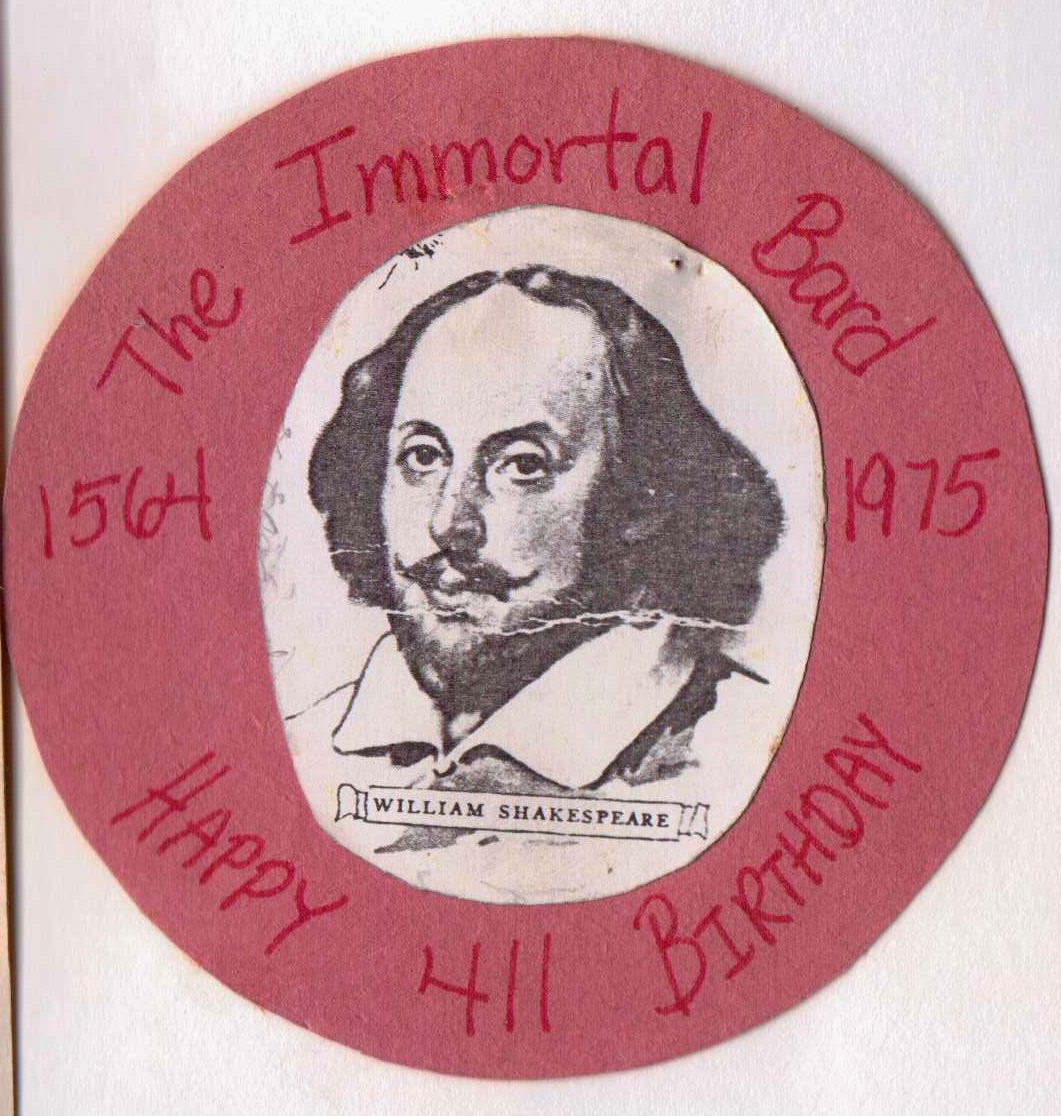
A happy memory from my Senior year in highschool was celebrating Shakespeare's 411th birthday with my good friends Etta and Marilyn. We checked out the book Dining With William Shakespeare from the library. We baked Cornish Pasties and Shrewsbury Cakes. We drove downtown (St. Louis) to see a production of A Midsummer Night's Dream by The New Shakespeare Company of San Francisco (on tour). We spent hours making these buttons for everyone in our Shakespeare class to wear:


Since that festive occasion when we went all out, I have tried to honor Shakespeare's birthday in my heart and keep it in at least some small way every year.

Today, I share with you the words of another great English poet, John Dryden:

Shakespeare [1564 - 1616] . . . was the man who of all Modern, and perhaps Ancient Poets, had the largest and most comprehensive soul. All the Images of Nature were still present to him, and he drew them not laboriously, but luckily: when he describes any thing, you more than see it, you feel it too. . . . he was naturally learn'd; he needed not the spectacles of Books to read Nature; he look'd inwards, and found her there. . . . he is always great, when some great occasion is presented to him: no man can say he ever had a fit subject for his wit, and did not then raise himself as high above the rest of the Poets, "As cypresses usually do among supple trees."

The consideration of this made Mr. Hales of Eaton say, That there was no subject of which any Poet ever writ, but he would produce it much better treated of in Shakespeare; and however others are now generally prefer'd before him, yet the Age wherein he liv'd, which had contemporaries with him, Fletcher and Johnson never equall'd them to him in their esteem: And in the last Kings Court, when Ben's reputation was at highest, Sir John Suckling, and with him the greater part of the Courtiers, set our Shakespeare far above him.

. . . If I would compare him [Ben Jonson] with Shakespeare, I must acknowledge him the more correct Poet, but Shakespeare the greater wit. Shakespeare was the Homer, or Father of our Dramatick Poets; Johnson was the Virgil, the pattern of elaborate writing; I admire him, but I love Shakespeare.


by John Dryden (1631 - 1700)
English Poet and Literary Critic

from his Essay of Dramatick Poesie, 1668
as edited by Jack Lynch

Thanks to my brother Dave for the cool button!

And to conclude:
Maybe not "the most unkindest cut of all,"
but a taunt, a jest from my brother Bruce:


Dear Bill,
For your birthday,
I relinquish to you the right to use
any of my material and claim it as your own.
With warmest personal regards,
Sir Francis Bacon

Rejoinder:

Dear Frank,
If in the years to come,
they should ascribe my works to you,
well, no hard feelings!
Yours by the pen,
Will

Friday, April 15, 2011

Chagall Four Seasons Mosaic

Dagmar, Kitti, and Cathy in February 2009
at the Chagall Four Seasons Mosaic
First National Plaza
Corner South Dearborn & West Monroe Streets


"The stars were my best friends.
The air was full of legends and phantoms,
full of mythical and fair-tale creatures,
which suddenly flew away over the roof,
so that one was at one with the firmament."

Marc Chagall


Read more:
Dagmar's Birthday
The Fortnightly Kitti Carriker

Previous Four Seasons post: "Life and Good"


Ben's Chagall Mural Photo, Summer 2011

Friday, March 26, 2010

Life and Good

Awhile back, I received the following note from my friend Cate -- remember, the one who reads and knits:

"This was in my mail today from my weekly Torah readings. I like the rhythm of it . . . I consider the most beautiful passage in the Torah to be found in Parashat Nitzavim (Deut. 30:11-14)":

"Surely, this mitzvah that I enjoin upon you this day is not too baffling for you, nor is it beyond reach. It is not in the heavens, that you should say, 'Who among us can go up to the heavens and get it for us and impart it to us, that we may observe it?' Neither is it beyond the sea . . . No, the thing is very close to you, in your mouth and in your heart, to observe it."

Upon reading this, I felt sure that it was one of the passages I had been required to memorize years ago in school, so I ran to my old paper (yes!) files and pulled out a couple of archived folders: "Bible as Literature (Fall 1973)" & "English Bible (Spring 1982)" and sure enough, there it was:

11: For this commandment which I command thee this day, it is not hidden from thee, neither is it far off.

12: It is not in heaven, that thou shouldest say, Who shall go up for us to heaven, and bring it unto us, that we may hear it, and do it?

13: Neither is it beyond the sea, that thou shouldest say, Who shall go over the sea for us, and bring it unto us, that we may hear it, and do it?

14: But the word is very nigh unto thee, in thy mouth, and in thy heart, that thou mayest do it.

15: See, I have set before thee this day life and good, and death and evil;

16: In that I command thee this day to love the LORD thy God, to walk in his ways, and to keep his commandments and his statutes and his judgments, that thou mayest live and multiply: and the LORD thy God shall bless thee in the land whither thou goest to possess it.

Deuteronomy 30: 11 - 17

Detail from
Four Seasons Mosaic Mural by Marc Chagall
First National Plaza in downtown Chicago
Corner of Monroe & Dearborn