Saturday, April 28, 2012

Except Thou Bless Be

Jacob Wrestling with the Angel, 1963
by Marc Chagall, 1887 - 1985

And Jacob said to the angel,
"I will not let thee go, except thou bless me."
Genesis 32:26

Art
In placid hours well-pleased we dream
Of many a brave unbodied scheme.
But form to lend, pulsed life create,
What unlike things must meet and mate:
A flame to melt--a wind to freeze;
Sad patience--joyous energies;
Humility--yet pride and scorn;
Instinct and study; love and hate;
Audacity--reverence. These must mate,
And fuse with Jacob's mystic heart,
To wrestle with the angel--Art.

Herman Melville
, 1819 - 1891
American novelist, essayist, poet

I first came across this mystical wrestling poem in the most interesting way: I saw it inscribed around a circular ceiling mural in the lobby of an apartment highrise in Chicago. I was in that vestibule a few times many years ago but am now not even entirely sure what building it was. How I would love to see it again! The question is, do I have the courage to approach the door-keeper and say, "Excuse me, I don't live here or know anyone who lives here, but could I please step inside and glance at your ceiling?!" A few friends have suggested that such a request might not be ill - received. Audacity -- reverence. Right? But where to start? I've actually thought of asking a realtor to help me, since agents probably have access to such buildings that are otherwise closed to the general public.

Could it be one of these?

For Melville's poem and more on Jacob and the Angel,
see my new post

"Except Thou Bless Me"

on THE FORTNIGHTLY KITTI CARRIKER
my fortnightly literary blog [every 14th & 28th]
of connection and coincidence

Friday, April 27, 2012

Arbor Day Trees

Every creature is better alive than dead,
men and moose and pine trees,
and he who understands it aright
will rather preserve its life than destroy it.


Henry David Thoreau, 1817-1862
American author and naturalist

Unusual Tree Formation in our Favorite Pine Forest

*****************

Amazingly Beautiful Trees
on the grounds of Sudley House
Liverpool, England

Thursday, April 26, 2012

By the Sea

"The sea pronounces something,
over and over, in a hoarse whisper;
I cannot quite make it out.
But God knows I have tried”

~ Annie Dillard ~

My Rooms at the Beau Rivage, 1918
by Henri Matisse, 1869 - 1954
[To learn more, see Artsy]

Place by the Sea
"He kept a piece of algae behind his ear to remind him of his roots. A million years ago every place was a little place by the sea, he would say & my mind would go blank & I would swim through the day without a care in the world & it all seemed so familiar that I knew I would go back someday to my own little place by the sea."
~ Brian Andreas ~

For these passages & more, see
"Surface Dwellers"
on THE FORTNIGHTLY KITTI CARRIKER
my fortnightly literary blog
[every 14th & 28th]
of connection and coincidence

Monday, April 23, 2012

Happy 448th to William Shakespeare!

A Midsummer Night's Dream, 1939 ~ by Marc Chagall

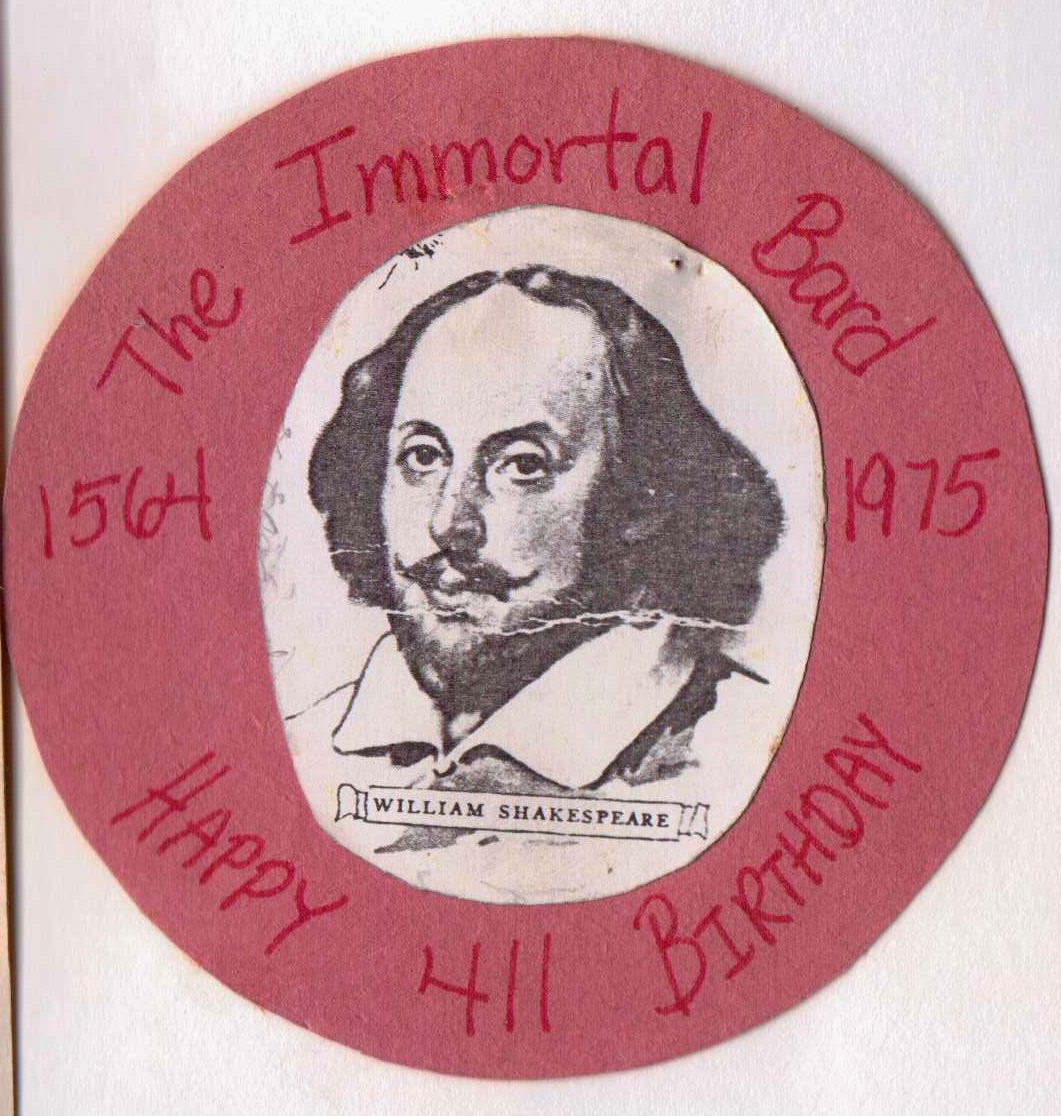
A happy memory from my Senior year in highschool was celebrating Shakespeare's 411th birthday with my good friends Etta and Marilyn. We checked out the book Dining With William Shakespeare from the library. We baked Cornish Pasties and Shrewsbury Cakes. We drove downtown (St. Louis) to see a production of A Midsummer Night's Dream by The New Shakespeare Company of San Francisco (on tour). We spent hours making these buttons for everyone in our Shakespeare class to wear:


Since that festive occasion when we went all out, I have tried to honor Shakespeare's birthday in my heart and keep it in at least some small way every year.

Today, I share with you the words of another great English poet, John Dryden:

Shakespeare [1564 - 1616] . . . was the man who of all Modern, and perhaps Ancient Poets, had the largest and most comprehensive soul. All the Images of Nature were still present to him, and he drew them not laboriously, but luckily: when he describes any thing, you more than see it, you feel it too. . . . he was naturally learn'd; he needed not the spectacles of Books to read Nature; he look'd inwards, and found her there. . . . he is always great, when some great occasion is presented to him: no man can say he ever had a fit subject for his wit, and did not then raise himself as high above the rest of the Poets, "As cypresses usually do among supple trees."

The consideration of this made Mr. Hales of Eaton say, That there was no subject of which any Poet ever writ, but he would produce it much better treated of in Shakespeare; and however others are now generally prefer'd before him, yet the Age wherein he liv'd, which had contemporaries with him, Fletcher and Johnson never equall'd them to him in their esteem: And in the last Kings Court, when Ben's reputation was at highest, Sir John Suckling, and with him the greater part of the Courtiers, set our Shakespeare far above him.

. . . If I would compare him [Ben Jonson] with Shakespeare, I must acknowledge him the more correct Poet, but Shakespeare the greater wit. Shakespeare was the Homer, or Father of our Dramatick Poets; Johnson was the Virgil, the pattern of elaborate writing; I admire him, but I love Shakespeare.


by John Dryden (1631 - 1700)
English Poet and Literary Critic

from his Essay of Dramatick Poesie, 1668
as edited by Jack Lynch

Thanks to my brother Dave for the cool button!

And to conclude:
Maybe not "the most unkindest cut of all,"
but a taunt, a jest from my brother Bruce:


Dear Bill,
For your birthday,
I relinquish to you the right to use
any of my material and claim it as your own.
With warmest personal regards,
Sir Francis Bacon

Rejoinder:

Dear Frank,
If in the years to come,
they should ascribe my works to you,
well, no hard feelings!
Yours by the pen,
Will

Sunday, April 22, 2012

Green Effective Earth Day*


from Atalanta in Calydon
[Click to hear a longer section read aloud]

And the southwest-wind and the west-wind sing.
For winter's rains and ruins are over,
And all the season of snows and sins;
The days dividing lover and lover,
The light that loses, the night that wins;
And time remembered is grief forgotten,
And frosts are slain and flowers begotten,
And in green underwood and cover
Blossom by blossom the spring begins.

Algernon Charles Swinburne
(1837 - 1909)


Speaking of spring rain ("shoures soote") and flowers begotten ("engendred is the flour"), could Swinburne have been thinking of Chaucer when he wrote the above stanza? Click here to read the Prologue to the Canterbury Tales. Perhaps back in high school or college, you had to memorize the opening lines in Middle English or a modern translation. Here's an easier idea ~ my minimalist version:

April showers: Sweet! Radical!
Relief from March
Flowers, vines, veins, wine
Zephyr: Breath of Life
Celestial Ram
Melodic lark
Follow the West Wind;
Follow Your Heart!

*See the poem
"Permanently"
by Kenneth Koch

Thursday, April 19, 2012

How Music Began

Summer 2005: Striking the Rustic Wooden Pipes

Spring Break 2012: Still fun after all these years!

Formby Pinewoods
Victoria Road, Liverpool, Merseyside, England
A Great Place to Hang Out!
~ Striking a Pose: Ben, Gerry, Sam ~

********************

The Three Song
music and lyrics by Mason Williams
performed by The Smothers Brothers

This is one of the few songs that I ever remember the Smothers Brothers singing seriously all the way through. Of course, I love all the silly ones, but "The Three Song" is my all - time fav!]

The little winds sing a song
of the sun in the sky
and I know, like the wind,
the songs will always be there

In your hair, soft and warm
light of dawn, shining fair
in your voice, as you sing
the songs will always be there

Oh little winds (in your hair) sing a song (soft and warm)
of the sun (light of dawn) in the sky (shining fair)
and I know (in your voice) like the wind (as you sing)
the songs will always be there

Oh little wines are the kiss
of the fruit from the earth
and I know, there I taste
surely the sweetest of all

In your lips, sweet as dew
on the vines in the fall
the first kiss from your lips
is surely the sweetest of all

Oh little wines (in your lips) are the kiss (sweet as dew)
from the fruit (on the vines) from the earth (in the fall)
and I know (the first kiss) there I taste (from your lips)
is surely the sweetest of all

Two little stars twinkle bright
in the still sky above
and I know only you
and wish it so to be true

In your eyes like the skies
of the night it is true
that I love only you
and wish it so to be true

The little stars (in your eyes) twinkle bright (like the skies)
in the still (of the night) sky above (it is true)
And I know (that I love) only you (only you)
and wish it so to be true


Tuesday, April 17, 2012

Camera, Memory Keeper, Time Machine

Back in 1994, sizing up the success of yet another visit to the photo studio, I said, "Well, it looks like Ben could have used a hair cut and Sam seems a little worried." Without skipping a beat, Little Ben spoke up (in reference to the camera):

"Sam thinks it's a big gun!"

Maybe he meant to say, "a time machine."

Last month on my book blog, I was looking at The Memory Keeper's Daughter by Kim Edwards. The title derives from a scene early in the novel when David, the memory keeper, says to his wife Norah:

"But you're so sad . . . don't be sad. I didn't forget, Norah. Not our anniversary, not our daughter. Not anything."

"Oh, David," she said. "I left your present in the car," She thought of the camera, its precise dials and levers. The Memory Keeper, it said on the box, in white italic letters; this, she realized was why she'd bought it -- so he'd capture every moment, so he'd never forget.
(88)

When I read those words, I was reminded of a Newsweek essay by Anna Quindlen -- entitled "The Time Machine" -- that she wrote around Christmastime 2006. She is reminiscing about various childhood presents -- in particular an enormous, longed - for dollhouse -- and how the memory of what those toys signified at the time can linger for years after the objects themselves have been broken or lost or given away.

Then she shoots ahead to the more recent past of her own children opening their surprises; and, even more recently, to the memory of herself re-watching their holiday videos and witnessing a moment that she did not even realize she had captured on film at the time. She says, "It was only recently, many years after the event, that I discovered that little boy giving me the time- machine tip, a ghost of Christmas past."

On the tape, her son "looks into the lens and says as though he is imparting a great secret, 'Do you know what a camera is? It's a time machine.'" She wonders what stray distraction prevented her from catching that remark the first time around, but never mind! "Thank God the VCR offered me a second chance."

In this essay, Quindlen also takes issue with that annoying bit of advice: "Don't sweat the small stuff, and its all small stuff." I couldn't agree more when she argues, "That's absurd. Lots of small stuff is really big. . . . The essence of the season lies in figuring out what small stuff is passing minutiae and what is enduring memory. Come to think of it, that may well be the essence of everything" -- a conclusion that is perfectly in keeping with a blog about the Quotidian!

P.S.
~ August 2020 ~
"All those photographs broke Jackson's heart. Holiday snaps, birthdays and Christmases, all the highlights of family life. Jackson found photographs unsettling enough at the best of times. There was a lie at the heart of the camera, it implied the past was tangible when the very opposite was the true."

from Started Early, Took My Dog
by Kate Atkinson

Sunday, April 15, 2012

Living on the Surface

Rooms by the Sea, 1951
By Edward Hopper (American, 1882–1967

The following poem has been in my notebook of favorites for thirty years now, since my Arkansas days, back when Bill Clinton was governor. I like the combination of grief and evolutionary biology, the mystery of salt water without and within, the existential quest for meaning -- "Not that we know what we're doing here." Yet, despite our sad lack of comprehension -- "We try to do what's right":

Living on the Surface
The dolphin
walked upon the land a little while
and crawled back to the sea
saying something thereby
about all that we live with.

Some of us
have followed him from time to time.
Most of us stay.
Not that we know what we're doing here.

We do it anyway
lugging a small part of the sea around.
It leaks out our eyes.

We swim inside ourselves
but we walk on the land.

What's wrong, we say, what's wrong?

Think how sadness soaks into
the beds we lie on.

Jesus, we've only just got here.
We try to do what's right
but what do we know?


by American poet Miller Williams
Professor of English and Foreign Languages
and Director of the University of Arkansas Press, Fayetteville

For this poem & more, see: "Surface Dwellers"
on THE FORTNIGHTLY KITTI CARRIKER
my fortnightly literary blog
[every 14th & 28th]
of connection and coincidence

Friday, April 13, 2012

The Atoms of Our Hearts

When I recently downloaded a tulip photo from wikipedia
onto my book blog, my husband Gerry said,
"You should take your own photographs of our own tulips!"
So I gave it a try! My results:


I like the way, in the following passages,
we humans share our bodies with the world,
our atoms with the sun,
and our time with the galaxies!

from The Memory Keeper's Daughter
by Kim Edwards
" . . . the body was, in some mysterious way, a perfect mirror of the world. . . . Sometimes I think the entire world is contained within each living person. . . . as if the underlying correspondences between tulips and lungs, veins and trees, flesh and earth, might reveal a pattern he could understand. . . . the intricate and exhausting task of trying to transform . . . the body into the world and the world into the body" (149, 201 - 02, 319).


from The Effect of Gamma Rays on Man-in-the-Moon Marigolds
by Paul Zindel
"For one thing, the effect of gamma rays on man-in-the-moon marigolds has made me curious about the sun and the stars, for the universe itself must be like a world of great atoms . . . but most important, I suppose my experiment has made me feel important--every atom in me, in everybody, has come from the sun--from places beyond our dreams. The atoms of our hands, the atoms of our hearts" (101-02).


A Blip on the Magnified
Computer Picture

On your way to the barbershop
you're almost blown off your feet
when it occurs to you that you're
using some of the very same time
needed to keep the galaxies
spinning through the light - years.


from the Collected Poems
of Ernest Sandeen

Wednesday, April 11, 2012

Life's Calm Secret


You see, I want a lot.
Perhaps I want everything:
the darkness that comes with every infinite fall
and the shivering blaze of every step up.

So many live on and want nothing
and are raised to the rank of prince
by the slippery ease of their light judgments.

But what you love to see are faces
that so work and feel thirst.

You love most of all those who need you
as they need a crowbar or a hoe.

You have not grown old, and it is not too late
to dive into your increasing depths
where life calmly gives out its own secret.


by Rainer Maria Rilke

from the Selected Poems of Rainer Maria Rilke
translated by Robert Bly

Saturday, April 7, 2012

New Features

Two new features:

to the right ->->->
the option to follow this blog by e - mail

<-<-<- to the left (scroll down) a series of passages from:
A Little Book of Forgiveness:
Challenges and Meditations for
Anyone with Something to Forgive

by D. Patrick Miller

See also: "Altering Events" on my book blog, Kitti's List

and: "A Politics of Forgiveness" on my facebook page

Thursday, April 5, 2012

The Magic of the Moon & the ABCs

"We spell away the overhanging night"

The Cool Web
Children are dumb to say how the day is hot,
How hot the scent is of the summer rose;
How dreadful the black wastes of evening sky,
How dreadful the tall soldiers drumming by.

But we have speech, to chill the angry day,
And speech, to dull the rose's cruel scent.
We spell away the overhanging night,
We spell away the soldiers and the fright.

There's a cool web of language winds us in,
Retreat from too much joy or too much fear;
We grow sea - green at last and coldly die
in brininess and volubility.

But if we let our tongues lose self - possession,
Throwing off language and its watery clasp
Before our death, instead of when death comes,
Facing the wide glare of the children's day,
Facing the rose, the dark sky and the drums,
We shall go mad no doubt and die that way.


by Robert Graves, 1895 - 1985
English poet, novelist, scholar, translator, writer of antiquity

This poem and more can be found on my
CURRENT FORTNIGHTLY BLOG POST
~ The Syntax of Love ~
The Fortnightly Kitti Carriker:
A Fortnightly [every 14th & 28th] Literary Blog of
Connection & Coincidence; Custom & Ceremony

Tuesday, April 3, 2012

How Ironic!

Don Quixote ~ 1955
by Picasso
a family favorite

~ Kafka ~ The Truth about Sancho Panza: Without making any boast of it Sancho Panza succeeded in the course of years, by feeding him a great number of romances of chivalry and adventure in the evening and night hours, in so diverting from himself his demon, whom he later called Don Quixote, that this demon thereupon set out, uninhibited, on the maddest exploits, which, however, for the lack of a preordained object, which should have been Sancho Panza himself, harmed nobody. A free man, Sancho Panza philosophically followed Don Quixote on his crusades, perhaps out of a sense of responsibility, and had of them a great and edifying entertainment to the end of his days.

~ Thomas de Quincey ~ If once a man indulges himself in murder, very soon he comes to think little of robbing; and from robbing he comes next to drinking and Sabbath-breaking, and from that to incivility and procrastination. Once begun upon this downward path, you never know where you are to stop. Many a man has dated his ruin from some murder or other that perhaps he thought little of at the time.

~ Kierkegaard ~ Oh, the sadness of having understood something true—and then of only seeing oneself misunderstood. Oh, sadness—for what is irony in the mystery of the heart but sadness. Sadness means to be alone in having understood something true and as soon as one is in the company with others, with those who misunderstand, that sadness becomes irony.

How many ever experience the maturity of discovering that there comes a critical moment where everything is reversed, after which the point becomes to understand more and more that there is something which cannot be understood. . . . That is Socratic ignorance, and that is whet the philosophy of our times requires as a corrective . . . As Johannes Climacus truly observes, the majority of men turn aside precisely where the higher life should begin for them, turn aside and become practical.

~ Beverly Coyle ~ Why waste our time like this when we'd drawn the best teacher in the school? This was talk that excited us. We loved all instances of irony because it both made us think we were cuter than we were and hinted of bigger things in the world to come. . . . And so my classmates and I sat there for a while with just enough extra time for our private intuitions, full of foreboding and full of dread, that there was going to be a kind of lambent dullness in the world to come. And more wars.
("O For a Thousand Tongues to Sing," 94 - 95, 105).

Don Quixote & Sancho Panza
Click to read more on the study of Irony:
when appearance differs from reality in words or actions.

PS

Sunday, April 1, 2012

Not Always What They Seem

Pink Daffodils and Almost Hidden Butterfly

For Palm Sunday to coincide with April Fool's Day, as it does today, is a most unusual event in the calendrical world. The rate of occurrence is four times (counting today) since 1900, fifteen times, going back to 1600.

An important lesson shared by both holidays:
things are not always what they seem!

Sometimes It Happens
Sometimes it happens that you are friends and then
You are not friends,
And friendship has passed.
And whole days are lost and among them
A fountain empties itself.

And sometimes it happens that you are loved and then
You are not loved,
And love is past.
And whole days are lost and among them
A fountain empties itself into the grass.

And sometimes you want to speak to her and then
You do not want to speak,
Then the opportunity has passed.
Your dreams flare up, they suddenly vanish.

And also it happens that there is nowhere to go and then
There is somewhere to go,
Then you have passed.
And the years flare up and are gone,
Quicker than a minute.

So you have nothing.
You wonder if these things matter and then
As soon as you begin to wonder if these things matter
They cease to matter,
And caring is past.
And a fountain empties itself into the grass.


by British poet Brian Patten (b. 1946)
best known as one of the Liverpool Poets

see previous Quotidian posts:
All Souls: From Dust Thou Art
"Believe In Your Own Full Moonlight"
"Brush With Greatness"

and "Happy Batday" on The Fortnightly Kitti Carriker

P.S.
2018 ~ that crazy year when
Ash Wednesday coincided with Valentine's Day
and Easter coincided with April Fool's Day!

April 2019 ~ the daffodils again!

Saturday, March 31, 2012

Spring ~ Time

Early Spring in Hanover, Germany, on the river Leine

The Doppler Effect
One face of the clock is saying
there's not much time. Finish
what you think you were born to do.

The other rounds and spheres
like sleep, it questions
over and over, what is time.

Did we pass through winter
or did winter pass through us?
You creak your windows open

to this familiar green clutter
called the spring. But nothing happens.
You only change places with yourself.

****************

Surreal and Real
Although you were barely prompt enough,
you did glimpse time blending into space
in Einstein's brain. But luckily you
didn't throw your watch away;
because it's Newton who has remained your closest friend
and neighbor.


Ernest Sandeen, 1908 - 1997
Notre Dame Professor and Poet

A fascinating little book about time, that goes hand in hand with Sandeen's poems, is Einstein's Dreams by Alan Lightman. I mentioned it briefly on my book blog a few years ago in connection with The Invention of Hugo Cabret, which is now an award - winning movie in addition to being an endlessly intriguing book.

[I wrote earlier that Brian Selznick's Hugo was an absolutely amazing novel / picture book for kids and grown-ups, about time, space, secrets, automata, and movies. Some history, some fiction, some magic. You will be living inside this book for a little while!
. . . and that Einstein's Dreams was another book of another dimension. Also some history, some fiction, some science, some poetry. Prepare for time travel. Days of future passed, back to the future, forward to the past, and so forth.]

Lightman writes, "For while the movements of people are unpredictable, the movement of time is predictable. While people can be doubted, time cannot be doubted. While people brood, time skips ahead without looking back" (37).

Who could forget the chapter describing the world of no memory? And even more memorable are the people who stand in line to worship the Great Clock in the Temple of Time: "They stand quietly, but secretly they seethe with their anger. For they must watch measured that which should not be measured. They must watch the precise passage of minutes and decades. They have been trapped by their own inventiveness and audacity. And they must pay with their lives" (p 152).

Equally contradictory is the world where the people live up on the hill because they think the high altitudes will make their lives longer, when in fact the thin air makes their lives shorter. It's sort of like my own personal theory about staying up 'til all hours when I can't (or don't want to) sleep. Sleeping as little as possible is my strategy for cheating Death. The more hours I'm awake, the longer my life is, right? Though secretly I realize that this plan could backfire!

A few timely songs that I love to put on "replay"
and listen to time and time again:

John Denver:
"Rocky Mountain Suite
(Cold Nights in Canada)"

And the time is upon us, today is forever
Tomorrow is just one of yesterday's dreams


*************

Enya: "Only Time"
Who can say if your love grows
As your heart chose
Only time
And who can say where the road goes
Where the day flows
only time


*************

Alan Parsons: "Time"
Who knows when we shall meet again
If ever
But time
Keeps flowing like a river
To the sea
Thousand Hills State Park, Kirksville, Missouri
~ Photo by Jay Beets ~


Saving Time & Full Hand

Wednesday, March 28, 2012

The Syntax of Love

who pays any attention
to the syntax of things
will never wholly kiss you . . .

~ e. e. cummings ~


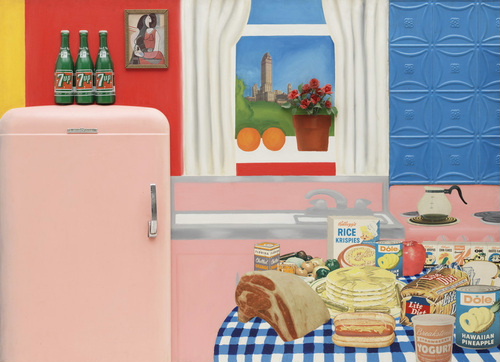
Still Life #30 (Museum of Modern Art)
by Tom Wesselmann, 1931 - 2004
American collage artist, painter, sculptor

Something about this picture reminds me of one my favorite poems. I think it must be the window and the green grass, where perhaps the Sentences and Nouns are lying silently. And I suspect that the pot of flowers on the window sill might be on the verge of changing color due to some kind of factory or other, not far off there in the distance.

Permanently

One day the Nouns were clustered in the street.
An adjective walked by, with her dark beauty.
The Nouns were struck, moved, changed.
The next day a Verb drove up, and created the Sentence.

Each Sentence says one thing -- for example,

"Although it was a dark rainy day when the Adjective walked by,
I shall remember the pure and sweet expression on her face
until the day I perish from the green, effective earth."

Or, "Will you please close the window, Andrew?"

Or, for example, "Thank you, the pink pot of flowers on
the window sill has changed color recently to a light
yellow, due to the heat from the boiler factory which
exists nearby."

In the springtime the Sentences and the Nouns lay silently on the grass.
A lonely Conjunction here and there would call, "And! But!"
But the Adjective did not emerge.

As the adjective is lost in the sentence,
So I am lost in your eyes, ears, nose, and throat --
You have enchanted me with a single kiss
Which can never be undone
Until the destruction of language.


by Kenneth Koch, 1925 - 2002 [pronounced "coke"]
American poet, playwright, professor

These poems and more can be found on my
NEW FORTNIGHTLY BLOG POST
~ The Syntax of Love ~

The Fortnightly Kitti Carriker:
A Fortnightly [every 14th & 28th] Literary Blog of
Connection & Coincidence; Custom & Ceremony

Saturday, March 24, 2012

Jewel Rainbow Splendor

Spring Rainbow in West Lafayette, Indiana
23 March 2012, 7:30 pm

"Only you and I can help
the sun rise each coming morning.
If we don't, it may drench itself out in sorrow.

You are amazing grace.
You are a precious jewel.

You ~
special, miraculous,
unrepeatable fragile,
fearful, tender, lost,
sparkling ruby emerald
jewel rainbow splendor person."

~ Joan Baez ~


See the Little Ruby Emerald Sun Dog (lower left)?Sunset in our side yard, just hours before the Autumnal Equinox
22 September 2010

P.S.
As my friend Carmen says,
"Remember who you truly are,
a spiritual being a shining star."

P.P.S. 2023
See The Fortnightly Kitti Carriker

Thursday, March 22, 2012

Pine Forest Update 2012

How to find the Lucky Tree? Look for the ice cream truck! Of course! And stroll down the nearest path. Ben's expression here is kind of funny because, as I was taking the photograph, he was laughing at me for choosing an ice cream truck as a permanent landmark. Haha. Well, I happen to have great faith in the regularity of ice cream trucks.

Ye Olde Ice Creame Trucke
Isn't that truck parked in the same spot every year? In earlier times, we relied upon a very tall neighboring tree to show the way, only to find that in our absence it had been chopped down. So what can you trust? Your sense of direction? With only a few missteps, we've taken our annual walk in the woods for sixteen years now. Tradition!

PREVIOUS YEARS:
Christmas 1996

Christmas 1997

Christmas 1998

Spring Break 2000

Summer 2005

Summer 2006

Spring Break 2008

Spring Break 2009

Spring Break 2010

Spring Break 2011
Spring Break 2012GERRY MCCARTNEY & SONS
FORMBY PINE WOODS, MERSEYSIDE, ENGLAND

SEE ALSO:
Pine Forest Update 2017
Pine Forest Update 2013
Pine Forest Update 2012
Pine Forest Update 2011
Tree of Life
Watching the Boys Grow