Showing posts with label John William Waterhouse. Show all posts

Tuesday, August 27, 2013

Two Gazed Into a Pool:
Echo & Narcissus

Love Gone Wrong: Echo and Narcissus, 1903
by John William Waterhouse, 1849 - 1917

Two poems
by Christina Georgina Rossetti, 1930 - 94

It seems to be understood that Rossetti wrote this first poem, "Echo" in sorrow at the loss of one of her suitors; and the second poem, "An Echo From Willow-wood" in mourning after the death of her sister - in - law, Elizabeth Siddal. Indeed both poems can be read in such a way. However, the language of star - crossed love and eternal separation seems just as applicable to the heartbreaking conflict between the nearly voiceless nymph Echo and the handsome hunter Narcissus, enamored of his own reflection.

Never in love with anyone except himself, Narcissus reminds me of selfish Little Chap in Stop the World, I Want to Get Off who acknowledges at the play's conclusion that "the only person I ever really loved was me." For Echo, Narcissus was the dream "too bitter sweet." They gazed "not hand in hand . . . reluctant, without speech":

Echo
Come to me in the silence of the night;
Come in the speaking silence of a dream;
Come with soft rounded cheeks and eyes as bright
As sunlight on a stream;
Come back in tears,
O memory, hope, love of finished years.

O dream how sweet, too sweet, too bitter sweet,
Whose wakening should have been in Paradise,
Where souls brimfull of love abide and meet;
Where thirsting longing eyes
Watch the slow door
That opening, letting in, lets out no more.

Yet come to me in dreams, that I may live
My very life again though cold in death:
Come back to me in dreams, that I may give
Pulse for pulse, breath for breath:
Speak low, lean low
As long ago, my love, how long ago.


An Echo From Willow-wood
"O ye, all ye that walk in willow-wood." (D.G. Rossetti)

Two gazed into a pool, he gazed and she,
Not hand in hand, yet heart in heart, I think,
Pale and reluctant on the water's brink
As on the brink of parting which must be.
Each eyed the other's aspect, she and he,
Each felt one hungering heart leap up and sink,
Each tasted bitterness which both must drink,
There on the brink of life's dividing sea.
Lilies upon the surface, deep below
Two wistful faces craving each for each,
Resolute and reluctant without speech: —
A sudden ripple made the faces flow
One moment joined, to vanish out of reach:
So those hearts joined, and ah! were parted so.


Waterhouse's Study for the Head of Echo

~ And just for fun! ~

Wednesday, February 29, 2012

Leap Day

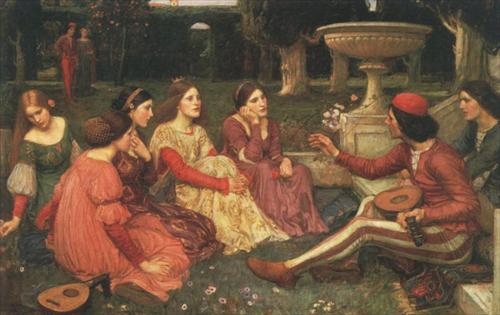
A Tale from the Decameron
John William Waterhouse (1849 - 1917)

My last Fortnightly post, "Love You Can't Imagine" ~ in celebration of Valentine's Day ~ drew to a close before I was able to incorporate all of the great selections that I was hoping to connect. So I have assembled another Fortnightly post out of that remaindered material, including a couple of somber sonnets by Edna St. Vincent Millay, and a few sobering thoughts from Anne Lamott. As my father used to say when we had inadvertently left something behind -- a garment for dry cleaning, an overdue library book, a stack of newspapers on trash day -- "Well it's alright to save some over for seed." Over for seed. We weren't even farmers, but how I grew to love my dad's rustic way of saying, "I meant to do that!"

Another little intentional error ~ as in, "I meant to do that" ~ was saving this post, scheduled for the 28th, until today, Wednesday, February 29th! Since the opportunities for celebrating Leap Day are relatively rare and complicated, it would be a shame to let the chance pass by unobserved. Many of the customs and traditions of this every - four - yearly occasion are romantic in nature, providing a most fitting coda to Valentine's Day.

New Fortnightly Post ~ Love Is Not All

On The Fortnightly Kitti Carriker:
A Fortnightly [every 14th & 28th] Literary Blog of
Connection & Coincidence; Custom & Ceremony

The Enchanted Garden
John William Waterhouse (1849 - 1917)

Sunday, June 19, 2011

Happy Birthday to Cate!

Celtic Knot

" . . . knit your heart
With an unslipping knot."

from Antony and Cleopatra, Act II, scene ii

Bouguereau's La Fileuse
shows a woman hand-spinning,
using a drop spindle in the right hand,
with a distaff held in the left hand.

La Fileuse / The Spinner / Girl with Spindle and Distaff, 1873
William-Adolphe Bouguereau (1825-1905)
French painter of classical and mythological subjects, known in his lifetime as one of the world's greatest painters.
{To learn more, see Artsy's William Adolphe Bouguereau Page}


Waterhouse's La Fileuse
shows Fate spinning human
destiny on her distaff.

La Fileuse / The Fate, 1874
John William Waterhouse(1849 - 1917)
English painter particularly of women from Arthurian and Greek Legend, in the Pre-Raphaelite style.


HAPPY BIRTHDAY
to the best knitter I know, my friend CATE


Cate likes to say that the whole world and all of life are about knitting. Knitting & unknitting! As Shakespeare says:

"Sleep . . . knits up the ravell'd sleeve of care."
from Macbeth, Act ii, scene ii

A few months ago, I came across a great passage about knitting in Sandra Tsing Loh's highly entertaining book, Mother on Fire: A True Motherf%#$@ Story About Parenting! Early in the story, trying to put up a good front at a pre-school fundraiser for literacy, she springs for a "Knitting Kit," confessing, "I don't know from literacy projects, and I've never knit in my life. I'll buy two!" (42).

As her quest to find the perfect grade school for her daughters grows ever more stressful, and her career spins out of control, she attempts to calm down and make the best of things: "Where's that knitting kit? Here it is! Turquoise wool! Fluffy! Nice!" (154).

By the end of the book, she's in full swing! She's like Cate!

"To calm myself, I reach into my bag and take out my knitting. Just touching the fluffy sapphire - colored wool, with its little red and violet spots, like hidden jewels, and unfolding the cascading foot - and - a - half length of my muffler, and its many satisfyingly even stitches . . . I instantly feel a lift. I sit back on my chair and begin to absorbingly clack my needles" (ellipses Loh's).

Sandra has brought along her knitting to her special wine and cheese session with her therapist, who asks how she is doing amidst all the issues: "'I guess the main thing I have to report is that for once in my life I am incredibly happy,' I reply. I have moved to the end of my row, which was almost finished, and now flip over the muffler and begin a new row. This new row picks up a little more of the violet, with the sapphire. the whole effect is very pleasing. It's such a kick - ass scarf."

Loh is sleeping better, not obsessing at the computer: "'I'm so into knitting now. Oh my GOD, do I love my knitting. It's almost obscene how much I look forward to it. It makes me happy. Look at this scarf! Just looking at it makes me really really happy. That's why I'm graduating from therapy after two decades. I'm just pretty . . . damn . . . happy'" (ellipses Loh's).

All's right with the world: "I have wine, I have cheese, I have my knitting -- there is nothing not perfect in my universe" (248 - 49).

See my previous post
on Sandra Tsing Loh,
A Mom On Fire

and previous Cate posts:
Sandal Weather
Cate's Books
Cate's Coffee Table
STOMP

and more on Bouguereau
Portland / Minneapolis
Denver

Friday, October 29, 2010

Isabella and the Pot of Basil

CURRENT POST ON
THE FORTNIGHTLY KITTI CARRIKER:
LITERARY BLOG OF CONNECTION & COINCIDENCE

"SWEET BASIL EVERMORE"

A FEW HIGHLIGHTS:

Isabella and the Pot of Basil, 1846
by English Pre-Raphaelite, William Holman Hunt (1827 - 1910)

"Isabella, or the Pot of Basil" is a long narrative poem by John Keats, adapted from a tale in Boccaccio's Decameron about a young woman whose family plans for her to marry a local wealthy landowner. Isabella, however, is in love with Lorenzo, who works as a clerk for her family. When her two controlling brothers learn of Isabella's inappropriate love interest, they murder Lorenzo in the woods. Isabella is at a loss until Lorenzo's ghost appears in a dream to inform her of his whereabouts. She proceeds to exhume the body, bury the head in a pot of basil, and go a little crazy.

Keats' poem was popular with the nostalgic sentimental Pre-Raphaelite painters, who illustrated it from several perspectives. First came William Holman Hunt's version (above) which in turn influenced several later artists:

Lorenzo and Isabella, 1849
by English Pre-Raphaelite, John Everett Millais (1829 - 1896)
Isabella and the Pot of Basil, 1879
by English Pre-Raphaelite, John Melhuish Strudwick (1849 - 1937)

Isabella and the Pot of Basil, 1907
by English Pre-Raphaelite, John William Waterhouse (1849 - 1917)

In contrast to these lush Pre-Raphaelite renditions, an additional painting, by John White Alexander, conveys a portrait-like figure of Isabella in neutral tones:

Isabella and the Pot of Basil, 1897
by American Painter and Illustrator, John White Alexander
(1856 – 1915)


CLICK TO READ / SEE MORE DETAILS:
"SWEET BASIL EVERMORE"