Showing posts sorted by relevance for query dickinson. Sort by date Show all posts

Tuesday, August 11, 2026

Mid - August Sadness

Grasshopper (Sprinkhaan) 1918
Anna Julia "Julie" de Graag (1877–1924)
Rijksmuseum, Amsterdam

A phase of August sadness -- what Emily Dickinson calls "further in summer" -- is now upon us: too late to say midsummer, too early to say late summer. Birdsong has given way to insect chorus, and beneath our feet, somewhere in the grass, an entire, nearly invisible civilization is celebrating the seasonal change. The crickets have their own ceremonial customs and canticles, unobtrusive, gradual, gentle. No obstrusive ordinances required, only the ancient -- or as Dickinson puts it, "antiquest" -- enhancement of Nature.

But what about that "Enlarging Loneliness"? Surely the lament of summer's impending end is experienced not only (if at all) by the insects; but more likely as a pathetic fallacy within our human hearts. Our existential sadness is mitigated only by "Druidic Difference," a sense that our ancient globe is rounding toward autumn, inevitably as ever.

Indeed, in another week or so,
August will be "burning low":

Further in Summer than the Birds –
Pathetic from the Grass –
A minor Nation celebrates
Its unobtrusive Mass.

No Ordinance be seen –
So gradual the Grace
A gentle Custom it becomes –
Enlarging Loneliness –

Antiquest felt at Noon –
When August burning low
this spectral Canticle
Repose to typify –

Remit as yet no Grace –
No furrow on the Glow,
But a Druidic Difference
Enhances Nature now –
Artist: Janie Olsen

Again, assisted by insects -- flies & bees --
Dickinson captures our autumnal anguish:

If you were coming in the Fall
I'd brush the Summer by
With half a smile, and half a spurn
As Housewives do, a Fly

If I could see you in a year
I'd wind the months in balls
And put them each in separate Drawers
For fear the numbers fuse

If only Centuries, delayed
I'd count them on my hand
Subtracting, til my fingers dropped
Into Van Dieman's Land

If certain, when this life was out
That yours and mine, should be
I'd toss it yonder, like a Rind
And take Eternity

But, now, uncertain of the length
Of this, that is between
It goads me, like the Goblin Bee
That will not state its sting


~Both poems by Emily Dickinson (KL ~ FN ~ QK)
Artist: Katrina Sesum

Are not these owls superb
portrayls of Druidic Difference?
Click here for more superb owls!

Thursday, April 11, 2013

Confidence in Confidence


Seasonal Inevitability:
All Souls Day at the Cemetery in West Lafayette
My friend Beata* and I found this wayward arrangement,
apparently from the previous Easter,
blown into a bank of dry autumn leaves and rubble.

Writing earlier this week of The Unbearable Lightness of Being (click or scroll down) brought to mind the following beautiful Easter meditation taken from the pretend Diary of Emily Dickinson, actually written by Jamie Fuller.

It's Sunday 21 April 1867 -- a late Easter that year -- and instead of attending church with the family, Emily stays home and writes her own sermon. (I'm often tempted to do the same, with so much excellent material at hand, as well as the inclination to liven thinks up a bit: shed a little doubt, spread a little worry, a little realism, a little heartbreak.) In her Easter contemplation, the fictional Emily Dickinson writes not of an unbearable lightness but of a bearable heaviness, the "weight" of "the seeker's burden":

"Morning came with reluctance -- and the sky still mingles tears with hope. We like a vivid Easter -- but Nature -- remembering the first -- chooses a more fitting compromise. The family are at church -- where presumptuous bonnets vie with Faith -- but I prefer to spend this morning with my Bible -- to hear again the story of that Day -- that taught us how to suffer. The Gospels promise permanence but remind us of our evanescence. Even he who died for Truth -- the greatest blasphemy -- could not escape fulfillment of that ageless Prophecy.

"We read the tale -- admonishing the Followers -- but the cock crows many times in our hearts and Thomas sets our example. Faith itself is our cross -- We stumble under it's weight but cannot put it down. How much lighter the step of those who do not bear the seeker's burden"
(p 33).

As a poet, Dickinson forgoes the (perhaps unbearably) "lighter . . . step." I'm struck by Dickinson / Fuller's image of the cock that crows "in our hearts," where doubt resides, and her conclusion that "faith is our cross," cumbersome but bearable. The dual burdens, one of doubt and one of faith, call to mind my favorite passage of the conflicted father in the Gospel of Mark: "I believe. Help thou mine unbelief" (9: 24). Doesn't that say it all? Especially for a Gemini and a doubting Thomasina, what's the difference really? Belief / unbelief: they go together. Doubt / faith: which is heavy; which is light?

As a wise spiritual teacher (I'm not sure who) once said,
“The enemy of faith is not doubt.
Doubt is faith’s friend.
The enemy of faith is fear.”

Not to shock the shy and modest Emily, but I can't help thinking of something irreverent here, one of Stephen Colbert's characteristic quips: "Ladies . . . show a little cleavage. It lets a man know that you're confident enough to show some cleavage!" Not much of an option for the unendowed such as myself; yet I grasp the concept. Of course, the circularity of Colbert's suggestion is laughable; yet, on the serious side, it bears a resemblance to the Easter idea -- we need faith to have faith, confidence to have confidence. As Julie Andrews sings in The Sound of Music, "I have confidence in sunshine, I have confidence in rain . . . I have confidence in confidence alone."**

Or the courage to have courage, like Stephen Dedalus when he says, "I will tell you also what I do not fear" -- and then goes on to list the things he is afraid of, the things he summons the courage to deal with every day.

In closing, another wise teacher (this one I do know) said,
"Fear is an important consultant, but a lousy leader.
You can listen to its advice, but you must not let it lead.
Courage is a wise leader. You should follow it."
Noam Shpancer
from his novel The Good Psychologist (78)

*****************

**Such excellent lyrics!
I must include the rest of them here:

I Have Confidence
What will this day be like? I wonder.
What will my future be? I wonder.
It could be so exciting to be out in the world, to be free
My heart should be wildly rejoicing
Oh, what's the matter with me?

I've always longed for adventure
To do the things I've never dared
And here I'm facing adventure
Then why am I so scared

A captain with seven children
What's so fearsome about that?

Oh, I must stop these doubts, all these worries
If I don't I just know I'll turn back
I must dream of the things I am seeking
I am seeking the courage I lack

The courage to serve them with reliance
Face my mistakes without defiance
Show them I'm worthy
And while I show them
I'll show me

So, let them bring on all their problems
I'll do better than my best
I have confidence they'll put me to the test
But I'll make them see I have confidence in me

Somehow I will impress them
I will be firm but kind
And all those children (Heaven bless them!)
They will look up to me
And mind me

With each step I am more certain
Everything will turn out fine
I have confidence the world can all be mine
They'll have to agree I have confidence in me

I have confidence in sunshine
I have confidence in rain
I have confidence that spring will come again
Besides which you see I have confidence in me

Strength doesn't lie in numbers
Strength doesn't lie in wealth
Strength lies in nights of peaceful slumbers
When you wake up -- Wake Up!

All I trust I leave my heart to
All I trust becomes my own
I have confidence in confidence alone


(Oh help!)

I have confidence in confidence alone
Besides which you see I have confidence in me!


sung by the character Maria in The Sound of Music
by Rodgers and Hammerstein

*Beata & Kitti ~ 2 November 2012


P.S.
With a few minor changes,
this post also appears on
The Fortnightly Kitti Carriker ~ March 15, 2023

Friday, May 28, 2021

Flower & Flower Moon

The Annual "Rare Treat" Iris

In the following poem, Emily Dickinson longs for a way to traverse the distance between life and afterlife. Other poets have described the beautiful iris flowers (aka "flags" or "swords") as messengers from the afterlife, traveling back from the otherworld, offering new perspectives on mortality and light.
Under the Light, yet under,
Under the Grass and the Dirt,
Under the Beetle's Cellar
Under the Clover's Root,

Further than Arm could stretch
Were it Giant long,
Further than Sunshine could
Were the Day Year long,

Over the Light, yet over,
Over the Arc of the Bird—
Over the Comet's chimney—
Over the Cubit's Head,

Further than Guess can gallop
Further than Riddle ride—
Oh for a Disc to the Distance
Between Ourselves and the Dead!


by Emily Dickinson


Partly Cloudy Flower Moon (Pre - Eclipse)
~ May Moonbeams ~
Thanks to my friend Claude for the Dickinson reference.

Monday, March 9, 2026

Home By Another Way

Follow the Star
The Star
up on Lewis Mountain, Virginia,
as seen from my backyard.


As February yields to March, Epiphany has given way to Lent. When that transition came for the Three Magi, what did they do? Realizing that the old paths no longer served their purpose they went home by another way:
"For we have seen his star in the east . . .

When they saw the star, they rejoiced with exceeding great joy.

And when they were come into the house, they saw the young child with Mary his mother, and fell down, and worshipped him: and when they had opened their treasures, they presented unto him gifts; gold, and frankincense and myrrh.

And being warned of God in a dream that they should not return to Herod, they departed into their own country another way.


Matthew 2:2, 10 - 12
For a lengthier treatment of this theme,
see essays & gift book
by Barbara Brown Taylor

With a little help from our friends and spiritual advisors, we too will seek -- and hopefully find -- a better way. That's what Lent is all about -- and today we near the halfway point.

As I have said before, Pastor Nadia Bolz - Weber and Architect Duo Dickinson are two of my perpetually reliable sources for inspiration, both during Lent and all year round.

Recently, for example, Dickinson shared an observation that reminded me of an easy - to - remember definition of "God's Will" that I heard long ago: "With our without." That's it. Duo says it this way:

"The idea that any thing can wreck a life
we have been given is the definition of entitlement."


from the essay
"Description is not Creation"
by Duo Dickinson

Three Kings
by Richard Hook ( 1938 - 2010)
Follow the Star

Wednesday, March 3, 2010

Dear March

PRINT BY EUGENE SAMUEL GRASSET (1845 -1917)
FROM HIS LA BELLE JARDINIERE CALENDAR SERIES, 1896

You have to love Emily Dickinson's breezy personification of March walking down the path and bursting through the front door. The narrator welcomes March with open arms, a kiss perhaps. Sometimes March is a Lion, sometimes a Lamb, but for Dickinson, March is a Gentleman Caller:

Dear March -- Come in --
How glad I am --
I looked for you before --
Put down your hat --
You must have walked --
How out of breath you are --
Dear March, how are you, And the Rest --
Did you leave Nature well --
Oh, March, Come right upstairs with me --
I have so much to tell --


From Poem #1320
by Emily Dickinson (1830 - 1886)
American Poet

See also my recent Fortnightly Post: "Kiss Today"

Friday, May 19, 2023

Hope Like a Bad Check

Available at Amazon & Target

A poem for graduation time . . .
Hope; An Owner's Manual

Look, you might as well know, this thing
is going to take endless repair: rubber bands,
crazy glue, tapioca, the square of the hypotenuse.
Nineteenth century novels. Heartstrings, sunrise:
all of these are useful. Also, feathers. [emphasis added]

To keep it humming, sometimes you have to stand
on an incline, where everything looks possible;
on the line you drew yourself. Or in
the grocery line, making faces at a toddler
secretly, over his mother's shoulder.

You might have to pop the clutch and run
past all the evidence. Past everyone who is
laughing or praying for you. Definitely you don't
want to go directly to jail, but still, here you go,
passing time, passing strange. Don't pass this up.

In the worst of times, you will have to pass it off.
Park it and fly by the seat of your pants. With nothing
in the bank, you'll still want to take the express.
Tiptoe past the dogs of the apocalypse that are sleeping
in the shade of your future. Pay at the window.
Pass your hope like a bad check.
You might still have just enough time. To make a deposit.


by Barbara Kingsolver
from "How to be Hopeful"
her commencement address at Duke University
Durham, North Carolina, May 11, 2008.
Published online by Duke Today

Also included in Kingsolver's poetry collection:
How to Fly (In Ten Thousand Easy Lessons)

And this one by Emily Dickinson goes along with it:

“Hope” is the thing with feathers
(poem #314)

“Hope” is the thing with feathers -
That perches in the soul -
And sings the tune without the words -
And never stops - at all -

And sweetest - in the Gale - is heard -
And sore must be the storm-
That could abash the little Bird
That kept so many warm -

I’ve heard it in the chillest land -
And on the strangest Sea -
Yet - never - in Extremity,
It asked a crumb - of me.


~Emily Dickinson
See also: "Hope is a Strange Invention"
& commentary by Duo Dickinson
& "This World is Not Conclusion"
And for additional good luck:
"Feather Bag, Stick Bag"

In the Spirit of the Graduation Season!

Monday, July 28, 2025

Not Older With the Years

For further thoughts on
Emily Dickinson's Poem #1055
see my recent post

Happy Birthday Anyway

@The Fortnightly Kitti Carriker
A literary blog of connection & coincidence;
custom & ceremony


See also:
Various Poetical Misattributions

~~~~~~~~~~~~~~~~~~

Channeling Emily Dickinson this week
[see all previous]
~ QK ~ FN ~ KL ~
in honor of my friend Victoria Amador:

HAPPY BIRTHDAY VICKIE!
And thanks for your unceasing
inspiration and input
into these blogposts over the years!

~~~~~~~~~~~~~~~~~~

"We turn not older with years,
but newer every day
."
~ from the letters of Emily Dickinson

Thursday, October 23, 2014

Gossamer!

Detail of photo by my friend Joni Menard:
"My house has all natural spookiness going on. I am so grateful.
All that fake cobweb stuff is for spook pretenders."

When we read Emily Dickinson back in college, the teacher had us look up gossamer as it appears in the fourth stanza of "Because I could not stop for Death." Of all the things that I've forgotten over the years, those lovely descriptors have stayed in my mind forever:
goose summer
summer thread
spider threads
summer - like weather in late autumn
light or flimsy or filmy.
Each fall, when the lawn and leaves are strewn with "spider threads," I think of Dickinson's delicately clad heroine, dressed for summer even as inevitable winter approaches. Headed toward Eternity, she shivers in her fine array:

Because I could not stop for Death –
He kindly stopped for me –
The Carriage held but just Ourselves –
And Immortality.

We slowly drove – He knew no haste
And I had put away
My labor and my leisure too,
For His Civility –

We passed the School, where Children strove
At Recess – in the Ring –
We passed the Fields of Gazing Grain –
We passed the Setting Sun –

Or rather – He passed Us –
The Dews drew quivering and Chill –
For only Gossamer, my Gown –
My Tippet – only Tulle –

We paused before a House that seemed
A Swelling of the Ground –
The Roof was scarcely visible –
The Cornice – in the Ground –

Since then – 'tis Centuries – and yet
Feels shorter than the Day
I first surmised the Horses' Heads
Were toward Eternity –
[emphasis added]

~ Emily Dickinson, 1830 - 86

Note from Joni:
"Not just one plant but two; pic is fuzzy."

P.S.
Click to see Summer Gossamer!

Friday, September 18, 2020

Older With the Years, Or Not


When I shared this photo of my tablecloth and centerpiece,
my observant friend -- and excellent photographer* Julie Windhorst
responded with the following decorative cabbages:

Nature Imitates Art

Time & Chance Happeneth to Them All

from the letters of
Emily Dickinson:

"Affection is like bread,
unnoticed till we starve, and then we dream of it,
and sing of it, and paint it, when every urchin
in the street has more than he can eat.
We turn not older with years,
but newer every day."


***************


"As I grow older
I'm growing younger
every day
"
To my surprise, when I ordered Atul Gawande's book used from amazon, it arrived with this note tucked inside the pages, written in a shaky hand and uncannily echoing the words of Emily Dickinson.

Gerry and I both used this prophetic scrap of paper for a bookmark as we read this highly and often recommended commentary on how to deal with / avoid unnecessary end - of - life medical intervention, sometimes thoughtlessly suggested, if not forced upon us, by health care professionals.

***************

For more on aging and mortality and
our connective, collective life on earth, see
my Fortnightly Posts from Summer 2020

Plasticity

We Hardly Knew Ye

Lament

Connectivity

An Inheritance of Ephemera

@The Fortnightly Kitti Carriker
A literary blog of connection & coincidence;
custom & ceremony


Also by Julie ~ this luminous morning glory!

Tuesday, December 10, 2013

Burning Bush

First Snow Flakes, 11 November 2013
"Earth's crammed with heaven,
And every common bush afire with God . . . "


from the poem "Aurora Lee"
by Elizabeth Barrett Browning

"So the poet's habit of living should be set
on a key so low and plain,
that the common influences should delight . . . "


from the essay "The Poet"
Ralph Waldo Emerson

***************

I also like the way that in this photograph
the entire heavens are afire with God!
Photo of Dickinson's House by Stan Lichens

In honor of Emily Dickinson's birthday:
Born this day in 1830
[died May 15, 1886]

I posted a few days early this week on
The Fortnightly Kitti Carriker
A fortnightly [every 14th & 28th]
literary blog of connection & coincidence; custom & ceremony


Hope you will enjoy my essay
"Hopefully"

Sunday, May 15, 2016

With a Lily of the Valley for a Bell

When I heard the church bells ring,
I thought I heard the voice of God.

Albert Schweitzer, 1875 - 1965

Lilies of the Valley
photographed by Mark Bass

Some keep the Sabbath going to Church -
I keep it, staying at Home –
With a Bobolink for a Chorister –
And an Orchard, for a Dome –

Some keep the Sabbath in Surplice –
I, just wear my Wings –
And instead of tolling the Bell, for Church,
Our little Sexton – sings.

God preaches, a noted Clergyman –
And the sermon is never long,
So instead of getting to Heaven, at last –
I’m going, all along.


~ Emily Dickinson

Gerry . . .

sorting out a batch of Lily of the Valley bulbs . . .

to plant alongside the driveway.

Previous Success on the Other Side of the HouseMay 2013


P.S.
Another picture to go with Emily Dickinson's poem:
Some keep the Sabbath by going for a walk in the woods!
Mark says:
"Walking through the woods is what we call True Religion."

Thursday, March 31, 2011

Experiments of Green

Fig Plant in Our Sun Room

A little Madness in the Spring
Is wholesome even for the King,
But God be with the Clown —
Who ponders this tremendous scene —
This whole Experiment of Green —
As if it were his own!

~ Emily Dickinson ~

As Czeslaw Milosz says in his poem "Esse," we strive to name the world, the spring landscape, the green experiment: "repeating only: is! . . . I was left behind with the immensity of existing things. A sponge, suffering because it cannot saturate itself; a river, suffering because reflections of clouds and trees are not clouds and trees."

Dickinson, Milosz, and more ~ currently on
The Fortnightly Kitti Carriker:
Like a Spinning Top, Like a Sponge

I LOVE PHOTOGRAPHING THE FIG!


Wednesday, October 30, 2019

Haunted Head


One need not be a chamber to be haunted,
One need not be a house;
The brain has corridors surpassing
Material place.

Far safer, of a midnight meeting
External ghost,
Than an interior confronting
That whiter host.

Far safer through an Abbey gallop,
The stones achase,
Than, moonless, one’s own self encounter
In lonesome place.

Ourself, behind ourself concealed,
Should startle most;
Assassin, hid in our apartment,
Be horror’s least.

The prudent carries a revolver,
He bolts the door,
O’erlooking a superior spectre
More near.

********************

The brain is wider than the sky,
For, put them side by side,
The one the other will include
With ease, and you beside.

The brain is deeper than the sea,
For, hold them, blue to blue,
The one the other will absorb,
As sponges, buckets do.

The brain is just the weight of God,
For, lift them, pound for pound,
And they will differ, if they do,
As syllable from sound.


both poems
by Emily Dickinson (1830–86)
More Dickinson posts --
just right for Halloween!
~ also facebook ~

Tuesday, December 10, 2024

Barn of My Heart

Happy Birthday ~ Emily Dickinson
Born this day in 1830
[died May 15, 1886]
#178 ~ I cautious, scanned my little life

I cautious, scanned my little life—
I winnowed what would fade
From what would last till Heads like mine
Should be a-dreaming laid.

I put the latter in a Barn—
The former, blew away.
I went one winter morning
And lo—my priceless Hay

Was not upon the “Scaffold”—
Was not upon the “Beam”—
And from a thriving Farmer—
A Cynic, I became.

Whether a Thief did it—
Whether it was the wind—
Whether Deity’s guiltless—
My business is, to find!

So I begin to ransack!
How is it Hearts, with Thee?
Art thou within the little Barn

Love provided Thee?


~ Emily Dickinson [emphasis added]
My friend Tammy Sandel takes these stunning photographs
and then captures the personality
of each Indiana barn with a unique name.
The two shown here are from her "Barn Heart Series"
Tammy has also inpsired me a couple of times
with my own barn - naming:
Kittredge & Portia

Wednesday, June 25, 2014

"A choir is a beautiful thing"

St. Peter's Choir of ~ in alphabetical order ~ Boys, Girls, Men, Women
Foreground, St. Peter's Churchyard ~ Philadelphia
Background, St. Peter's School ~ 2004

Seems I just can't stop quoting from The Elegance of the Hedgehog.
Here's one more:

Journal of the Movement of the World No. 4

A choir is a beautiful thing


from The Elegance of the Hedgehog
by Muriel Barbery
[more on my book blog & Fortnightly]

Yesterday afternoon was my school's choir performance. In my posh neighborhood school, there is a choir: nobody thinks it's square and everyone competes to join but it's very exclusive: Monsieur Trianon, the music teacher, hand picks his choristers. The reason the choir is so successful is because of Monsieur Trianon himself. He is young and handsome and he had the choir sing not only the old jazz standards but also the latest hits, with very classy orchestration. Everyone gets all dressed up and the choir performs for the other students. Only the choir members' parents are invited because otherwise there'd be too many people. The gymnasium is always packed fit to burst as it is and there's an incredible atmosphere.

. . . the choir arrived to thundering applause, dressed in red and white with bow ties for the boys and long dresses with shoulder straps for the girls. Monsieur Trianon sat down on a high stool, his back to the audience, then raised a sort of baton with a little flashing red light at the end, silence fell nd the performance began.

Every time, it's a miracle. Here are all these people, full of heartache or hatred or desire, and we all have our troubles and the school year is filled with vulgarity and triviality and consequence, and there are all these teachers and kids of every shape and size, and there's this life we're struggling through full of shouting and tears and laughter and fights and break-ups and dashed hopes and unexpected luck -- it all disappears, just like that, when the choir begins to sing. Everyday life vanishes into song, you are suddenly overcome with a feeling of community, of deep solidarity, even love, and it diffuses the ugliness of everyday life into a spirit of perfect communion. Even the singers' faces are transformed: it's no longer Achille Grand-Fernet that I'm looking at (he is a very fine tenor), or Déborah Lemeur or Ségolène Rachet or Charles Saint-Sauveur. I see human beings, surrendering to music.

Every time, it's the same thing, I feel like crying, my throat goes all tight and I do the best I can to control myself but sometimes it gets close: I can hardly keep myself from sobbing. So when they sing a canon I look down at the ground because it's just too much emotion at once: it's too beautiful, and everyone singing together, this marvelous sharing, I'm no longer myself, I am just one part of a sublime whole, to which the others also belong, and I always wonder at such moments why this cannot be the rule of everyday life, instead of being an exceptional moment, during a choir.

When the music stops, everyone applauds, their faces all lit up, the choir radiant. It is so beautiful.

In the end, I wonder if the true movement of the world might not be a voice raised in song.
(pp 184 - 85)

PS
McCartney Brothers, Spring 2004

In the fall of 2002, Ben & Sam had a choir / field trip to Trinity on the Green and spent the weekend with the New Haven choir families. Liz, Duo, Will, and Sam Dickinson were Ben's host family; and Ben managed to leave a pair of shoes behind, which Liz put in the mail for us. We've been BPPs (best pen pals) ever since! Thanks Dickinsons!

We also like to marvel over the parallels that both our elder boys are named "William" (our Ben is actually "William Benedict") and both younger sons are named "Samuel." The two older boys have both continued to focus on their music; while the two younger, taller sons focused on collegiate football. Will coincidences never cease?

Dickinson Brothers, Christmas 2003

More choir photos at Pew #41 & Happy Easter

Thursday, April 8, 2010

April Leaf


INVITATION STANDING

Bring a leaf to me
just a leaf just a
spring leaf, an
april leaf

just

come

Blue sky
never mind
Spring rain
never mind
Reach up and
take a leaf and

come

just come


by Paul Blackburn (1926 - 71)
American poet and translator (from the Spanish)


Was it only a month ago that March stopped by to say hello to Emily Dickinson? If you remember, she invited him in -- "Put down your hat"! -- for a long chat about the hues and tints and shades of Spring. In the closing stanzas, the poet is astonished -- aren't we all? -- to realize that right in the midst of her visit with March, here comes April!

So soon:

Who knocks? That April.
Lock the Door --
I will not be pursued --
He stayed away a Year, to call
When I am occupied --
But trifles look so trivial
As soon as you have come

That Blame is just as dear as Praise
And Praise as mere as Blame --


from Poem #1320
by Emily Dickinson (1830 - 1886)
American Poet

Monday, February 14, 2022

Don't Dishearten

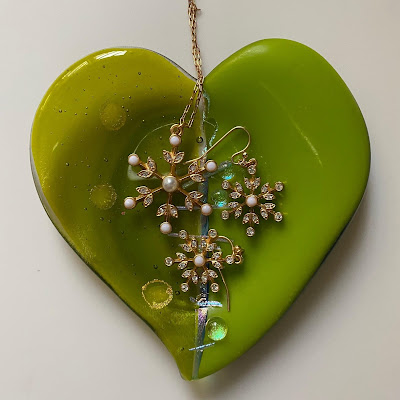
On Valentine's Day,
the heart wants what the heart wants!
**********
Thanks to my friend Katie for the green glass heart
and winter snowflake jewelry!
In the summer of 1862, Emily Dickinson (1830 - 86) wrote to her friend Mary Bowles (1827 - 93), offering comfort during a time when Mary's husband Samuel Bowles (1826 - 78) was traveling abroad and Mary was missing him:
Dear Mary, When the Best is gone - I know that other things are not of consequence - The Heart wants what it wants - or else it does not care -

You wonder why I write - so - Because I cannot help - I like to have you know some care - so when your life gets faint for it's other life - you can lean on us - We wont break, Mary. We look very small - but the Reed can carry weight.

Not to see what we love, is very terrible - and talking - does'nt ease it - and nothing does - but just itself.

. . . Don't dishearten - Mary - We'll keep thinking of you - Kisses for all.

Emily.
Years later, Emily comforts Mary
upon the occasion of Samuel's death.
Broken heart . . . broken words:

January 1878

I hasten to you, Mary, because no moment must be lost when a heart is breaking, for though it broke so long, each time is newer than the last, if it broke truly. To be willing that I should speak to you was so generous, dear.

Sorrow almost resents love, it is so inflamed.

I am glad if the broken words helped you. I had not hoped so much, I felt so faint in uttering them, thinking of your great pain. . . .

Emily
**********

See the Everyman Edition of
Emily Dickinson Letters
(pages 139 - 140, 198 - 99)

Monday, October 4, 2021

Was such still dwelling there?

Here are a couple of favorites that Ellie and I
often stroll past on our autumnal peregrinations:
Situated just a few blocks apart, one always reminds me of the other. Not that I've ever lived in -- or even been inside of -- either place, yet the following poems from Emily Dickinson and Robert Frost capture my curiosity to know what these houses may have witnessed over the past century or so:
Emily Dickinson's Home Poem #440

Years I had been from home,
And now, before the door
I dared not open, lest a face
I never saw before

Stare vacant into mine
And ask my business there.
My business, - just a life I left,
Was such still dwelling there?

I fumbled at my nerve,
I scanned the windows near;
The silence like an ocean rolled,
And broke against my ear.

I laughed a wooden laugh
That I could fear a door,
Who danger and the dead had faced,
But never quaked before.

I fitted to the latch
My hand, with trembling care,
Lest back the awful door should spring,
And leave me standing there.

I moved my fingers off
As cautiously as glass,
And held my ears, and like a thief
Fled gasping from the house
.

**************

Robert Frost's "Ghost House"

I dwell in a lonely house I know
That vanished many a summer ago,
And left no trace but the cellar walls,
And a cellar in which the daylight falls
And the purple-stemmed wild raspberries grow.

O'er ruined fences the grape-vines shield
The woods come back to the mowing field;
The orchard tree has grown one copse
Of new wood and old where the woodpecker chops;
The footpath down to the well is healed.

I dwell with a strangely aching heart
In that vanished abode there far apart
On that disused and forgotten road
That has no dust-bath now for the toad.
Night comes; the black bats tumble and dart;

The whippoorwill is coming to shout
And hush and cluck and flutter about:
I hear him begin far enough away
Full many a time to say his say
Before he arrives to say it out.

It is under the small, dim, summer star.
I know not who these mute folk are
Who share the unlit place with me—
Those stones out under the low-limbed tree
Doubtless bear names that the mosses mar.

They are tireless folk, but slow and sad—
Though two, close-keeping, are lass and lad,—
With none among them that ever sings,
And yet, in view of how many things,
As sweet companions as might be had.

**************

As I mentioned a few days ago, here is the house
that represents my all - time fantasy renovation project:
It turns out, upon closer examination,
that several other houses in the vicinity
share a similar, angular, stately style:

The Falley Double

**************
And these two ~ ABOVE & BELOW ~
that I never fail to admire on the drive
between Lafayette and Indianapolis

**************

P.S.
These ones also
give me a strangely aching heart.