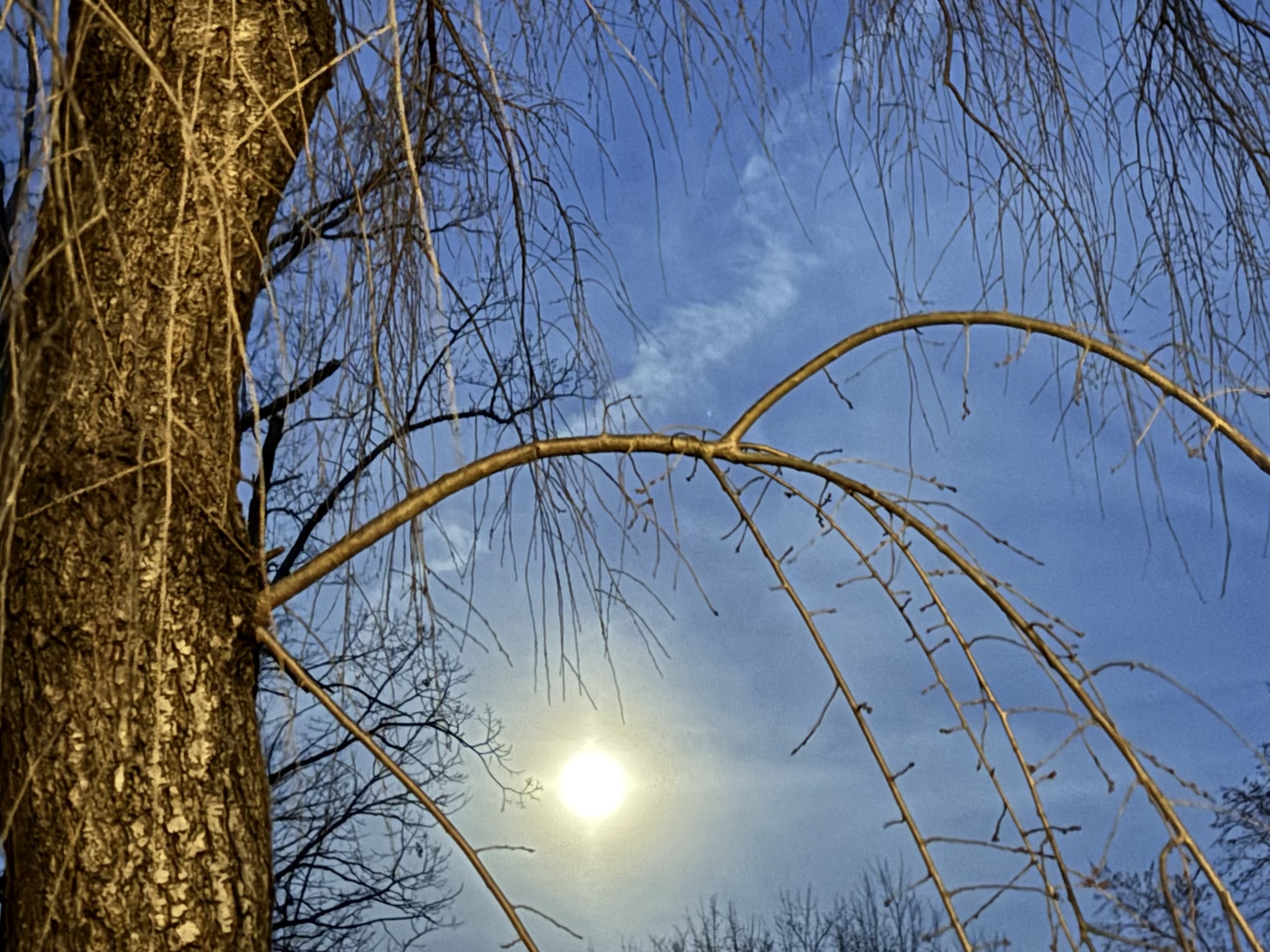
Monday, April 28, 2025

Rocks, Keats, Sentences

These good luck rocks in my car are souvenirs
from Ben & Sam's sleepover at St. John the Divine
Junior high field trip ~ New York City ~ 2004

[below: good luck charms and worry beads
from my father - in - law Ron & my friend Etta]

~~~~~~~~~~~~~~~~~~~~~~~~

Recent posts from my
Fortnightly Blog:


1. Indoor Rocks
&
2. Sitting Down to Read Keats

And my
Book Blog:


Do You Like Sentences?
~ some good luck worry beads in my car ~

Friday, April 25, 2025

The Trees Shall Clap Their Hands

Happy Arbor Day!
A most dignified and unusual tree trunk at the
University of Virginia ~ Charlottesville
UVA Cemetery & Columbarium

and a

A surprisingly joyful inscription:

For ye shall go out with joy,

and be led forth with peace;
the mountains and the hills shall
break forth before you into singing,

and all the trees of the field
shall clap their hands
."

Isaiah 55:12, KJV
Vernal Equinox
Christmas Wreaths, lingering into Spring
Waiting for Easter
So many graves so sad & small amongst the others.

Novels about trees:
The Overstory & Prodigal Summer

Previous Arbor Day Posts
2010
2011
2012
2013
2014
2015
2016
2017
2018
2019
2020
2021
2022
2023 & Veterans Day
2024
2025
2026 & Earth Day

Wednesday, April 23, 2025

The Linchpin

A novel to read on
Shakespeare's 461st Birthday:

"How were they to know that
Hamnet was the pin holding them together?
That without him they would all fragment and
fall apart, like a cup shattered on the floor
?" (233)

Click for more quotes.
&
Hamnet on my Book Blog & Facebook.

Additional Shakespeare Birthday Posts

23 April 2010
18 May 2011
23 April 2012
23 April 2013
25 April 2014 & Buttons
29 April 2015
23 April 2016
23 April 2017
~~~
~~~
24 April 2020
~~~
~~~
23 April 2023
23 April 2024
23 April 2025
23 April 2026

Tuesday, April 22, 2025

Earth Day Bond


We are each other's harvest;
we are each other's business;
we are each other's magnitude and bond
.”

~ Gwendolyn Brooks ~


A Poem for Earth Day
Paul Robeson

That time

we all heard it,

cool and clear,

cutting across the hot grit of the day.

The major Voice.

The adult Voice

forgoing Rolling River,

forgoing tearful tale of bale and barge

and other symptoms of an old despond.

Warning, in music-words

devout and large,

that we are each other’s

harvest:

we are each other’s

business:

we are each other’s

magnitude and bond
. [emphasis added]

Written in 1970
by Gwendolyn Brooks (1917 – 2000)

The Mighty Mississippi

[Not forgetting The Wide Missouri]

A Song for Earth Day

Old Man River

Sung by Paul Robeson (1898 - 1976)
Respect the Earth!

Happy Earth Day! ~ Previous Posts

P.S.
Lest we forget:
Earth Day is a Protest!
Heather Cox Richardson: The first "Earth Day, held on April 22, 1970, brought more than 20 million Americans—10% of the total population of the country at the time—to call for the nation to address the damage caused by 150 years of unregulated industrial development. The movement included members of all political parties, rich Americans and their poorer neighbors, people who lived in the city and those in the country, labor leaders and their employers. Fifty-five years later, it is still one of the largest protests in American history."

Sunday, April 20, 2025

Belief, Superstition, Disbelief

The smallest church in England?
South Downs, East Sussex
Lullington Church, 1939
James Bateman (1893 – 1959)
[and this church bell by Georgia O'Keeffe, 1917]

Church Going

Once I am sure there's nothing going on
I step inside, letting the door thud shut.
Another church: matting, seats, and stone,
And little books; sprawlings of flowers, cut
For Sunday, brownish now; some brass and stuff
Up at the holy end; the small neat organ;
And a tense, musty, unignorable silence,
Brewed God knows how long. Hatless, I take off
My cycle-clips in awkward reverence,

Move forward, run my hand around the font.
From where I stand, the roof looks almost new-
Cleaned or restored? Someone would know: I don't.
Mounting the lectern, I peruse a few
Hectoring large-scale verses, and pronounce
"Here endeth" much more loudly than I'd meant.
The echoes snigger briefly. Back at the door
I sign the book, donate an Irish sixpence,
Reflect the place was not worth stopping for.

Yet stop I did: in fact I often do,
And always end much at a loss like this,
Wondering what to look for; wondering, too,
When churches fall completely out of use
What we shall turn them into, if we shall keep
A few cathedrals chronically on show,
Their parchment, plate, and pyx in locked cases,
And let the rest rent-free to rain and sheep.
Shall we avoid them as unlucky places?

Or, after dark, will dubious women come
To make their children touch a particular stone;
Pick simples for a cancer; or on some
Advised night see walking a dead one?
Power of some sort or other will go on
In games, in riddles, seemingly at random;
But superstition, like belief, must die,
And what remains when disbelief has gone?

Grass, weedy pavement, brambles, buttress, sky,

A shape less recognizable each week,
A purpose more obscure. I wonder who
Will be the last, the very last, to seek
This place for what it was; one of the crew
That tap and jot and know what rood-lofts were?
Some ruin-bibber, randy for antique,
Or Christmas-addict, counting on a whiff
Of gown-and-bands and organ-pipes and myrrh?
Or will he be my representative,

Bored, uninformed, knowing the ghostly silt
Dispersed, yet tending to this cross of ground
Through suburb scrub because it held unspilt
So long and equably what since is found
Only in separation - marriage, and birth,
And death, and thoughts of these - for whom was built
This special shell? For, though I've no idea
What this accoutred frowsty barn is worth,
It pleases me to stand in silence here;

A serious house on serious earth it is,
In whose blent air all our compulsions meet,
Are recognised, and robed as destinies.
And that much never can be obsolete,
Since someone will forever be surprising
A hunger in himself to be more serious,
And gravitating with it to this ground,
Which, he once heard, was proper to grow wise in,

If only that so many dead lie round.


Philip Larkin (1922 - 1985)
[See also: KL & FN]
Larkin's poem is mentioned in the wikipedia entry of novelist Malcolm Bradbury (1932 - 2000): "Though Bradbury was not an orthodox religious believer, he respected the traditions and socio-cultural role of the Church of England and enjoyed visiting churches in the spirit of Philip Larkin's poem, 'Church Going.' "
Q: From Larkin's poem:
"And what remains when disbelief has gone?"

A: From Theodore Hesburgh's (1917 - 2015) essay:
"A Plea for Excellence in Higher Education"
The first fruit of a liberal education is to free a person from ignorance, which fundamentally means freedom to think, clearly and logically. Moreover, allied with this release from stupidity — nonthinking or poor thinking — is the freedom to communicate one's thoughts, hopefully with clarity, style, and grace . . .

A liberal education should also enable a person to judge, which in itself presupposes the ability to evaluate: to prefer this to that, to say this is good and that bad, or at least this is better than that. To evaluate is to prefer, to discriminate, to choose, and each of these actions presupposes a sense of values. . . . This, too, is a value judgment and a liberation from valuelessness, insecurity and despair, at times.

Liberal education, by all of these value‐laden processes, should confer a sense of peace, confidence and assurance on the person thus educated and liberate him or her from the adriftness that characterizes so many in an age of anomie [valuelessness].

Lastly, a liberal education should enable a person to humanize everything that he or she touches in life, which is to say that one is enabled not only to evaluate what one is or does, but that, in addition, one adds value consciously to relationships that might otherwise be banal or superficial or meaningless: relations to God, to one's fellow men, to one's wife or husband or children, to one's associates, one's neighborhood, one's country and world. In this way, the list of what one expects of liberal education is really a list of the very real values that alone can liberate a person from very real evils or nonvalues — stupidity, meaninglessness, inhumanity.

Hesburgh's essay is dense, but I always included it on my syllabus to give students a definition of anomie and liberal. A truly liberal (as in “freeing”) education can help you rise above conditioning and the centuries of superstition that has does nothing but damage to human culture and intellect. That’s what post-modern deconstructionism is all about — peeling down to the “first principal.”

Beyond belief, superstition, and disbelief -- what remains?

As Oscar Wilde reminds us:
"And agnosticism should have its ritual no less than faith.
It has sown its martyrs, it should reap its saints,
and praise God daily for having hidden Himself from man
.

from De Profundis

Thursday, April 17, 2025

A Samurai or the Son of God

Le Cirque Bleu ~ The Blue Circus
By Marc Chagall (1887 - 1985)

Many more Chagalls: QK & FN

An Ekphrastic Poem for Easter
A Chagall (#1)

A Blue Circus,
a spotlight, and a red girl
swinging in the air,
illuminated, twisting,
face and breasts and buttocks
all facing you, you'd
really find it hard
to believe, except
it's supernormal compared
to the floating green donkey
she's facing, and the blue carp
who holds a bouquet,
floating above her, and
a blue chicken
with a yellow bill
resting upon her leg.
There's a radiant yellow sun
which contains a white crescent
moon with an eye, and a violin,
the moon may be playing it,
you can't be sure,
and other people, dancing,
hanging, twirling, spinning
hoops and playing violins,
and a green beautiful boy
who could be a Samurai
or the son of God
,
vague among green leaves.


7 / 2 / 68

by Dan Propper (1937 - 2003)
[See also UN & Gulf]

To complement Propper's poem,
check out this one by Lawrence Ferlinghetti

More exphrasis on my blog:
Brueghel's Icarus & American Gothic

Five examples, six examples, ten examples,
with some duplication.

I'm just wondering if there is a name for the reverse:
when a poem inspires a painting,
such as these watercolors by Gerry McCartney,
and these selections from The Guardian?

If there is, I can't find it. Help?
Pehaps ut pictura poesis

********************
Music for Maundy Thursday & Good Friday:
Mozart's "Confutatis and Lacrimosa"

&

Some thoughts about Jesus
from The Rev. Sarah Condon
from her book Churchy

"Jesus was terrible at encouraging equitable relationships with good boundaries. Just ask those people who worked all day in the vineyard. Or the ninety-nine lambs that got left behind while he searched for the lost one. Or even the disciples who felt they had rightfully earned their place at the front of the heavenly queue.

. . . Whether we like it or not, a low anthropology exemplifies the reality of human nature juxtaposed with the perfection of Christ. If he did not come to save us from ourselves, then what did he come for? To be a teacher? A prophet? A community organizer? He was an elusive teacher at best, a failed and crucified prophet, and the world's least organized community organizer
" (12, 19).

See also Imbolc Angel & Small Sweet Tangible Things

Monday, April 14, 2025

The Master & Margarita Moon

~ The Full Pink April Moon ~
~ Sunday, April 12, 12:00 AM ~

"But I don't want comfort. I want God,
I want poetry, I want real danger,
I want freedom, I want goodness. I want sin
.”
Aldous Huxley ~ Brave New World

I live in a family of Huxley fans who have yet to enjoy one of my all - time favorite novels, Mikhail Bulgakov's The Master and Margarita. To get them started, I shared as a counterpoint to Huxley's quotation, the discussion of Peace vs Light, that occurs near the end of the novel, after Jesus reads the Master's manuscript and determines his eternal reward.
On an errand from Jesus, St. Matthew speaks to Satan: "'He [Jesus] has read the Master's work and asks you to take the Master with you and reward him with peace. Is that hard for you to do, spirit of evil?'

"'Nothing is hard for me to do,' answered Woland [Satan], 'You know that very well.' He was silent for a while, and added: 'But why don't you take him with you, into the light?'

"'He has not earned light, he earned peace,' Matthew said in a sorrowful voice.

"'Tell him it will be done,' Woland replied."
As you can imagine, there is a lot of literary analysis on the topic of why the Master & Margarita deserve peace [comfort] instead of light. But obviously it is seen as a sad outcome & a lesser reward than light -- and all the other things that Huxley mentions: God, poetry, danger, freedom, goodness, sin.

Significantly, in the context of the novel, it's not so much a battle of good (Jesus) AGAINST evil (Satan), but more like Good & Evil (the characters of Yeshua & Woland) working together AGAINST cynicism, skepticism, and stupidity.

Stanford Online


Additional Resources

Everything You Always Wanted To Know
About The Master & Margarita
by Jan Vanhellemont

more about Vanhellemont's book

facebook page

new movie

And of course, everything on my blogs:
QK ~ KL ~ FN
Between The Master and Margarita -- the perfect novel for Holy Week -- and Jesus Christ Superstar, I've sort of put together my own version of the Life of Christ that I carry around inside my head. Every now and then, I have to remind myself that it's not entirely biblical. On the other hand, much of it is!

Saturday, April 12, 2025

The Bee-Man & The Bees

You can read
The Bee-Man of Orn online.

Or look at another magical edition,
beautifully illustrated by P. J. Lynch

"When I first catch sight of a bee tree I am drawn toward it.
I know not how. Something says to me:
'That is what you are looking for
.' "

In keeping with my favorite theme of literary coincidences in daily life, these two works were suggested to me on the same day by two different and very creative friends. Steven recommended The Bee-Man of Orn; and Jan sent along "The Bees" by Audre Lorde (see Ink & Pixel, #6).
The Bees

In the street outside a school
what the children learn
possesses them.
Little boys yell as they stone a flock of bees
trying to swarm
between the lunchroom window and an iron grate.
The boys sling furious rocks
smashing the windows.
The bees, buzzing their anger,
are slow to attack.
Then one boy is stung
into quicker destruction
and the school guards come
long wooden sticks held out before them
they advance upon the hive
beating the almost finished rooms of wax apart
mashing the new tunnels in
while fresh honey drips
down their broomsticks
and the little boy feet becoming expert
in destruction
trample the remaining and bewildered bees
into the earth.

Curious and apart
four little girls look on in fascination
learning a secret lesson
and trying to understand their own destruction.
One girl cries out
“Hey, the bees weren’t making any trouble!”
and she steps across the feebly buzzing ruins
to peer up at the empty, grated nook
“We could have studied honey-making!”


by Audre Lorde (1934 - 92)

It is unfortunate that Lorde stereotypes by gender; however, looking past that flaw, the final line of compassion and cooperation is truly inspiring: “We could have studied honey-making!”

It goes along with what I thought was going to happen when the Bee-Man runs back to get his hive and throws it at the dragon. I thought the Bee-Man was going to calm the dragon by offering him honey, and then the dragon would calmly relinquish the baby in exchange for honey.

I also predicted that the Bee-Man was ultimately going to request being changed into a Bee as his true original form! But -- spoiler alert -- becoming a baby and re-growing back into his same old self is also a good twist!

A few more connections:

As Denise Levertov says:
" . . . nothing we do has the quickness, the sureness,
the deep intelligence living at peace would have.
"

If living at peace was all we had, we could study honey-making
-- and so much more!

Remember the song: “If Peace Was All We Had

See also:
A Song for MLK Day
Think Globally & Bee-Man

Friday, April 11, 2025

Old Easter Baskets

These are the only two I kept, a matching set for my twin brother Bruce and me. I get them out every year and fill with miscellaneous memorabilia. Look closely, and you can see that the date on the photo of me says: 1959. The bottom of one of the baskets says: “79 cents.”
We're not holding our baskets in this photograph, but same era.
And, yes, I am wearing white gloves and holding an egg!
I still have the little lace purse for Ellie to play with:
A year ago, my friend Steven and I were discussing our childhood Easter baskets, and I was very impressed to learn that he still had (or had until very recently) the same basket from his very first Easter!
Steven clarified: "Alas, my Easter Basket was falling apart, so I decorated it with flowers and used it on the set for The Miser two years ago. It now has a new life, after 70 years. It was mine as a child. I think my mother must have gotten it at Woolworth's. It came back to me after my grandmother died. I used it for keys and other stuff, but finally it couldn't stand on its own. I was going to have it remade, but decided it should be a prop instead."
A good life for a cherished item! Sometimes a new life is for the best, right?!

I left my stash of Easter baskets and Easter grass behind when we down-sized from Indiana to Virginia. Now I just throw everything into gift bag, or grab a bowl from the kitchen. In fact, to verify, here is some evidence from my photo album of “Stuff we gave away”:
I even gave these away, the closest Ben and Sam ever came to matching baskets. Well, yes, they matched, but they never grew dear to anyone's heart over the years the way mine and Bruce's had. So I let them go.
And of course I kept our favorite Easter Story Book!

Saturday, April 5, 2025

The Fear is Real

Today's Protests:
Washington DC, New York City, Philadelphia

I liked a lot of things about Ann Patchett's novel Tom Lake -- beautiful imagery and references to Our Town, calling out some ridiculous stereotypes, a deep understanding of the passage of time. But I also disliked a lot of things, most of which concern the superficiality of Lara's character. I could never quite figure out if Patchett is intentionally creating a shallow character, or if Patchett herself is shallow. Is Patchett lying to her readers, or is Lara lying to her daughters?
In a serious family discussion, Lara's daughters express their concern about the dangers of childbirth and the disinclination to bring children into a troubled world.

Lara responds: "Every generation believes the world is going to end."

Her daughter Emily: "Is that true? Did you and Dad think it was all going up in a fiery ball?"

Lara: "No, I said it to make you feel better." We "thought about the plays we wanted to get tickets for, the price of rent, whether or not we should go out to dinner, how soon we could afford to have a baby. We didn't think anything would end, any of it ever." (149).

Really? Why does Patchett choose these flippant lines for her character? Lara, just like Patchett in real life, was born in 1963. My friends and I were a little older (born in 1957), but we certainly were not immune from thinking about the "fiery ball" of nuclear devastation. That's what it meant to grow up during the Cold War. Apocalyptic visions and narratives of annihilation were everywhere -- at the movies, at Sunday School, in fiction and non - fiction; on the news at night waiting for the Vietnam War to end. We were taught that ZPG was necessary to avoid the population explosion and a predicted scarcity of natural resources. Is Lara supposed to be oblivious to the fact that Earth Day has been an environmental protest event for the last 55 years?

Okay, at first she was a little kid, but the threat of nuclear destruction lasted for decades. How about when everyone else in the country was watching The Day After? That was 1983, when Patchett / Lara was 19 or 20 years old. Has she forgotten all that? Or did she just miss it entirely the first time around and now denies that the anxiety ever existed? Either way, she is very wrong when she says that young adults in the 1980s were not worried about anything beyond restaurants and shows.

In his article, "Mad Max's implausible post-oil eco-dystopia," journalist and Slow Boring blogger Matthew Yglesias -- born in 1981 -- corroborates:
" . . . there is no nuclear apocalypse in the original 'Mad Max,' just Australian society teetering on the brink of dissolution due to natural resource scarcity.

"That film was made in 1979, when eco-dystopian thought had incredible cultural currency. . . . It’s not that we don’t still have eco-dystopians. But they are much more likely to worry that oil is too plentiful than that it’s too scarce
. [emphasis added]

"What’s fascinating, though, is that in the doomer mindset, the line between 'the world will end because we are running out of oil' and 'the world will end because we are burning too much oil' is paper thin."

One of Yglesias's readers responds:

"Doomers went from 'the world will end because we are running out of oil' to 'the world will end because we are burning too much oil,' just like they flipped from 'We're doomed because people are having too many children' to 'We're doomed because people are having too few children,' or from 'Society is falling apart because permissive parents give their kids too much freedom' to 'Society is falling apart because helicopter parents give their kids too little freedom.' The one constant is the belief that humanity is bad and deserves to be punished; they fill in the details later."
~Wayne Karol

Sure, whether or not the fears are well-founded is debatable. But the fear was real then, and it is real now. Don't tell your childen or your readers otherwise.
In her memoir Loose Change, Sara Davidson recalls being a college student during the Cuban Missile Crisis. Up until then, around the fountain on the mall "at noon, liberal students and religious fanatics would speak to small crowds. In October of 1962, something changed . . . the crowds . . . swelled to thousands. The Russians were sending a fleet of ships loaded with nuclear missiles to Castro . . . Atomic weapons would be pointed at our cities. . . .

Around her kids were talking about buying canned food and building air - raid shelters. She closed her eyes and saw San Francisco in flames beneath a mushroom-shaped cloud. She went to a pay phone and called her mother to say good-bye. . . . The next morning, Susie woke up to find herself alive. The crisis was over; the Russian ships had turned back
" (37).
The Second Trumpet
from the Cloisters Apocalypse (1330)

Thursday, April 3, 2025

Out to Lunch

Is there a proper blessing for the sliders?
[Why do I always feel a little nauseous saying "sliders"?]

While I'm not exactly recommending the 2017 movie
Brigsby Bear, one line has stuck with me over the years.
It features a wacky family with a solid ritual blessing:
"May our minds be stronger tomorrow."

I think that works for Lent!


Sometimes when things don't go as planned, you just have to turn your day of misadventures into a kind of lyrical poem! I decided to use the format devised by poet & professor Joseph J. Benevento: "A dozen or so years ago, I invented a form of poetry called the "After" poem; it had very simple rules, the title of the poem had to start with the word "after," and there would be 26 lines, 5, 5 line stanzas and a one line coda."

After Our Lunch Manqué

We’ve enjoyed better. Food was mediocre.
One of us had a bum scratchy throat.
Another was sleep-deprived,
with little rest the night before,
and a missed morning class.

We all wondered if we should call and cancel
and sleep it off but vetoed the idea.
Because we wanted a normal day, didn't want
to bow out of lunch and rest a spell.
Was our determination misguided?

The waiter was obnoxious and unsubtle.
We could not sit where we wanted.
The light was low; the shades were down,
yet somehow still an inescapable glare
pervaded the room, negating eye contact.

Even so, nice to see all y'all.
Perhaps next time will be better,
an evening meal rather than lunch.
We'll go out and get our extra sauce, and
"in that space" we'll see our lives "really start to open up."

Benediction: "Stay the course.
Continue your Lenten fast and other spiritual disciplines.
Work the garden, enjoy the grands.
Safe travels to the men,
and keep it down during the hen party!

And every other good thing."


Many thanks to Ed Tourangeau
for providing the bulk of this text!

Thursday, March 27, 2025

Eclipse of the Heart

I was happy with my full moon pics this month
but didn't have much luck with the eclipse.
Best pics I got were moonrise
and right before the decline
Here in Virginia, I watched the moon completely disappear between 1 - 2:40am -- not even to a dark red "blood moon" but entirely blacked out and gone. Around that time, a stray white cat ran through our backyard! Was it the moon, on the run, personified / animated as a feline? Perhaps so, because I stayed up til 4am, but never did the moon return.

Most likely, the cloud cover had grown too dense. Yet, despite this logical explanation, I felt at the one with the skywatchers of ancient times who wondered with every waning moon if its light would ever be see again.

Far away in Missouri, my friend Jay got some great shots. His photography is far superior to mine, but our viewing experiences were similar: "Fun Blood Moon, not cold at all, that was nice, after totality some clouds moved in and blurred the Moon, went to bed about 3am."

Sometimes, instead of searching the sky,
you have to turn inside to the moon of your heart.
And sometimes . . .

Seeing the moon
is not enough
For anything
except to make
me wonder if
you have seen it too


Check out my niece Sara's insights on working through
the emotional eclipses that are bound to come our way.
Here are a couple of her recent posts and my responses:

Comparison
Sara, here's a quotation I think you'll like:" 'Oh, bosh! Should have. Could have. Would have. What an odious trio. . . . I made a promise to ignore those gloomy villains. I suggest you do the same' " (from the novel "Deception's Daughter," by Cordelia Frances Biddle, p 108). I think "gloomy villain" fits right in with calling "comparison...the thief of joy." I think my most dangerous and time-wasting comparisons are making up alternative histories in my head -- shoulda, coulda, woulda. I shoulda done this; I shoulda done that; why didn't I? If only I had. I can go on for hours comparing the make - believe me to the real me and judging myself harshly for not being my alternative fictional self who never makes a stupid mistake. Sigh . . .

900 Days Sober
Thanks for this essay Sara! So easy to fall into that trap of of listing your failures instead of your successes. Every now and then, I have to remind myself that I completed a PhD in Modern British Fiction. Oh yeah, that's right. And a bunch of other things. Now why is it so hard to feel positive about that? Somehow we got mis-programmed to think "bad daughter, bad mother, bad cat - mom, bad friend, bad student" -- but it's not true! It's the anxiety speaking, and we have to shout it down. Thanks for helping us to accomplish that monumental task! It is a perpetual struggle.

Additional thoughts for the day
from my thoughtful nieces.

Giving James Baldwin the last word . . .
[author of The Fire Next Time]

Sunday, March 23, 2025

Wonder Beyond Dreams

~ Happy Birthday Cousin Gregg ~

~ More on facebook ~
~ More photos by Gregg & Kim

Thanks to my Cousin - in - law Gregg Ree
for sharing the photographs (above and below)
and these soul-soothing poems that he wrote
back in the 1970s:

An evening reverie . . .

Restless Night
The night is our keeper
Waiting so long for the dawn
We wonder beyond our dreams memories
To the place where time stands still
Never looking back
We feel the power to go on


A wedding blessing . . .

Just Beginning
Together, Living, Loving
Time spent in need of each other.
Life alone can only bring a sour heart.
Today is Your Day!
But who knows what tomorrow will bring.
Live your lives together today,
As though it were the last day,
And your love shall have no end

Thursday, March 20, 2025

Up Again, Old Heart!

~ Happy First Day of Spring! ~
Late Vernal Equinox Sunrise
through the southern magnolia in my front yard

A Series of Blessings
for a Day of New Beginnings


Back in grad school days, I had each of the following
passages written out on an index card and taped up
inside my library carrel for focus and inspiration:

Emerson: "We dress our garden, eat our dinners, discuss the household with our wives, and these things make no impression, are forgotten next week; but in the solitude to which every man is always returning, he has a sanity and revelations, which in his passage into new worlds he will carry with him. Never mind the ridicule, never mind the defeat: up again, old heart! — it seems to say, — there is victory yet for all justice; and the true romance which the world exists to realize, will be the transformation of genius into practical power." *

Coleridge: "The Imagination, then, I consider either as primary, or secondary. The primary Imagination I hold to be the living Power and prime Agent of all human Perception, and as a repetition in the finite mind of the eternal act of creation in the infinite I AM."

Juvenal: "Whatever woman do -- their longing, their fears, their angers, their pleasures, their delights,their comings and goings -- these form the medley of my little book."

Wordsworth: "Imagination, which, in truth, Is but another name for absolute power."

~ Half light ~ half dark ~
P.S.
Southern Magnolia / Winter Solstice

P.P.S.

* A get well wish from Ralph Waldo Emerson,
also from the essay "Experience":

"Life itself is a bubble and a skepticism, and a sleep within a sleep. Grant it, and as much more as they will,--but thou, God's darling! heed thy private dream: thou wilt not be missed in the scorning and skepticism: there are enough of them: stay there in thy closet, and toil, until the rest are agreed what to do about it. Thy sickness, they say, and thy puny habit, require that thou do this or avoid that, but know that thy life is a flitting state, a tent for a night, and do thou, sick or well, finish that stint. Thou art sick, but shalt not be worse, and the universe, which holds thee dear, shall be the better."
More excellent
advice from Emerson:
QK ~ FN ~ KL

Monday, March 17, 2025

A Day for Blessings

~ Happy St. Patrick's Day ~
Three Sisters in the Garden
by Jen Norton

A Blessing for the Day
"To love someone long-term is to attend a thousand funerals of who they used to be.
The people they're too exhausted to be any longer. The people
they don't recognize inside themselves anymore. The people
they grew out of, the people they never ended up growing into.
We so badly want the people we love to get their spark back
when it burns out, to become speedily found when they are
lost.

"But it is not our job to hold anyone accountable to the people
they used to be. It is our job to travel with them between each
version and to honor what emerges along the way.
Sometimes, it will be an even more luminescent flame.
Sometimes, it will be a flicker that
disappears and temporarily
floods the room with a perfect and necessary darkness."


by 🖋Heide Priebe
Upon reading this meditation, I immediately thought of my sibs and how we keep on growing and changing and loving each other, even as we become old people!

I was also reminded of these great lyrics by Tom Waits:

Old boyfriends

They look you up
when they're in town
To see if they can still
burn you down
He fell in love, you see
With someone that I used to be . . .


Sung by Crystal Gale
Glass Heart by Siobhan Allen

Saturday, March 15, 2025

Taking Death Seriously

Key West Sunset ~ February 2025
Originally called "Cayo Hueso," meaning "Bone Island"
in reference to piles of bones & human remains
dicovered by settlers in the early 1800s.

1. Willa Cather (1873 - 1947) : "She hadn't any of the sentimentality that comes from a fear of dying. She talked about death as she spoke of a hard winter or a rainy March, or any of the sadnesses of nature."
The Professor's House, 256


2. Thomas Pynchon (b 1937): "At the heart of the story, most crucial and worrisome, is the defective way in which my narrator, almost but not quite me, deals with the subject of death. When we speak of 'seriousness' in fiction ultimately we are talking about an attitude toward death - how characters may act in its presence, for example, or how they handle it when it isn't so immediate. Everybody knows this, but the subject is hardly ever brought up with younger writers, possibly because given to anyone at the apprentice age, such advice is widely felt to be effort wasted. (I suspect one of the reasons that fantasy and science fiction appeal so much to younger readers is that, when the space and time have been altered to allow characters to travel easily anywhere through the continuum and thus escape physical dangers and timepiece inevitabilities, mortality is so seldom an issue.)"
Introduction to
Slow Learner: Early Stories
p 5, emphasis added


3.Terry Pratchett (1948 – 2015): "No one is finally dead until the ripples they cause in the world die away, until the clock wound up winds down, until the wine she made has finished its ferment, until the crop they planted is harvested. The span of someone's life is only the core of their actual existence."
from his novel Reaper Man

Ripples Left Behind
Thanks to my friend Lynn Z. who said:
"Nice way to hold people close even after they’re gone
~ be the ripple."

4. Emily Dickinson (1830 - 1886):

I stepped from plank to plank
So slow and cautiously;
The stars about my head I felt,
About my feet the sea.

I knew not but the next
Would be my final inch,—
This gave me that precarious gait
Some call experience
. (#875)


For further thoughts on
taking death seriously,
see my recent post

Vanity Fair:
Laughing at Death
[Also Smiling]

@The Fortnightly Kitti Carriker
A literary blog of connection & coincidence;
custom & ceremony


P.S.
I used to love "Prufrock" so much -- "There will be time, there will be time." But now we see that indeed there may NOT be time! So hurry, hurry, hurry to take it all in. In younger days, if I hadn't heard from someone in awhile, I would tell myself, "Oh settle down, they're just busy." But these days: no! You're right to worry; you're not being pararnoid; they may be dead. That's no longer being morbid, just realistic. Sometimes, your time has come; other times, your time is up.

Sadly, even after all the bargaining and denial, nothing will ever change the outcome — no amount of knowing or not knowing, no amount of poetry, no amount of soul searching or second guessing or rewriting history. This is the story now and we’re stuck with it.
As Shakespeare reminds us:

"I am dead:
Thou livest;
. . . draw thy breath in pain,
To tell my story
."

~Hamlet, V, ii

Wednesday, March 12, 2025

2nd Week of Lent: Ashes to Ashes

Calendar caption from my friend Megan: "The robin's egg!
A good find but a sad outcome for that baby chick!


George Saunders: " . . . nobody knows why death happens.
It's not bad. But it's not great. . . .
What are we to make of death?
How are we to live in a world where death is king
?"
~from The Braindead Megaphone, 181, 182

Thanks to my literary friend Kathleen O'Gorman
for sharing this diaglogue,
perfect for All Souls, Día de Los Muertos,
Memorial Day, Ash Wednesday:

ESTRAGON: All the dead voices.
VLADIMIR: They make a noise like wings.
ESTRAGON: Like leaves.
VLADIMIR: Like sand.
ESTRAGON: Like leaves.

Silence.

VLADIMIR: They all speak at once.
ESTRAGON: Each one to itself.

Silence.

VLADIMIR: Rather they whisper.
ESTRAGON: They rustle.
VLADIMIR: They murmur.
ESTRAGON: They rustle.

Silence.

VLADIMIR: What do they say?
ESTRAGON: They talk about their lives.
VLADIMIR: To have lived is not enough for them.
ESTRAGON: They have to talk about it.
VLADIMIR: To be dead is not enough for them.
ESTRAGON: It is not sufficient.

Silence.

VLADIMIR: They make a noise like feathers.
ESTRAGON: Like leaves.
VLADIMIR: Likes ashes.
ESTRAGON: Like leaves.

from Waiting for Godot (Act 2, lines 98-118, emphasis added)
by Samuel Beckett (1906 - 1989)

*******************

Quoted before ~ but here it is ~ again,
because Vladimir and Estragon are true to one another:

Ah, love, let us be true
To one another! for the world, which seems
To lie before us like a land of dreams,
So various, so beautiful, so new,
Hath really neither joy, nor love, nor light,
Nor certitude, nor peace, nor help for pain;
And we are here as on a darkling plain
Swept with confused alarms of struggle and flight,
Where ignorant armies clash by night
.”

~ by Matthew Arnold ~
~from the poem “Dover Beach” ~

*******************

More Lenten Readings
from two of my constants,
shedding a brilliant light on the darkling plain:

Ashes
from Duo Dickinson's series for the season:
Connection in Isolation

&

Pastor Nadia Bolz-Weber