Sunday, February 17, 2019

Flying Over Crosby

When Ben & Sam were small, we often read and sang and watched The Snowman as a favorite bedtime story. To add some local color, we liked to say that the Snowman was "flying over Crosby," the hometown of their British grandparents. Certainly, that's what the pictures made us think of!
~~~~~~~~~~~~~~~~~

For more about why we love
The Snowman
see my recent post

Our Favorite Snowman

@ The Fortnightly Kitti Carriker
A literary blog of connection & coincidence;
custom & ceremony


Based on the picture book by Raymond Briggs
Walking In The Air

We're walking in the air
We're floating in the moonlit sky
The people far below are sleeping as we fly

I'm holding very tight
I'm riding in the midnight blue
I'm finding I can fly so high above with you

On across the world
The villages go by like dreams
The rivers and the hills, the forests and the streams

Children gaze open-mouthed taken by surprise
Nobody down below believes their eyes

We're surfing in the air
We're swimming in the frozen sky
We're drifting over icy mountains floating by

Suddenly swooping low on an ocean deep
Rising up a mighty monster from its sleep

We're walking in the air
We're dancing in the midnight sky
And everyone who sees us greets us as we fly

Thursday, February 14, 2019

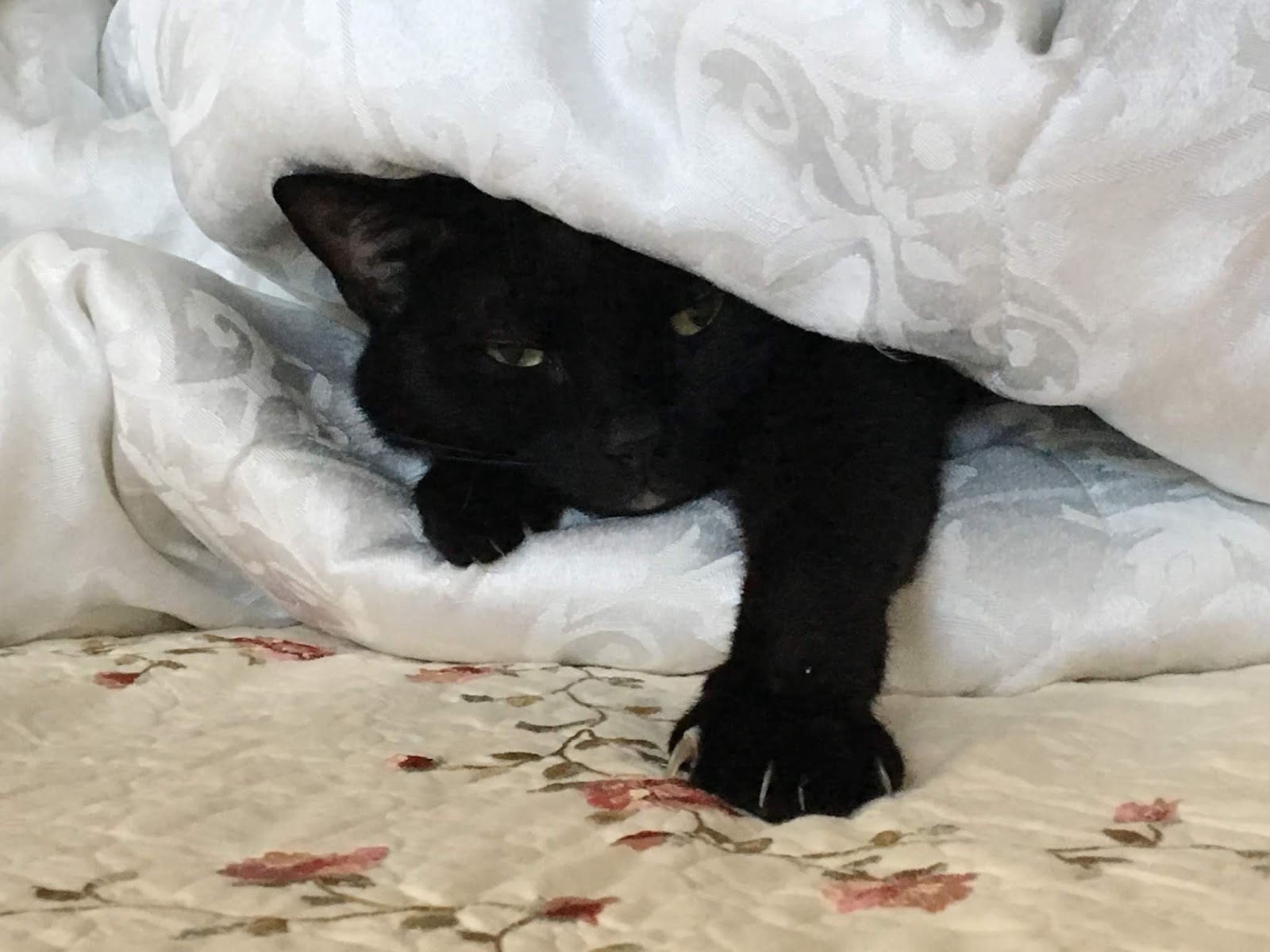
A Black Cat Comes


Snow in the Suburbs

Every branch big with it,
Bent every twig with it;
Every fork like a white web-foot;
Every street and pavement mute:
Some flakes have lost their way, and grope back upward when
Meeting those meandering down they turn and descend again.
The palings are glued together like a wall,
And there is no waft of wind with the fleecy fall.

A sparrow enters the tree,
Whereon immediately
A snow-lump thrice his own slight size
Descends on him and showers his head and eye
And overturns him,
And near inurns him,
And lights on a nether twig, when its brush
Starts off a volley of other lodging lumps with a rush.

The steps are a blanched slope,
Up which, with feeble hope,
A black cat comes, wide-eyed and thin;
And we take him in.


by Thomas Hardy

Many thanks to Gerry's Auntie Jan for introducing us to
this great restaurant, the above poem by Thomas Hardy,
and "London Snow" by Robert Bridges
The Cat Inn & Pub in West Hoathly, England
Purr-fect for a pre-Christmas lunch on a sunny winter day!

Monday, February 11, 2019

All Night It Fell

Lafayette ~ West Lafayette Pedestrian Bridge
Photo by Ben McCartney

Photos from Indiana . . .
poem from England:
London Snow (1890)

When we were all asleep the snow came flying,
In large white flakes falling on the city brown,
Stealthily and perpetually settling and loosely lying,
Hushing the latest traffic of the drowsy town;
Deadening, muffling, stifling its murmurs failing;
Lazily and incessantly floating down and down:
Silently sifting and veiling road, roof and railing;
Hiding difference, making unevenness even,
Into angles and crevices softly drifting and sailing.


All night it fell, and when full inches seven
It lay in the depth of its uncompacted lightness,
The clouds blew off from a high and frosty heaven;
And all woke earlier for the unaccustomed brightness
Of the winter dawning, the strange unheavenly glare:
The eye marvelled—marvelled at the dazzling whiteness;
The ear hearkened to the stillness of the solemn air;
No sound of wheel rumbling nor of foot falling,
And the busy morning cries came thin and spare.
Then boys I heard, as they went to school, calling,
They gathered up the crystal manna to freeze
Their tongues with tasting, their hands with snowballing;
Or rioted in a drift, plunging up to the knees;
Or peering up from under the white-mossed wonder,
‘O look at the trees!’ they cried, ‘O look at the trees!’


With lessened load a few carts creak and blunder,
Following along the white deserted way,
A country company long dispersed asunder:
When now already the sun, in pale display
Standing by Paul’s high dome, spread forth below
His sparkling beams, and awoke the stir of the day.
For now doors open, and war is waged with the snow;
And trains of sombre men, past tale of number,
Tread long brown paths, as toward their toil they go:
But even for them awhile no cares encumber
Their minds diverted; the daily word is unspoken,
The daily thoughts of labour and sorrow slumber
At the sight of the beauty that greets them, for the charm they have broken.


by Robert Bridges (1844 – 1930)
Britain's Poet Laureate: 1913 - 1930
Another lovely poem by Robert Bridges:
"Noel: Christmas 1913" ~ sung by John Denver


Friday, February 8, 2019

An Eternal February Day

Children Skating by Percy Tarrant (1855 - 1934)
~ father of the artist Margaret Tarrant (1888 - 1959) ~

~~~~~~~~~~~~~~~~~~~~~~~~~~~

A few years ago, I wrote this note:

Dear Poetical Friends,

I've been trying to track down a poem that I've misplaced and thought and thought I'd check with you in case you recognize the reference. I'm almost certain that the title is "Feast Day." The narrator is a woman who is feeling sad on the first day of her period, and the concluding line is "languorous blood." Does that happen to ring any bells? I remember reading it back in the late 1970s, early 80s, but can't remember where.

I've looked through all my old anthologies and notebooks but can't find it; and I've tried numerous google searches with no luck. I can't remember the poet, but vaguely thought that it might be Joyce Carol Oates. It seems to me that in the middle of the poem, she is looking out of a large window, watching children ice - skating on a pond and feeling fearful of their safety, but it could also be that I've borrowed that skating image from another forgotten poem -- something else I need to find! -- and merged it with the "Feast Day" poem in my mind.

Any clues?

~~~~~~~~~~~~~~~~~~~~~~~~~~~

Today I found the poems!

In New Letters: Volume 45 No. 2 (winter, 1978):

Feast Day

Today,
under the spell
of fat raindrops splattering the window
streaming down
blindly
with shameful eagerness --

Today, a feast
of rich overripe pulpy blood,
stagnant-smelling,
a swamp heaving tides of dragonflies and lichen
and fetid clots like exclamations

In disguise,
today,
as rusted blood,
thick and warm and sluggish,
your life begins to inch from you

Changed in the night
to liquid that trembles finely
in a jar of skin
eager to break
and flow to tarantula-sized shapes --
the unspeakable satisfaction
of the belly's hurt
wanting no love,
the thrumming ache of the womb
as it stirs to life
by dying

And the body's blush of fear
that it might this time bleed
away to death --

Still, you turn weak and selfish,
you want the sky to bleed black,
the rain to fall heavily
through the floorboards
where bits of straw and dirt
will float --
you are a scattering of noisy birds
drawn back suddenly to earth

a great beast of a bloodstain
lazy and sweetly - aching
sprawling across the sky

A woman, a fever: the sour hot bliss
of garbagey languorous blood


Winter Landscape: Children Teasing Death

Raucous as winter crows the children edge to the ice's rim
throwing fist - sized rocks of ice -- why? -- into the river
as their shrieks lead them out
their ignorance exploding like joy
their simple blunt souls steaming from their mouths

The sun, Heraclitus declared, measures one foot wide

The piano's note are waiting, tensed, in your fingertips
the lung filled to bursting with black water is waiting
beneath the ice

Overhead? A sky of blurred newsprint,
an eternal January day
that must be learned a syllable at a time

Well, if the ice cracks you are the only witness
you are the one who must save them
if the children fall screaming to their deaths you are the one
who must haul them back

The miracle won't happen --

Alone behind the steamy pane you stare, and listen
to their shouts
as death calls them and they inch outward
gay and raucous as the blackest of fluttery crows

You'll run out into the freezing air as unprepared --

The children are your own? Are you?
No. Nor are they metaphor: boldly, they are real
and the children of strangers
who don't even know your name.

The children will drown, then; it is their right
You are not their future, staring from your house
you might as well be King Pentheus, in women's clothes,
caught like a fool atop a tree

Death teases them out from shore and their cries mock death
and the day is anyway like every other
tundra-hard and dry and cruel
and it's pointless to fear disaster, a friend once said, since
the ones that happen are never
the ones you expect or deserve


both poems by Joyce Carol Oates (b. 1938)

~~~~~~~~~~~~~~~~~~~~~~~~~~~

Our Reindeer Sleigh by Arthur Hopkins (1848 - 1930)
~ brother of poet Gerard Manley Hopkins (1844 - 1889) ~

Tuesday, February 5, 2019

Larry Levis & the Pepsi Ad Girls


Years ago, I was lucky enough to hear Larry Levis give a reading, when I was an undergraduate in Missouri. I wrote three of his poems down in my notebook (Fall 1976) and have never forgotten them.

1. First, you may remember this one from a previous blog post:
We'll go on as always harvesting walnuts
on our hands and knees,
and die voicelessly
as a sedan full of cigar smoke
sinking under a bridge.
We'll turn slowly, flowers
in the mouths of drowned cattle
In a dawn of burned fields,
the sun disappoints you,
and the blight you begin to remember
is me.
Like an Alp overlooking a corpse
I explain nothing.

2. Next comes the second half of a poem entitled "Rhododendrons." For the entire poem, check out this essay, and this poetry blog which, like mine, strives to make connections.

Levis wishes he could offer a helping hand. Though he would have been only 30 when I heard him read this poem, he thinks back to himself at 20 and longs to connect with that ghostly young man, in need of money and sleep:
As I write this,
some blown rhododendrons are nodding
in the first breezes. I want
to resemble them, and remember nothing,
the way a photograph of an excavation
cannot remember the sun.
The wind rises or stops
and it means nothing.
I want to be circular;
a pond or a column of smoke
revolving, slowly, its ashes.
I want to turn back and go up
to myself at age 20,
and press five dollars into his hand

so he can sleep.
While he stands trembling on a street in Fresno,
suddenly one among many in the crowd
that strolls down Fulton Street,
among the stores that are closing,
and is never heard of again.

3. Finally, in "The Double," Levis evokes "the elderly drunks" and "the girl in the Pepsi ad," all "dead now." Sadly, very sadly, the poet who wrote those words is dead now too, for Larry Levis died young, in 1996 at age 49. In a poem filled with ghosts, the poet says, "This poem so like me / it could be my double":
The Double

Out here, I can say anything.
I can say, for example, that a girl
disappearing tonight
will sleep or stare out
fixedly as the train moves her
into its adulthood of dust
and sidings.

I remember watching wasps
on hot evenings
fly heavily over chandeliers
in hotel lobbies.
They’ve torn them down, too.
And the elderly drunks
who seemed not to mind anything,
who seemed to look for change
in their pockets, as they gazed
at the girl in the Pepsi ad,
and the girl who posed for the ad,
must all be dead now.


I can already tell that this
is no poem to show you,
this love poem. It’s so
flat spoken and ignorable,
like the man chain smoking
who discovers he’s
no longer waiting for anyone,
and goes to the movies
alone each Saturday, and grins,
and likes them.
This poem so like the hour
when the street lights turn
amber and blink, and the calm
professor burns another book,
and the divorcee waters her one
chronically dying plant.

This poem so like me
it could be my double.


I have stood for a long time
in its shadow, the way I stood
in the shadow of a dead roommate
I had to cut down from the ceiling
on Easter break, when
I was young.

That night I put my car
in neutral, and cut the engine
and lights to glide downhill
and hear the wind rush over
the dead metal.
I had to know what it felt
like, and under the moon,
gaining speed, I wanted to slip
out of my body and be
done with it.

A man can give up smoking
and the movies, and live for years
hearing the wind tick over roofs
but never looking up from
his one page, or the tiny
life he keeps carving over and
over upon it. And when everyone
around him dies, he can move
a grand piano into
his house, and sit down
alone, and finally play,
certain that no one will
overhear him, though he plays
as loud as he can,
so that when the dead come
and take his hands off the keys
they are invisible, the way air
and music are not.
[emphasis added]

"Rhododendrons" and "The Double"
can be found in The Selected Levis

~~~~~~~~~~~~~~~~~

For further analysis of these poems
see my recent post

Ghost of the Girl in the Pepsi Ad

@ The Fortnightly Kitti Carriker
A literary blog of connection & coincidence;
custom & ceremony


1910 Pepsi Calendar Girls

Saturday, February 2, 2019

Jesus, Mary, and Joseph!

The Holy Family is like me --
they don't want to take down their Christmas decorations yet!

And I don't want to put away The Nativity Scene
or take down any of the trees.

But, hey, Jesus, Mary, and Joseph, it's time!
It's Candlemas ~ the Fortieth Day of Chistmas!

Nativity Scene Puzzle ~ 1975
Everyone in my family was already too old
for a 100 - piece kids' jigsaw, but I saw this at the
Hallmark store & thought it would make a fun family present.

Previous Candlemas Posts
Also Groundhog Day & Imbolc & James Joyce's Birthday

Wednesday, January 30, 2019

Think Globally Act Locally

Unity of Country Souvenir Silver Sculpture
one of my favorites
at the
President`s Center of Culture & Museum
Astana, Kazakhstan
[more from this museum]

**********************

D. Patrick Miller:

"The extent to which we think 'world peace' is possible is exactly the extent to which we think our own minds can someday be peaceful through and through. If we cannot understand why distant warring nations fight over territories, national pride, or religious beliefs, then we need look for insight no further than our fight for a parking space, the struggle to procure a prestigious position over our competitors, or the aggressive ministry to convert one more soul to our church."

**********************

Patricia Henley:

"They toss little scraps of origami wishes into the fire. June thinks she should wish for World Peace, but she doesn't. She wishes for Local Peace."

**********************

Denise Levertov
"We are the humans, men who can make;
whose language imagines mercy,
lovingkindness we have believed one another
mirrored forms of a God we felt as good . . .

nothing we do has the quickness, the sureness,
the deep intelligence living at peace would have."
**********************

Rotary Connection: "If Peace Was All We Had"

**********************

Maya Angelou:

"I believe that there lives a burning desire in the most sequestered private heart of every American, a desire to belong to a great country. I believe that every citizen wants to stand on the world stage and represent a noble country where the mighty do not always crush the weak and the dream of a democracy is not the sole possession of the strong."

Throwback Post: "On This Day"

**********************

Jill Jackson-Miller & Sy Miller
Let peace begin with me
Let this be the moment now
With every step I take
Let this be my solemn vow

To take each moment
And live each moment
To take each moment
And live each moment
To take each moment
And live each moment
In peace eternally

Let there be peace on earth
And let it begin with me

Let There Be Peace On Earth
Photo taken 4 December 2014

**********************

And lastly:

So sad to see such blatant racial profiling.
Was the intent really to raise awareness or merely to
stir up resentment and reinforce hurtful stereotypes?


See also:
A Song for MLK Day
Think Globally & Bee-Man

Sunday, January 27, 2019

The Cat Who Walked Alone

I came across this independent little churchyard cat
at the Parish of Saint Nicholas, Worth, England.

See the resemblance?
Click to Read Kipling's Story


Thursday, January 24, 2019

Sleeping at the Foot of the Bed

James B. Fuqua

Sleepin' at the Foot o' the Bed

Did ye ever sleep at the foot o' the bed
When the weather wuz whizzin' cold,
When the wind wuz a-whistlin' aroun' the house
And the moon wuz yeller ez gold,
And give yore good warm feathers up
To Aunt Lizzie and Uncle Fred --
Too many kinfolks on a bad, raw night
And you wuz sent to the foot o' the bed.
For some dern reason the coldest night of the season
And you wuz sent to the foot o' the bed.

I could allus wait till the old folks et
An then eat the leavin's with grace,
The teacher could keep me after school,
An' I'd still hold a smile on my face,
I could wear the big boys' wore-out clothes
er let sister have my sled,
But it allus did git my nanny goat
to have to sleep at the foot o' the bed;
There's not a location topside o' creation
That I hate like the foot o' the bed.

'Twuz fine enough when the kinfolks come --
the kids brought brand new games,
You could see how fat all the old folks wuz,
and learn all the babies names,
Had biscuits an' custard and chicken pie,
An allus got Sunday fed,
But you knowed dern well when nighttime come on
You wuz headed fer the foot of the bed;
You couldn't git by it, they was no use to try it,
You wuz headed fer the foot o' the bed.

They tell me that some folks don't know whut it is
To have company all over the place,
To rassel fer cover thru a long winter night
with a big foot setting in your face,
Er with cold toenails a-scratchin' your back
An a footboard a scrubbin' yore head;
I'll tell the wide world you ain't lost a thing
Never sleepin' at the foot o' the bed;
You can live jest as gladly an' die jest as sadly
'N' never sleep at the foot o' the bed.

I've done it, an' I've done it a many uv a time
In this land o' brave an' the free,
An' in this all-fired battle of life
It's done left its mark upon me,
Fer I'm allus a-strugglin' around at the foot
Instead of forgin' ahead,
An' I don't think it's caused by a doggone thing
But sleepin' at the foot o' the bed.
I've lost all my claim on fortune an' fame
A-sleepin' at the foot o' the bed.


Lyrics by Luther Patrick, 1894 – May 26, 1957
U.S. Representative from Alabama, author and radio commentator

Sung by Little Jimmy Dickens & Connie Smith
**************************

Similar themes and equally humorous:


The Napping House by Audrey & Don Wood

"Grandma's Feather Bed"
sung by John Denver
music & lyrics by Jim Connor

**************************

Fuqua, occasionally at the foot . . .

but more often than not,
sleeping in style at the head of the bed!

Monday, January 21, 2019

Dissertation, Early Draft

Unlike that dreary law school movie, these scribbled pages show the exhilarating side of the "Paper Chase." The intriguing ideas just kept coming non - stop, and I tried my best to jot them all down for future reference!

These old class notes, providing a sample of how my brain works, must be from one of the last classes I took before writing my dissertation, since it seems that all the main ideas are here! I re - discovered these forgotten pages folded inside my E. T. A. Hoffmann book, which I took off the shelf yesterday to compare a couple of different translations of "Nutcracker." You just never know what you'll come across when re -reading old favorites during the post - holiday season . . .
Additional comments on facebook . . .

Friday, January 18, 2019

Mary Oliver: Rest in Wonder

In Memoriam ~ Mary Oliver
10 September 1935 ~ 17 January 2019
Award - winning American poet and naturalist

1.
The first Mary Oliver poem I ever read,
during a phase of uncertainty:
from The Journey

One day you finally knew
what you had to do, and began,
though the voices around you
kept shouting
their bad advice--
though the whole house
began to tremble
and you felt the old tug
at your ankles.
"Mend my life!"
each voice cried.
But you didn't stop.
You knew what you had to do . . .

But little by little,
as you left their voices behind,
the stars began to burn
through the sheets of clouds,
and there was a new voice
which you slowly
recognized as your own,
that kept you company
as you strode deeper and deeper
into the world,
determined to do
the only thing you could do--
determined to save
the only life you could save
.
[emphasis added]

On my blog: November 25, 2009, June 7, 2011,
and January 25, 2016

2. Next came this one, a gift from
my introspective friend Celine:
from The Roses

. . . there is no end,
believe me! to the inventions of summer,
to the happiness your body
is willing to bear.


On my blog: July 28, 2009 & July 12, 2010

3. Observing the Autumnal Equinox:
from Lines Written in the Days of Growing Darkness

Every year we have been
witness to it: how the
world descends

into a rich mash, in order that
it may resume.


On my blog: September 23, 2011 & March 10, 2014
& September 22 2025

4. Celebrating the miraculous arrival
and inevitable departure of Spring:
from Peonies

The Peonies
This morning the green fists of the peonies are getting ready
to break my heart . . .

Do you love this world?
Do you cherish your humble and silky life?
Do you adore the green grass with its terror beneath?

Do you also hurry, half-dressed and barefoot, into the garden,
and softly,
and exclaiming of their dearness,
fill your arms with the white and pink flowers,

with their honeyed heaviness, their lush trembling,
their eagerness
to be wild and perfect for a moment, before they are
nothing forever?


On my blog: May 7, 2012 & May 23, 2015

5. Mary Oliver's "one wild and precious life":
from The Summer Day

I don't know exactly what a prayer is.
I do know how to pay attention, how to fall down
into the grass, how to kneel down in the grass,
how to be idle and blessed, how to stroll through the fields,
which is what I have been doing all day.
Tell me, what else should I have done?
Doesn't everything have to die at last, and too soon?
Tell me, what is it you plan to do
with your one wild and precious life?
[emphasis added]

On my blog: July 8, 2012 & July 12, 2025

6. Searching for the Quotidian:
from Whelks, Goldfinches, Poppies, Winter,
Hummingbird Pauses at the Trumpet Vine,
October


All my life
I have been restless --
I have felt there is something
more wonderful than gloss --
than wholeness --
than staying at home.

I have not been sure what it is.

*****

every year
the hatchlings wake . . .

and love the world.
Is it necessary to say anymore?
Have you heard them singing in the wind,
above the final fields?
Have you ever been so happy in your life?

*****

of course
loss is the great lesson.

But also I say this: that light
is an invitation
to happiness
and that happiness,
when it's done right,
is a kind of holiness.

*****

in this world I am as rich
as I need to be.

*****

Look! for most of the world
is waiting
or remembering --
most of the world is time
when we're not here,

*****

Look, I want to love this world
as though it's the last chance I'm ever going to get
to be alive
and know it.


On my blog: October 24, 2012

7. Acknowledging our humble place in the Animal Kingdom:
from Her Grave

A dog can never tell you what she knows from the
smells of the world, but you know, watching her,
that you know
almost nothing.


On my blog: November 28, 2012 & November 29, 2012


8. Mary Oliver paid all species of fauna and flora their due:
from The Sunflowers

Don't be afraid
to ask them questions!
. . . the long work
of turning their lives
into a celebration
is not easy.


On my blog: August 21, 2013

9. From among so many treasures,
this brief poem remains my favorite.
Yes, this is the entire poem:
The Uses of Sorrow

(In my sleep I dreamed this poem)

Someone I loved once gave me
a box full of darkness.

It took me years to understand
that this, too, was a gift.


On my blog: March 21, 2015 & March 29, 2015

10. Vocation and avocation:
from Messenger

My work is loving the world.
Here the sunflowers, there the hummingbird . . .

Are my boots old? Is my coat torn?
Am I no longer young, and still not half-perfect? Let me
keep my mind on what matters,
which is my work,

which is mostly standing still and learning to be
astonished
.
[emphasis added]

On my blog: April 28, 2016 & May 3, 2016

11. Not only did Mary Oliver the world,
but it also loved her back:
from The Fist

Instead: such patience!
Such willingness

to let us continue!
To hear,
little by little,
the voices -

only, so far, in
pockets of the world -
suggesting the possibilities
of peace?


On my blog: May 24, 2016

12. Writing of her little puppy,
but just as true for my little sons:
from "Percy (Seven)"

Ah, this is the thing that comes to each of us.
The child grows up.
And, according to our own ideas, is practically asunder.

I understand it.
I struggle to celebrate.
I say, with a stiff upper lip familiar to many:

Just look at that curlyhaired child now,
he’s his own man.


On my blog: June 2, 2016

13. And lastly, a poem for the winter, about snow, about saving
yourself and putting "your own life in proportion." In is entirety:
Logan International

In the city called Wait,
also known as the airport,
you might think about your life --
there is not much else to do.
For one thing,
there is too much luggage,
and you're truly lugging it --
you and, it seems, everyone.

What is it, that you need so badly?
Think about this.

Earlier, in another city,
you're on the tarmac, a lost hour.
You're going to miss your connection, and you know it,
and you do.
You're headed for five hours of nothing.
And how long can you think about your own life?

What I did, to save myself,
was to look for children, the very young ones
who couldn't even know where they were going, or why.
Some of them were fussing, of course.
Many of them were beautifully Hispanic.

The storm was still busy outside, and snow falling
anywhere, any time, is a wonder.
But even more wonderful, and maybe the only thing
to put your own life in proportion
,
were the babies, the little ones, hot and tired,
but still
gurgling, chuckling, as they looked --
wherever they were going, or not yet going,
in their weary parents' arms (no!
their lucky parents' arms) --
upon this broken world.
[emphasis added]

On my blog: May 28, 2016
PS.
“Instructions for living a life.
Pay attention.
Be astonished.
Tell about it.”

from the poem "Sometimes"
in the collection Red Bird

Rest in Peace Mary Oliver,
Rest in Wonder, Rest in Astonishment!

14. Morning Glory

15. The Ordinary Daily Presentations & Mindful

16. The Peonies Have Their Day

17. Grasshopper ~ Praying Mantis

18. Black River of Loss

Tuesday, January 15, 2019

Resolutions for the New Year

1. Start Fresh

2. Drink Deep

3. Run With the Wind*

4. Live in the "Golden Envelope of Light"**


Spiced Coffee at Town & Gown Bistro

"Gilgamesh, whither rovest thou?
The life thou pursuest thou shalt not find.
When the gods created humankind,
Death for us they set aside,
Life in their own hands retaining.
Thou, Gilgamesh, let full be thy belly
Make thou merry by day and by night.
Of each day make thou a feast of rejoicing,
Day and night dance thou and play
Let thy garments be sparkling and fresh,
Thy head be washed, bathe thou in water.
Pay heed to the little one that holds thy hand,
Let thy spouse delight in thy bosom,
For this is the task of humankind.


~From The Epic of Gilgamesh ~ Tablet X
~Translated by E. A. Speiser
~~~~~~~~~~~~~~~~~

For additional New Year Poems:

*
"i am running into a new year" by Lucille ~ Clifton
and
** "in celebration of surviving" by Chuck Miller

see my current posts

Ghost of Myself

&

Ghost of the Girl in the Pepsi Ad

@ The Fortnightly Kitti Carriker
A literary blog of connection & coincidence;
custom & ceremony


~~~~~~~~~~~~~~~~~

Saturday, January 12, 2019

A Patience Larger Than Time

Three Grandmothers

After Epiphany . . . the Flight Into Egypt

Above:
Could these grandmothers be the Wise Ones,
departing "for their own country another way?"

Below:
Could this family's decision be to
"take the young child and . . . flee to Egypt?"
(Matthew 2: 12 - 14)

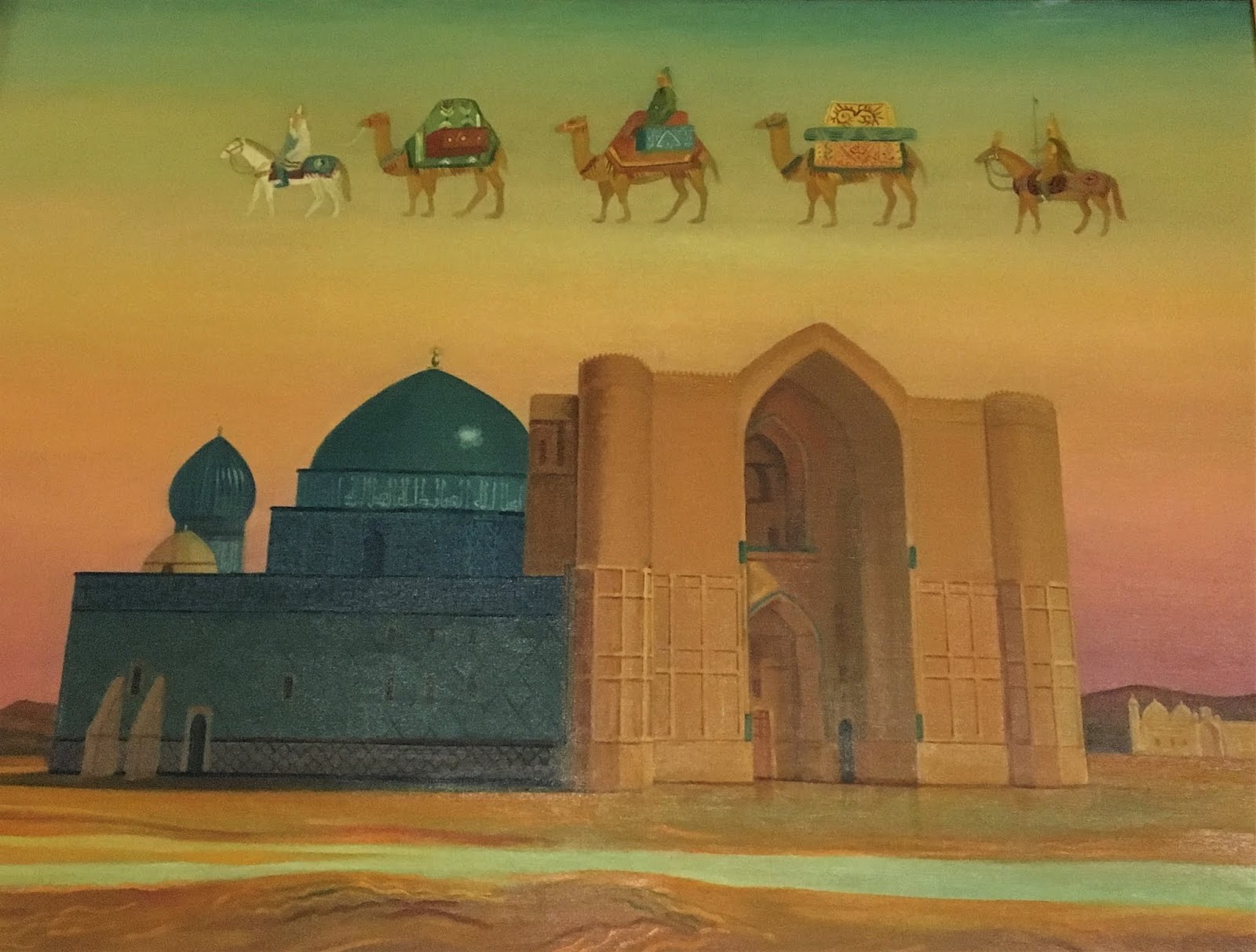
A Decision to Move

Both pantings by Yerbolat Tolepbay (b (1955)
At the National Museum of Kazakhstan

Neither look back upon Thy starry country,
Nor hear what rumors crowd across the dark . . .
Go, Child of God, upon the singing desert,
Where, with eyes of flame,
The roaming lion keeps thy road from harm . . .

~ Thomas Merton ~

****************

. . . O terrified birds in your nest,
Close wings on doubt, and rise, and come.
The corn shimmers with darkness, and the road
Is strong enough to bear the feet of God. . . .
. . . knowing at last . . .
A patience larger than time.

~ Vincent Buckley ~

Click to read more poems
about the flight into Egypt

****************

National Museum in Astana, Kazakhstan
By Night

By Day

Wednesday, January 9, 2019

Three More Wise Ones

Words of Ancestors ~ Bakhytzhan Myrzakhmetov
Canvas & oil, 1997
1. The Three Kings

Where do we go from here?
We left our country,
Bore gifts,
Followed a star.
We were questioned.
We answered.
We reached our objective.
We enjoyed the trip.
Then we came back by a different way.
And now the people are demonstrating in the streets.
They say they don’t need the Kings any more.
They did very well in our absence.
Everything was all right without us.
They are out on the streets with placards:
Wise Men? What’s wise about them?
There are plenty of Wise Men,
And who needs them?—and so on.

Perhaps they will be better off without us,
But where do we go from here?


~ Muriel Spark (1918 - 2006)
Silk Road ~ Sagyntai Alimbetov
Canvas & oil, 1998
2. Christmas Carol

The kings they came from out the south,
All dressed in ermine fine;
They bore Him gold and chrysoprase,
And gifts of precious wine.

The shepherds came from out the north,
Their coats were brown and old;
They brought Him little new-born lambs—
They had not any gold.

The wise men came from out the east,
And they were wrapped in white;
The star that led them all the way
Did glorify the night.

The angels came from heaven high,
And they were clad with wings;
And lo, they brought a joyful song
The host of heaven sings.

The kings they knocked upon the door,
The wise men entered in,
The shepherds followed after them
To hear the song begin.

The angels sang through all the night
Until the rising sun,
But little Jesus fell asleep
Before the song was done.


~ Sara Teasdale (1884- 1933)
Golden Steppes ~ Kazakbay Azhibekuly (b 1966)
Canvas & oil, 1997
3. St. Helen’s Prayer
to the Three Magi on the Feast of the Epiphany


Everyone in Jerusalem remarked on Helena’s vigour. The old lady was positively indefatigable, they all said. But in truth she was very weary. Winter set in. The convent was exposed, damp and chill. It was not thus, in Dalmatia, that she had planned her old age. She seemed to have come to the end of her questions. No one was helpful. No one was hopeful. At Christmas she had not the strength to ride out with the procession to Bethlehem. She went to communion in the convent chapel and that day allowed the nuns to make a fuss of her, spending the feast crouched over a wood fire which they lit for her in her room.

But by Twelfth Night she rallied and on the eve set out by litter along the five rough miles to the shrine of the Nativity. There was no throng of pilgrims. [Bishop] Macarius and his people kept Epiphany in their own church. Only the little community of Bethlehem greeted her and led her to the room they had prepared. She rested there dozing until an hour before dawn when they called her and led her out under the stars, then down onto the stable-cave, where they made a place for her on the women’s side of the small, packed congregation.

The low vault was full of lamps and the air close and still. Silver bells announced the coming of the three vested, bearded monks, who prostrated themselves before the altar. So the long liturgy began.

Helena knew little Greek and her thoughts were not in the words nor anywhere in the immediate scene. She forgot even her quest and was dead to everything except the swaddled child long ago and those three royal sages who had come from so far to adore him.

“This is my day, she thought, “and these are my kind.”

Perhaps she apprehended that her fame, like theirs, would live in one historic act of devotion; that she too had emerged from a kind of ‘ουτοπία’ [Utopia] or nameless realm and would vanish like them in the sinking nursery fire-light among the picture-books and the day’s toys.

“Like me,” she said to them, “you were late in coming. The shepherds were here long before; even the cattle. They had joined the chorus of angels before you were on your way. For you the primordial discipline of the heavens was relaxed and a new defiant light blazed among the disconcerted stars.

“How laboriously you came, taking sights and calculations, where the shepherds had run barefoot! How odd you looked on the road, attended by what outlandish liveries, laden with such preposterous gifts!

“You came at length to the final stage of your pilgrimage and the great star stood still above you. What did you do? You stopped to call on King Herod. Deadly exchange of compliments in which there began that unended war of mobs and magistrates against the innocent!

“Yet you came, and were not turned away. You too found room at the manger. Your gifts were not needed, but they were accepted and put carefully by, for they were brought with love. In that new order of charity that had just come to life there was room for you too. You were not lower in the eyes of the holy family than the ox or the ass.

“You are my especial patrons,” said Helena, “and patrons of all late-comers, of all who have had a tedious journey to make to the truth, of all who are confused with knowledge and speculation, of all who through politeness make themselves partners in guilt, of all who stand in danger by reason of their talents.

“Dear cousins, pray for me,” said Helena, “and for my poor overloaded son [the Emperor Constantine himself, who was still unbaptized]. May he, too, before the end find kneeling-space in the straw. Pray for the great, lest they perish utterly. And pray for Lactantius and Marcias and the young poets of Trèves and for the souls of my wild, blind ancestors; for their sly foe Odysseus and for the great Longinus.

“For His sake who did not reject your curious gifts, pray always for the learned, the oblique, the delicate. Let them not be quite forgotten at the Throne of God when the simple come into their kingdom.”


~ Evelyn Waugh (1903 - 1966)
from Chapter 9 ~ “Epiphany” ~ of his novel Helena
Thanks to Peter Bunder
for including this selection for Epiphany
in the Good Shepherd Bulletin
on Sunday, 14 January 2018

************************

All artwork above from the
President`s Center of Culture & Museum
Astana, Kazakhstan

************************

More Magi
Medellín Magi
Magi and Fruitcake
"The Magi" ~ Peter, Paul & Mary

Sunday, January 6, 2019

Medellín Magi

Huge Wise Ones from the Medellín Alumbrados ~ 2016

"Three for the kings
bringing gold, bringing myrrh, bringing incense . . . "

1. Song of the Camels
Not born to the forest are we,
Not born to the plain,
To the grass and the shadowing tree
And the splashing of rain.
Only the sand we know
And the cloudless sky.
The mirage and the deep-sunk well
And the stars on high.
To the sound of our bells we came
With huge soft stride,
Kings riding upon our backs,
Slaves at our side.
Out of the east drawn on
By a dream and a star,
Seeking the hills and the groves
Where the fixed towns are.
Our goal was no palace gate,
No temple of old,
But a child on his mother's lap
In the cloudy cold.
The olives were windy and white,
Dust swirled through the town,
As all in their royal robes
Our masters knelt down.


~ Elizabeth Coatsworth (1893 – 1986)


2. The Journey Of The Magi
A cold coming we had of it,
Just the worst time of the year

For a journey, and such a long journey:
The ways deep and the weather sharp,
The very dead of winter.
And the camels galled, sorefooted, refractory,
Lying down in the melting snow.
There were times we regretted
The summer palaces on slopes, the terraces,
And the silken girls bringing sherbet.
Then the camel men cursing and grumbling
and running away, and wanting their liquor and women,
And the night-fires going out, and the lack of shelters,
And the cities hostile and the towns unfriendly
And the villages dirty and charging high prices:
A hard time we had of it.
At the end we preferred to travel all night,
Sleeping in snatches,
With the voices singing in our ears, saying
That this was all folly.

Then at dawn we came down to a temperate valley,
Wet, below the snow line, smelling of vegetation;
With a running stream and a water-mill beating the darkness,
And three trees on the low sky,
And an old white horse galloped away in the meadow.
Then we came to a tavern with vine-leaves over the lintel,
Six hands at an open door dicing for pieces of silver,
And feet kicking the empty wine-skins.
But there was no information, and so we continued
And arriving at evening, not a moment too soon
Finding the place; it was (you might say) satisfactory.

All this was a long time ago, I remember,
And I would do it again, but set down
This set down
This: were we led all that way for
Birth or Death? There was a Birth, certainly
We had evidence and no doubt. I had seen birth and death,
But had thought they were different; this Birth was
Hard and bitter agony for us, like Death, our death.
We returned to our places, these Kingdoms,
But no longer at ease here, in the old dispensation,
With an alien people clutching their gods.
I should be glad of another death.


~ T. S. Eliot (1888 - 1965)
Collected Poems, 1909-1962
This poem has been shared here under fair use guidelines.


3. The Meeting Place
(after Rubens: The Adoration of the Magi, 1634)
It was the arrival of the Kings
that caught us unawares;

we'd looked on the woman in the barn,
curiosity you could call it,
something to do on a cold winters night;
we'd wished her well—
that was the best we could do, she was in pain,
and the next thing we knew
she was lying on the straw
—the little there was of it—
and there was a baby in her arms.

It was as I say the Kings
that caught us unawares—
Women have babies every other day,
not that we are there—
lets call it a common occurrence though,
giving birth. But Kings
appearing in a stable with a
'Is this the place?' and kneeling,
each with his gift held out towards the child!

They didn't even notice us.
Their robes trailed on the floor,
rich, lined robes that money couldn't buy.
What must this child be
to bring Kings from distant lands
with costly incense and gold?
What could a tiny baby make of that?

And what were we to make of it?
was it angels falling through the air,
entwined and falling as if from the rafters
to where the gaze of the Kings met the child's
—assuming the child could see?

What would the mother do with the gift?
What would become of the child?
And we'll never admit there are angels

or that between one man's eye and another's
is a holy place, a space where a king could be
at one with a naked child,
at one with an astonished soldier.


~ Christopher Pilling (b 1936)
[I first heard this poem, given as a reading
entitled "A Soldier’s Recollection," at
Ex Cathedra, 21 Dec 2017, Birmingham, UK]

More Magi
Three More Wise Ones
Magi and Fruitcake
"The Magi" ~ Peter, Paul & Mary

Thursday, January 3, 2019

The Sun Returns

Sunrise on the 10th Day of Christmas

The Winter Solstice was two weeks ago and Earth's perihelion is today. Is it just a coincidence that the Earth is closest to the Sun a mere two weeks after the shortest day? Yes, mostly, kind of. It was not ever thus; it will not be ever so, just as the North Star will not always be Polaris, no matter how constant it may seem to be in our day and age.

I'm reminded of that mystical line in "Hark, the Herald Angels Sing," when the Messiah arrives "Late in time." Or even better, the closing stanza of "It Came Upon the Midnight Clear":

For lo!, the days are hastening on,
By prophet bards foretold,
When with the ever-circling years
Comes round the age of gold . . .

(Wikipedia & The New Oxford Book of Carols give this version)

For lo! the days are hastening on,
By prophets seen of old,
When with the ever-circling years
Shall come the time foretold . . .

(this version from the Episcopal Hymnal &
The Reader's Digest Merry Christmas Songbook)

Lyrics by Edmund H. Sears (1810 - 1876)

Peter, Paul, and Mary capture the mystery in their prophetic lyrics:

And the wisemen spoke of peace on earth,
Of harmony and struggle.
Know you now a cycle's gone and a new one is revealed
In the weaving of your fingers . . .

We are "invited by our culture and by the shortened days to a time of reflection" (Peter Bunder). On one of the darkest nights, the Child is born. Fast away the old year passes, and the days hasten on. A fortnight later, the Wise Men arrive, the days lengthen visibly, and we shift our focus to yet another ever - circling year.