Showing posts sorted by relevance for query All Souls. Sort by date Show all posts

Monday, November 2, 2020

A Bonfire for All Souls

All Souls Night

Bonfires dot the rolling hills
Figures dance around and around
To drums that pulse out echoes of darkness
Moving to the pagan sound

Somewhere in a hidden memory
Images float before my eyes
Of fragrant nights of straw and of bonfires
And dancing till the next sunrise

I can see lights in the distance
Trembling in the dark cloak of night
Candles and lanterns are dancing, dancing
A waltz on All Souls Night

Figures of cornstalks bend in the shadows
Held up tall as the flames leap high
The green knight holds the holly bush
To mark where the old year passes by

I can see the lights in the distance
Trembling in the dark cloak of night
Candles and lanterns are dancing, dancing
A waltz on All Souls Night

Bonfires dot the rolling hillsides
Figures dance around and around
To drums that pulse out echoes of darkness
And moving to the pagan sound

Standing on the bridge that crosses
The river that goes out to the sea
The wind is full of a thousand voices
They pass by the bridge and me

I can see the lights in the distance
Trembling in the dark cloak of night
Candles and lanterns are dancing, dancing
A waltz on All Souls Night


Music & lyrics by Loreena Mckennitt (b 1957)
Canadian singer - songwriter
It was completely dark when I took these pictures,
but somehow I unintentionally captured
more light than expected.
Happy Blue Halloween Moon!
All Saints Moonrise

Wednesday, November 2, 2016

Soul Cakes

The Cider Mill, 1880
John George Brown, 1831 -1913

Back in Medieval times, back before Halloween candy, there were Soul Cakes. The cakes had a twofold purpose -- an offering for the dead who might be back to visit; and a refreshment for the soulers who came a'souling from door to door (like trick - or - treaters / Christmas carolers), offering prayers and songs in return for treats. The prayerful Hallowmas Season comprised three consecutive holidays: Halloween (aka All Hallows' Eve) on October 31, All Saints' Day (aka All Hallows') on November 1, and All Souls' Day on November 2.

On their Holiday Celebration Album, Peter, Paul, and Mary sing a jolly good rendition, rousing but with a hint of ancient mystery. I have not yet discovered why they alter the spelling from soulin' to soalin' -- perhaps to avoid some taboo of invoking the dead souls from beyond the grave.


A Soalin'

Hey ho, nobody home, meat nor drink nor money have I none
Yet shall we be merry, Hey ho, nobody home.
Hey ho, nobody home, Meat nor drink nor money have I none
Yet shall we be merry, Hey ho, nobody home.
Hey Ho, nobody home.

Soal, a soal, a soal cake, please good missus a soul cake.
An apple, a pear, a plum, a cherry,
any good thing to make us all merry,
One for Peter, two for Paul, three for Him who made us all.

God bless the master of this house, and the mistress also
And all the little children that round your table grow.
The cattle in your stable and the dog by your front door
And all that dwell within your gates
we wish you ten times more.

Soal, a soal, a soal cake, please good missus a soul cake.
An apple, a pear, a plum, a cherry,
any good thing to make us all merry,
One for Peter, two for Paul, three for Him who made us all.

Go down into the cellar and see what you can find
If the barrels are not empty we hope you will be kind
We hope you will be kind with your apple and strawber'
For we'll come no more a 'soalin' till this time next year.

Soal, a soal, a soal cake, please good missus a soul cake.
An apple, a pear, a plum, a cherry,
any good thing to make us all merry,
One for Peter, two for Paul, three for Him who made us all.

The streets are very dirty, my shoes are very thin.
I have a little pocket to put a penny in.
If you haven't got a penny, a ha' penny will do.
If you haven't got a ha' penny then God bless you.

Soal, a soal, a soal cake, please good missus a soul cake.
An apple, a pear, a plum, a cherry,
any good thing to make us all merry,
One for Peter, two for Paul, three for Him who made us all.

Now to the Lord sing praises all you within this place,
And with true love and brotherhood each other now embrace..
This holy tide of Christmas of beauty and of grace,
Oh tidings of comfort and joy.


" . . . we'll come no more a 'soalin'
till this time next year . . . "

In addition to singing along with Peter, Paul, and Mary in the car, Ben and Sam got to experience the Soul Cake tradition firsthand as students at St. Peter's School in Philadelphia. Halloween Day was celebrated in the conventional way, with costumes, apple cider and donuts; All Saints Day was pretty much business as usual; then came All Souls Day with an all - school circle dance before school and the ceremonious distribution of "Soul Cakes" -- unceremoniously referred to by Sam as "stupid store - bought gingersnaps."

I tried to rectify the situation by baking a more authentic batch of Mrs. Sharp's Soul Cakes. These were not a big hit with the children. But that was fifteen years ago, so maybe it's time to try another batch:

Cream together:
1 cup butter
1 cup sugar

Beat in:
3 eggs

Add & mix:
1 teaspoon vanilla extract
1 teaspoon lemon extract

Sift & add to butter mixture:
4 cups flour
1 teaspoon cinnamon
1 teaspoon nutmeg
1 teaspoon allspice

Stir in:
1/2 cup currants

Add to soften:
1/2 cup milk

Form into flat cakes & place on greased cookie sheet.
Bake for 15 minutes or until golden brown.

****************

Some Modern - Day Soul Cakes
Everybody's Favorite Homemade Gingersnaps!

Thursday, November 2, 2017

Allerseelen

Four Trees / Vier Baume, 1917 ~ Egon Schiele, 1890 - 1980

From Missouri Photographer Jay Beets:
"Trees in the Sunrise two mornings ago . . .
the painting reminded me of them . . . "


All Souls' Day / Allerseelen

Place on the table the fragrant mignonettes,
Bring in the last red asters,
and let us talk of love again,
as once we did in May.

Give me your hand, so that I may secretly press it;
and if someone sees, it's all one to me.
Just give me one of your sweet glances,
as once you did in May.

Flowers bloom and spread their fragrance today on every grave;
one day in the year is sacred for the dead.
Come close to my heart, so that I can have you again,
as once I did in May.


by the Austrian poet Hermann von Gilm (1812 - 1864)
set to music in 1885 by Richard Strauss (1864 - 1949)

This beautiful song for The Day of All Souls first came to may attention in the 1984 film of Malcolm Lowry's novel Under the Volcano, which takes place in Mexico on November 2nd, aka: All Souls Day or Allerseelen; The Day of the Dead or Dia de los Muertos.

Alternate translation for stanzas 1 & 3:

Place on the mound sweet mignonette before us,
The last red blooming asters hither bring
Let memr'y's charm our early love restore us
As once in Spring.

How sweetly blooms each grave with fragrant flowers
Sacred to all souls of our dead, this day,
Come to my heart, through all the blessed hours
As once in May

In his eerie "November" dirge, contemporary American Tom Waits provides an interesting comparison to the German love song. As von Gilm hearkens back to May at the conclusion of each stanza, so Waits calls out to April for rescue from bleak November's skeletal imagery:

Black & White / Color

November

No shadow
No stars
No moon
No care
November
It only believes
In a pile of dead leaves
And a moon
That's the color of bone

No prayers for November
To linger longer
Stick your spoon in the wall
We'll slaughter them all

November has tied me
To an old dead tree
Get word to April
To rescue me
November's cold chain

Made of wet boots and rain
And shiny black ravens
On chimney smoke lanes
November seems odd
You're my firing squad
November

With my hair slicked back
With carrion shellac
With the blood from a pheasant
And the bone from a hare

Tied to the branches
Of a roebuck stag
Left to wave in the timber
Like a buck shot flag

Go away you rainsnout
Go away, blow your brains out
November


Tom Waits, b 1949
Singer-songwriter, composer, actor, poet

Related Article for
Día de los Muertos:
"A Brief History of the ‘Danse Macabre’"

Sunday, November 2, 2025

Overthinking on All Souls

Farewell All Hallows ~ All Saints ~ All Souls
Halloween in Scotland ca 1911
by William Stewart MacGeorge (1861–1931)

Two Readings for All Souls Day

An eerie thought: year after year as we cycle through the months, we encounter the day that eventually will become the date of our death. We skim right over it, never giving it a thought. How could we? It would take morbid Thomas Hardy (or one of his characters) to think of that:
She philosophically noted dates as they came past in the revolution of the year . . . her own birthday; and every other day individualized by incidents in which she had taken some share. She suddenly thought one afternoon, when looking in the glass at her fairness, that there was yet another date, of greater importance to her than those; that of her own death, when all these charms would have disappeared; a day which lay sly and unseen among all the other days of the year, giving no sign or sound when she annually passed over it; but not the less surely there. When was it? Why did she not feel the chill of each yearly encounter with such a cold relation? . . . some time in the future those who had known her would say: 'It is the ——th, the day that poor Tess Durbeyfield died'; and there would be nothing singular to their minds in the statement. Of that day, doomed to be her terminus in time through all the ages, she did not know the place in month, week, season or year.

from Chapter 15
of Tess of the d'Urbervilles: A Pure Woman
by Thomas Hardy

Another overthinking pitfall is the dreaded insomnia rabbit hole. The moon rolls by, the hours roll by, memory after memory . . .
“Oh God, midnight’s not bad, you wake and go back to sleep, one or two’s not bad, you toss but sleep again. Five or six in the morning, there’s hope, for dawn’s just under the horizon. But three, now, Christ, three A.M.! Doctors say the body’s at low tide then. The soul is out. The blood moves slow. You’re the nearest to dead you’ll ever be save dying. Sleep is a patch of death, but three in the morn, full wide-eyed staring, is living death! You dream with your eyes open. God, if you had strength to rouse up, you’d slaughter your half-dreams with buckshot! But no, you lie pinned to a deep well-bottom that’s burned dry. The moon rolls by to look at you down there, with its idiot face. It’s a long way back to sunset, a far way on to dawn, so you summon all the fool things of your life, the stupid lovely things done with people known so very well who are now so very dead – And wasn’t it true, had he read somewhere, more people in hospitals die at 3 A.M. than at any other time . . .” (p 58)

from Something Wicked This Way Comes
by Ray Bradbury

Additional Autumnal Ray Bradbury:
The Halloween Tree ~ Moundshroud
The Pedestrian ~ from Dandelion Wine
On Facebook ~ August 26

Saturday, November 2, 2013

The Great Divide

At the local cemetery on All Souls Day: from dust thou art . . .
"Remember, O Thou Man"*

“So live your life that the fear of death can never enter your heart. Trouble no one about their religion; respect others in their view, and demand that they respect yours. Love your life, perfect your life, beautify all things in your life. Seek to make your life long and its purpose in the service of your people. Prepare a noble death song for the day when you go over the great divide. Always give a word or a sign of salute when meeting or passing a friend, even a stranger, when in a lonely place. Show respect to all people and grovel to none. When you arise in the morning give thanks for the food and for the joy of living. If you see no reason for giving thanks, the fault lies only in yourself. Abuse no one and no thing, for abuse turns the wise ones to fools and robs the spirit of its vision.

When it comes your time to die, be not like those whose hearts are filled with the fear of death, so that when their time comes they weep and pray for a little more time to live their lives over again in a different way. Sing your death song and die like a hero going home.”

Chief Tecumseh, 1768 - 1813
Shawnee Nation, Indiana

Similarly, Canadian singer and composer Loreena McKennitt
sings of "the great divide":

"Standing on the bridge that crosses
The river that goes out to the sea
The wind is full of a thousand voices
They pass by the bridge and me
"

from "All Souls Night"
words & music by Loreena McKennitt

You can find this song on her CD The Visit, perfect for this time of year and for this triumvirate of haunting mystic holidays: Halloween, All Saints, and All Souls. If you find yourself filled with seasonal sadness, McKennitt's music may not exactly cheer you up, but it will enter your heart.

* Also a good song for Lent.

Autumnal Grave Decorations

Monday, November 2, 2009

Day of the Dead

Sunnyside Cemetery on Thanksgiving Day 2007
Caney, Kansas

In Barbara Kingsolver's sad but magical novel Animal Dreams, the narrator, Codi Noline, joins the people of Grace, Arizona, for "the town's biggest holiday, the Day of All Souls." They walk together to the cemetery to weed and tend the family graves, decorate with marigolds, and enjoy the traditional skull-shaped candies with the children:

"It was the bittersweet Mexican holiday, the Day of the Dead, democratic follow-up to the Catholic celebration of All Hallows. Some people had business with the saints on November 1, and so went to mass, but on November 2, everybody had business at the graveyard." (158 - 59)

Whenever November 2nd and May 30th roll around, I always wish I lived nearer to the cemeteries where most of my loved ones and ancestors are buried so that I too could pay a visit and decorate the graves in the time - honored fashion. When I was growing up, months and months might pass between visits to our grandparents, but we never missed Thanksgiving or Memorial Day weekend.

No matter what the weather, on Memorial Day we spent a good part of the day at the cemetery, attending various ceremonies and speeches in honor of the Veterans and the War Dead; placing wreathes and potted plants; sometimes even planting flowers that would bloom throughout the summer. Nobody really says "Decoration Day" anymore, but that's what I remember calling it when I was small -- because we decorated! If I was lucky enough to spend a week or two of summer vacation with my grandparents, we spent the evenings one of two ways -- sitting on the porch or taking a walk to Sunnyside Cemetery. Those were happy times for me, tagging along, picking stray flowers, and listening to the old stories about those at rest there.

At Thanksgiving, when the cemetery was bare and empty -- no parades, podiums or bands; very few visitors, very few flowers -- even then we didn't miss the opportunity to wander from grave to grave, paying our respects. I guess that was our Midwestern way of observing All Souls -- just three or four weeks late.

These days, I live only a few blocks from the nearest local cemetery and can spend a reflective hour there anytime, thinking of the old days, reading the names of strangers, but it's not quite the same. As Codi says:

"More than anything else I wished I belonged to one of these living, celebrated families, lush as plants, with bones in the ground for roots. I wanted pollen on my cheeks and one of those calcium ancestors to decorate as my own." (165)

*******************

And this from Ray Bradbury's The Halloween Tree: "It's both happy and sad. It's all firecrackers and skeleton toys down here in the plaza and up in that graveyard now are all the Mexican dead folks with the families visiting and flowers and candles and singing and candy. I mean it's almost like Thanksgiving, huh? And everyone set down to dinner, but only half the people able to eat, but that's no mind, they're THERE. It's like holding hands at a séance with your friends, but some of the friends gone."
(118 - 19)

Sunday, November 7, 2021

All Souls Observed

What better way to observe All Souls Day than with a Baptism, to honor the dearly departed with a celebration of the newly arrived.

For the past year, I have been filling notebook after notebook with letters, photographs, receipts, and certificates from parents, grands, greats, and beyond. Between these clear protector sheets reside The Dead. Over a century ago, poet Edith M. Thomas (1854 - 1925) asked the haunting question:

"Heart throb, heart throb, wonder past knowing,
Where did you come from, where are you going?"

The following poem answers solemnly that the dead have gone nowhere, "They are about us always . . . ":

Nothing is Lost

Nothing is lost.
We are too sad to know that, or too blind;
Only in visited moments do we understand:
It is not that the dead return ---
They are about us always, though unguessed.

This penciled Latin verse
You dying wrote me, ten years past and more,
Brings you as much alive to me as the self you wrote it for,
Dear father, as I read your words
With no word but Alas.

Lines in a letter, lines in a face
Are the faithful currents of life: the boy has written
His parents across his forehead, and as we burn
Our bodies up each seven years,
His own past self has left no plainer trace.

Nothing dies.
The cells pass on their secrets, we betray them
Unknowingly: in a freckle, in the way
We walk, recall some ancestor,
And Adam in the color of our eyes.


Yes, on the face of the new born,
Before the soul has taken full possession,
There pass, as over a screen, in succession
The images of other beings:
Face after face looks out, and then is gone.

Nothing is lost, for all in love survive.
I lay my cheek against his sleeping limbs
To feel if he is warm, and touch in him
Those children whom no shawl could warm,
No arms, no grief, no longing could revive.

Thus what we see, or know,
Is only a tiny portion, at the best,
Of the life in which we share; an iceberg’s crest
Our sunlit present, our partial sense,
With deep supporting multitudes below.


Anne Barbara Ridler (1912 - 2001)
Iceberg: Above & Below

Friday, November 2, 2012

Cempasuchil

Cempasuchil ~ The Marigold
[sem-pa-soo-cheel]

On a day like today, you can find many beautiful images of the marigold (flor de muerto) and its celebratory role in observations of the Mexican Day of the Dead (Día de los Muertos). The displays range from a modest vase or basketful to elaborately woven wreaths and floats . . . to the entirely unintentional, as was the case a couple of days ago when my friend Eileen and I pulled together our very own found art arrangement in the aftermath of the World Series parade.
Eileen finds everything we need!

Black and orange ticker tape filled the sky and the streets of downtown San Francisco, but what caught our eye a few blocks off the beaten path was a humble pile of crushed marigold petals right there on the sidewalk. Nearby were a couple of stems that had remained intact and, to complete our I Spy photo shoot, a bright orange plastic disc featuring a "G" for "Giants" . . . or is that merely a Gatorade lid? Well, no matter, we were ultra - pleased with our arrangement and left it behind for those who followed in our footsteps to admire!
Whatever else you may think about the Giants,
you have to admit that they've definitely
got the right team colors for
a Halloween Day Victory Parade!

Photo Album:
San Francisco, Giants Parade, Halloween, All Souls


Previous Posts for Día de los Muertos:

2009: "Day of the Dead"

2010: "All Souls, Never Alone"

2010: "From Dust Thou Art"

And a Thought for the Day from Socrates:

"To fear death, my friends,
is only to think ourselves wise, without being wise:
for it is to think that we know what we do not know.
For anything that we can tell, death may be
the greatest good that can happen to us:
but we fear it as if we knew quite well
that it was the greatest of evils.
And what is this but that shameful ignorance
of thinking that we know what we do not know?"

Saturday, November 2, 2019

On the Other Side

We die only once, and for such a long time!
[On ne meurt qu'une fois; et c'est pour si longtemps!]
Le Dépit Amoureux
, Act V, sc. iii (1656) ~ Moliere (1622 – 1673)

Dick Wall: ". . . All Souls Day (Dia de los Muertos) and the celebration that combines Aztec and Catholic rituals to honor the dead. I started reading more about that and was intrigued by reference to the idea that a person dies three times. The first death is described by author Victor Landa as 'when our bodies cease to function; when our hearts no longer beat of their own accord, when our gaze no longer has depth or weight, when the space we occupy slowly loses its meaning.' I cannot pinpoint the hour or the day, but I sense this has already occurred. . . . The second death will be next -- it will come when she draws her final breath and her body is [lowered into the ground, returned to mother earth,] out of sight. . . .

"The final death in the legend -- the third death -- comes when your name is spoken for the last time on earth. After that, you are on the 'other side of eternity.' For most of us, that is a short time."


from Dick Wall's epilogue
to Mister Owita's Guide to Gardening
a memoir by his wife Carol Wall (1951 - 2014)

All Souls Day is also a good time to watch Pixar's Coco, a charming, lively, and surprisingly weighty treatment of Dia de los Muertos and the struggle to cope with "the most definitive death, when there is no one left alive to remember us" (Landa).

Wednesday, January 9, 2019

Three More Wise Ones

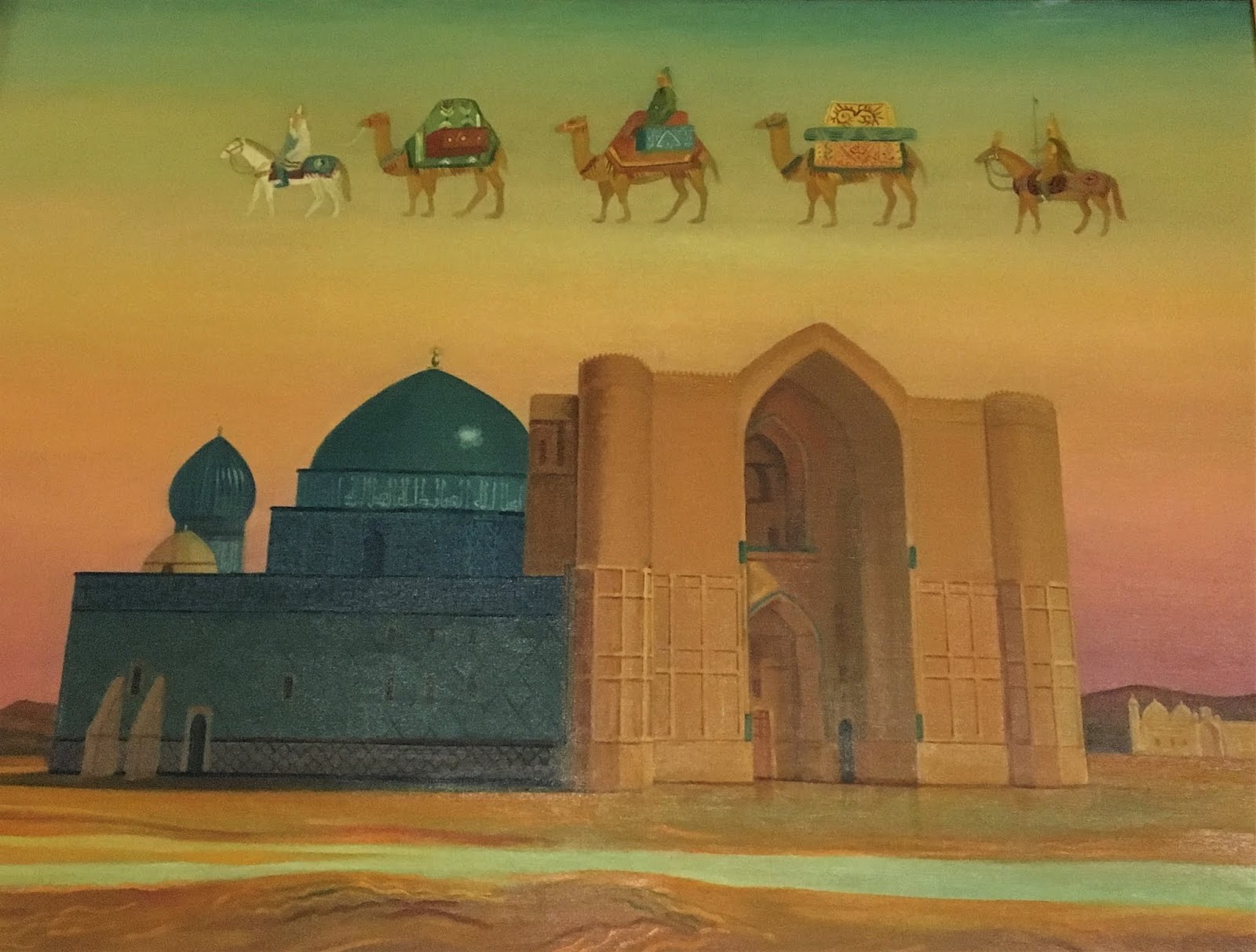
Words of Ancestors ~ Bakhytzhan Myrzakhmetov
Canvas & oil, 1997
1. The Three Kings

Where do we go from here?
We left our country,
Bore gifts,
Followed a star.
We were questioned.
We answered.
We reached our objective.
We enjoyed the trip.
Then we came back by a different way.
And now the people are demonstrating in the streets.
They say they don’t need the Kings any more.
They did very well in our absence.
Everything was all right without us.
They are out on the streets with placards:
Wise Men? What’s wise about them?
There are plenty of Wise Men,
And who needs them?—and so on.

Perhaps they will be better off without us,
But where do we go from here?


~ Muriel Spark (1918 - 2006)
Silk Road ~ Sagyntai Alimbetov
Canvas & oil, 1998
2. Christmas Carol

The kings they came from out the south,
All dressed in ermine fine;
They bore Him gold and chrysoprase,
And gifts of precious wine.

The shepherds came from out the north,
Their coats were brown and old;
They brought Him little new-born lambs—
They had not any gold.

The wise men came from out the east,
And they were wrapped in white;
The star that led them all the way
Did glorify the night.

The angels came from heaven high,
And they were clad with wings;
And lo, they brought a joyful song
The host of heaven sings.

The kings they knocked upon the door,
The wise men entered in,
The shepherds followed after them
To hear the song begin.

The angels sang through all the night
Until the rising sun,
But little Jesus fell asleep
Before the song was done.


~ Sara Teasdale (1884- 1933)
Golden Steppes ~ Kazakbay Azhibekuly (b 1966)
Canvas & oil, 1997
3. St. Helen’s Prayer
to the Three Magi on the Feast of the Epiphany


Everyone in Jerusalem remarked on Helena’s vigour. The old lady was positively indefatigable, they all said. But in truth she was very weary. Winter set in. The convent was exposed, damp and chill. It was not thus, in Dalmatia, that she had planned her old age. She seemed to have come to the end of her questions. No one was helpful. No one was hopeful. At Christmas she had not the strength to ride out with the procession to Bethlehem. She went to communion in the convent chapel and that day allowed the nuns to make a fuss of her, spending the feast crouched over a wood fire which they lit for her in her room.

But by Twelfth Night she rallied and on the eve set out by litter along the five rough miles to the shrine of the Nativity. There was no throng of pilgrims. [Bishop] Macarius and his people kept Epiphany in their own church. Only the little community of Bethlehem greeted her and led her to the room they had prepared. She rested there dozing until an hour before dawn when they called her and led her out under the stars, then down onto the stable-cave, where they made a place for her on the women’s side of the small, packed congregation.

The low vault was full of lamps and the air close and still. Silver bells announced the coming of the three vested, bearded monks, who prostrated themselves before the altar. So the long liturgy began.

Helena knew little Greek and her thoughts were not in the words nor anywhere in the immediate scene. She forgot even her quest and was dead to everything except the swaddled child long ago and those three royal sages who had come from so far to adore him.

“This is my day, she thought, “and these are my kind.”

Perhaps she apprehended that her fame, like theirs, would live in one historic act of devotion; that she too had emerged from a kind of ‘ουτοπία’ [Utopia] or nameless realm and would vanish like them in the sinking nursery fire-light among the picture-books and the day’s toys.

“Like me,” she said to them, “you were late in coming. The shepherds were here long before; even the cattle. They had joined the chorus of angels before you were on your way. For you the primordial discipline of the heavens was relaxed and a new defiant light blazed among the disconcerted stars.

“How laboriously you came, taking sights and calculations, where the shepherds had run barefoot! How odd you looked on the road, attended by what outlandish liveries, laden with such preposterous gifts!

“You came at length to the final stage of your pilgrimage and the great star stood still above you. What did you do? You stopped to call on King Herod. Deadly exchange of compliments in which there began that unended war of mobs and magistrates against the innocent!

“Yet you came, and were not turned away. You too found room at the manger. Your gifts were not needed, but they were accepted and put carefully by, for they were brought with love. In that new order of charity that had just come to life there was room for you too. You were not lower in the eyes of the holy family than the ox or the ass.

“You are my especial patrons,” said Helena, “and patrons of all late-comers, of all who have had a tedious journey to make to the truth, of all who are confused with knowledge and speculation, of all who through politeness make themselves partners in guilt, of all who stand in danger by reason of their talents.

“Dear cousins, pray for me,” said Helena, “and for my poor overloaded son [the Emperor Constantine himself, who was still unbaptized]. May he, too, before the end find kneeling-space in the straw. Pray for the great, lest they perish utterly. And pray for Lactantius and Marcias and the young poets of Trèves and for the souls of my wild, blind ancestors; for their sly foe Odysseus and for the great Longinus.

“For His sake who did not reject your curious gifts, pray always for the learned, the oblique, the delicate. Let them not be quite forgotten at the Throne of God when the simple come into their kingdom.”


~ Evelyn Waugh (1903 - 1966)
from Chapter 9 ~ “Epiphany” ~ of his novel Helena
Thanks to Peter Bunder
for including this selection for Epiphany
in the Good Shepherd Bulletin
on Sunday, 14 January 2018

************************

All artwork above from the
President`s Center of Culture & Museum
Astana, Kazakhstan

************************

More Magi
Medellín Magi
Magi and Fruitcake
"The Magi" ~ Peter, Paul & Mary

Thursday, April 11, 2013

Confidence in Confidence


Seasonal Inevitability:
All Souls Day at the Cemetery in West Lafayette
My friend Beata* and I found this wayward arrangement,
apparently from the previous Easter,
blown into a bank of dry autumn leaves and rubble.

Writing earlier this week of The Unbearable Lightness of Being (click or scroll down) brought to mind the following beautiful Easter meditation taken from the pretend Diary of Emily Dickinson, actually written by Jamie Fuller.

It's Sunday 21 April 1867 -- a late Easter that year -- and instead of attending church with the family, Emily stays home and writes her own sermon. (I'm often tempted to do the same, with so much excellent material at hand, as well as the inclination to liven thinks up a bit: shed a little doubt, spread a little worry, a little realism, a little heartbreak.) In her Easter contemplation, the fictional Emily Dickinson writes not of an unbearable lightness but of a bearable heaviness, the "weight" of "the seeker's burden":

"Morning came with reluctance -- and the sky still mingles tears with hope. We like a vivid Easter -- but Nature -- remembering the first -- chooses a more fitting compromise. The family are at church -- where presumptuous bonnets vie with Faith -- but I prefer to spend this morning with my Bible -- to hear again the story of that Day -- that taught us how to suffer. The Gospels promise permanence but remind us of our evanescence. Even he who died for Truth -- the greatest blasphemy -- could not escape fulfillment of that ageless Prophecy.

"We read the tale -- admonishing the Followers -- but the cock crows many times in our hearts and Thomas sets our example. Faith itself is our cross -- We stumble under it's weight but cannot put it down. How much lighter the step of those who do not bear the seeker's burden"
(p 33).

As a poet, Dickinson forgoes the (perhaps unbearably) "lighter . . . step." I'm struck by Dickinson / Fuller's image of the cock that crows "in our hearts," where doubt resides, and her conclusion that "faith is our cross," cumbersome but bearable. The dual burdens, one of doubt and one of faith, call to mind my favorite passage of the conflicted father in the Gospel of Mark: "I believe. Help thou mine unbelief" (9: 24). Doesn't that say it all? Especially for a Gemini and a doubting Thomasina, what's the difference really? Belief / unbelief: they go together. Doubt / faith: which is heavy; which is light?

As a wise spiritual teacher (I'm not sure who) once said,
“The enemy of faith is not doubt.
Doubt is faith’s friend.
The enemy of faith is fear.”

Not to shock the shy and modest Emily, but I can't help thinking of something irreverent here, one of Stephen Colbert's characteristic quips: "Ladies . . . show a little cleavage. It lets a man know that you're confident enough to show some cleavage!" Not much of an option for the unendowed such as myself; yet I grasp the concept. Of course, the circularity of Colbert's suggestion is laughable; yet, on the serious side, it bears a resemblance to the Easter idea -- we need faith to have faith, confidence to have confidence. As Julie Andrews sings in The Sound of Music, "I have confidence in sunshine, I have confidence in rain . . . I have confidence in confidence alone."**

Or the courage to have courage, like Stephen Dedalus when he says, "I will tell you also what I do not fear" -- and then goes on to list the things he is afraid of, the things he summons the courage to deal with every day.

In closing, another wise teacher (this one I do know) said,
"Fear is an important consultant, but a lousy leader.
You can listen to its advice, but you must not let it lead.
Courage is a wise leader. You should follow it."
Noam Shpancer
from his novel The Good Psychologist (78)

*****************

**Such excellent lyrics!
I must include the rest of them here:

I Have Confidence
What will this day be like? I wonder.
What will my future be? I wonder.
It could be so exciting to be out in the world, to be free
My heart should be wildly rejoicing
Oh, what's the matter with me?

I've always longed for adventure
To do the things I've never dared
And here I'm facing adventure
Then why am I so scared

A captain with seven children
What's so fearsome about that?

Oh, I must stop these doubts, all these worries
If I don't I just know I'll turn back
I must dream of the things I am seeking
I am seeking the courage I lack

The courage to serve them with reliance
Face my mistakes without defiance
Show them I'm worthy
And while I show them
I'll show me

So, let them bring on all their problems
I'll do better than my best
I have confidence they'll put me to the test
But I'll make them see I have confidence in me

Somehow I will impress them
I will be firm but kind
And all those children (Heaven bless them!)
They will look up to me
And mind me

With each step I am more certain
Everything will turn out fine
I have confidence the world can all be mine
They'll have to agree I have confidence in me

I have confidence in sunshine
I have confidence in rain
I have confidence that spring will come again
Besides which you see I have confidence in me

Strength doesn't lie in numbers
Strength doesn't lie in wealth
Strength lies in nights of peaceful slumbers
When you wake up -- Wake Up!

All I trust I leave my heart to
All I trust becomes my own
I have confidence in confidence alone


(Oh help!)

I have confidence in confidence alone
Besides which you see I have confidence in me!


sung by the character Maria in The Sound of Music
by Rodgers and Hammerstein

*Beata & Kitti ~ 2 November 2012


P.S.
With a few minor changes,
this post also appears on
The Fortnightly Kitti Carriker ~ March 15, 2023

Thursday, October 29, 2020

Rest in Peace Henry Wise Miller

Posting today in honor of
my great - great - grandfather,
who died 105 years ago today ~ RIP
Henry Wise Miller
(May 27, 1834 ~ October 29, 1915)
&
Elizabeth Birkinbine Miller
(February 28, 1938 ~ March 28, 1925)

For more on his life and death,

see my current post:

"The Birkinbine Millers of Oak Street"

@The Fortnightly Kitti Carriker
A literary blog of connection & coincidence;
custom & ceremony

Looking over the various photographs and artifacts from Great - Great - Grandfather Miller's life, I can't help thinking of this haunting passage from William Soutar (1898 - 1943) and wondering if it goes both ways -- not only why do we wish to be remembered, but why do we wish to remember these dear old folks who have never looked, can never look, upon our face?
"Why do we wish to be remembered, even when none remain who looked upon our face? Surely, though it must retain an element of self- consideration, it is a last acknowledgment that we need to be loved; and, having gone from all touch, we trust that memory may, as it were, keep our unseen presence within the borders of day."
Is it their love or approval that we seek? Or perhaps the opportunitity to say, "Look at us; we are you great - great - grands! It was all worth it! We're going to the future and taking you with us!" Whatever our motiviation, we sense their unseen presence, whenever we look at the old photos, visit the cemetery, or honor the ancestors, on Memorial Day or Dia de los Muertos.

Wishing you a long, introspective weekend!
~ All Hallows ~ All Saints ~ All Souls ~

Sunday, November 1, 2015

Extra Hour

i do not worry if briefer days grow briefest . . .
i do not worry if longer nights grow longest . . .

e.e. cummings

Sunset

Moonset

Sunrise

Not by the sun’s arithmetic
or my own
can I make the days
go fast enough.
Yet there are those
who beg God daily
for an extra hour.
I wish for them no solitude,
no time apart from what they love,
and let them have their extra hour.


Rod McKuen (see also)

Last year when I posted this McKuen poem for the time change and wrote, "Yay! for the extra hour," my friend Tim responded, "I pretend every hour of this day is the extra hour! Time to get back to putting up Christmas decorations!" It's true, with Halloween over, the holidays hurtle forward!

In the next poem, try substituting Kooser's opening of "this Valentine's Day," with "this midnight of the extra hour," and suddenly it becomes perfect for the last night of Daylight Savings Time:

For You, Friend

this Valentine's Day, I intend to stand
for as long as I can on a kitchen stool
and hold back the hands of the clock,
so that wherever you are, you may walk
even more lightly in your loveliness;
so that the weak, mid-February sun
(whose chill I will feel from the face
of the clock) cannot in any way
lessen the lights in your hair, and the wind
(whose subtle insistence I will feel
in the minute hand) cannot tighten
the corners of your smile. People
drearily walking the winter streets
will long remember this day:
how they glanced up to see you
there in a storefront window, glorious,
strolling along on the outside of time.


Ted Kooser, from Valentines (see also)

To conclude, how timely that the hour change should come on Halloween Night this year! Or, more precisely, in the early hours of All Saints' Day, leading to this poem for tomorrow:

In the Elegy Season

Haze, char, and the weather of All Souls’:
A giant absence mopes upon the trees:
Leaves cast in casual potpourris
Whisper their scents from pits and cellar-holes.

Or brewed in gulleys, steeped in wells, they spend
In chilly steam their last aromas, yield
From shallow hells a revenance of field
And orchard air. And now the envious mind

Which could not hold the summer in my head
While bounded by that blazing circumstance
Parades these barrens in a golden trance,
Remembering the wealthy season dead,

And by an autumn inspiration makes
A summer all its own. Green boughs arise
Through all the boundless backward of the eyes,
And the soul bathes in warm conceptual lakes.

Less proud than this, my body leans an ear
Past cold and colder weather after wings’
Soft commotion, the sudden race of springs,
The goddess’ tread heard on the dayward stair,

Longs for the brush of the freighted air, for smells
Of grass and cordial lilac, for the sight
Of green leaves building into the light
And azure water hoisting out of wells.


by Richard Wilbur (see also)

Sunday, October 31, 2010

Samhain: When the Summer Goes

My Beautiful House Ghost Constance Chauncey
Previously Incarnated as
Victorine of 814 and Priscilla of Pine

In The Book of the Year: A Brief History of our Seasonal Holidays, author and anthropologist Athony Aveni writes that "Halloween is the modern day version of Celtic Samhain, literally when the summer goes" (127). What a lovely translation! -- "When the summer goes." How perfectly those words capture the tone of All Hallows, All Saints, All Souls, and all the time-honored festive customs that have become our collective psyche's way of tuning into the cosmos, turning with the sun, bidding farewell to the summer, and greeting the Wiccan New Year (called Samhain, pronounced "sow - en).


Just last week, in connection with the ginkgo light (click or scroll down), I was quoting from one of the best children's Halloween books ever -- The Witch Family -- a clever little story of two clever little girls, Amy and Clarissa, whose drawings can shape the reality of their choosing. If they want the Halloween sky to look a certain way, well, then, they just draw it that way! If they want to befriend Little Witch Girl and fly wildly through the sky with Old Witch on Halloween night, they just insert themselves into that picture, and away they go!

Here are a couple more favorite Halloween passages from The Witch Family by Eleanor Estes:

"Amy sat back and thought, 'Yes,' she said. 'It has to be dark, very dark. And the sky must be the Halloween sky. And the moon must be the Halloween moon. And the clouds, the Halloween clouds. Everything will be scary and spooky and windy "' (137).

"Halloween shadows played upon the walls of the houses. In the sky the Halloween moon raced in and out of clouds. The Halloween wind was blowing, not a blasting of wind but a right-sized swelling, falling, and gushing of wind. It was a lovely and exciting night, exactly the kind of night Halloween should be. Amy's rapture was complete. She looked up at the sky" (144).

"What a Halloween it had been! How could she wait a whole year for the next one?" (177).

Or, as Barry Manilow sings:

"Oh how I hate to see October go . . .
It doesn't matter much
How old I grow
I hate to see October go"

(nice slide show).

Also by Anthony Aveni, Stairways to the Stars: Skywatching in Three Great Ancient Cultures [Stonehenge, Mayas, Incas], recommended by a tour guide on one of the bus trips I took on the Yucatan Peninsula a few years ago.

Wednesday, November 1, 2017

Allerheiligen

"When the last person here is dead,
who'll put a tombstone at his head?"
Lenore Eversole Fisher, (1900 - 1990)
Contributing writer to the Indianapolis Star,
the Kokomo paper, and the Poetry Explorer.
Other poems include: "Survivor," "Motif," and "Spring Day."

As you can see from the above collage that I put together in one of my teen - age scrapbooks, I've always known myself to be just a bit like Keats, who was "half in love with easeful Death," and never more so than at this mystical time of year. Fittingly, Keats was born in 1795 on All Hallow's Eve; he loved Autumn, and died young -- "Here lies one whose name was writ in water" -- in 1821.

All Saints and All Souls; Allerheiligen and Allerseelen -- whether in Germany, England, Mexico, or the United States -- these are the days for contemplating mortality and immortality. In Bridget Jones: The Edge of Reason , Bridget Jones and her friends are compelled to focus on these issues. When Princess Diana dies, Bridget writes in her diary:
"Is unbelievable. Like dream or sick newspaper April Fool. Is unbelievable. Diana dies is just not kind of thing she would do. . . . Cannot believe it. Is so scary when is obvious no one in authority knows what to do. . . . Seems like the world has gone mad. Is no normality to come back to. . . . Is like Jude or Shazzer being there and full of life and giggly jokes and lip gloss then suddenly being something so grown - up and horror - filled and alien as dead. . . . 'And now Princess Diana is dead,' said Shazzer solemnly. The mood abruptly changed. We all fell silent, trying to absorb this violent, shocking and unthinkable thought" (emphasis added).
A Local Cairn

Wednesday, November 2, 2022

Day of the Dead Still Glowing

All Souls

Did someone say that there would be an end,
An end, Oh, an end, to love and mourning?
Such voices speak when sleep and waking blend,
The cold bleak voices of the early morning
When all the birds are dumb in dark November—
Remember and forget, forget, remember.

After the false night, warm true voices, wake!
Voice of the dead that touches the cold living,
Through the pale sunlight once more gravely speak.
Tell me again, while the last leaves are falling:
“Dear child, what has been once so interwoven
Cannot be raveled, nor the gift ungiven.”
Now the dead move through all of us still glowing,
Mother and child, lover and lover mated,
Are wound and bound together and enflowing.
What has been plaited cannot be unplaited—
Only the strands grow richer with each loss
And memory makes kings and queens of us.

Dark into light, light into darkness, spin.
When all the birds have flown to some real haven,
We who find shelter in the warmth within,
Listen, and feel new-cherished, new-forgiven,
As the lost human voices speak through us and blend
Our complex love, our mourning without end.


May (Eleanore Marie) Sarton (1912 – 1995)
The smallest grave:
only two oak leaves high
More Headstones
UVA Cemetery & Columbarium

*********************

P.S.
July 2026


"We are never done with thinking about our parents,
I suppose, and come to know them better
long after they are dead
than we ever did when they were alive.
"

~ May Sarton ~

Wednesday, October 31, 2018

Samhain Triumvirate

HALLOWEEN
My 5th Grade Art Project ~ Halloween 1967

"Backward, turn backward, O Time, in your flight,
Make me a child again just for tonight!"

~ Elizabeth Akers Allen ~

I was so pleased to re - discover this 50 - year - old (!) painting over the summer, rolled up in a closet at my parents' house. My friend Len humorously pointed out that perhaps it survived because "Somehow you knew as a child to always use acid-free archival paper, inks, and glues for all of your projects." On a serious note, my oldest brother Dave pointed out that "Interestingly your only concession to Halloween is the pumpkin in the lower right" and my own children were wondering why on earth their mom used to be such a morbid kid! What about candy, costumes, and jack - o - lanterns? I guess even at age 10, I intuited a sense of foreboding as the year wound itself down.

For a couple of months now, I have been haunted by Len's direful pre - seasonal warning:
"Two days ago I acknowledged the end of summer; Fall, with its ominous name, has been looming and lurking. With our backs turned, with our eyes fixed on new books, in the delusion of days without meetings or grading papers, suddenly the Fall leaps out and can't be shaken off any more. I posted the syllabuses to my course site. The books for my 'Representations of Exile' class are stacked on my desk (this time Conrad, Danticat, Cristina Garcia, Nabokov, Sebald, and Viet Thanh Nguyen). For the rest of the night: free reading."
Len's ode to Fall (ominous yet seductive) reminded me of many a paragraph in The Street of Crocodiles, eerie and lyrical. For example:
"Oh the skies of those days, skies of luminous signals and meteors, covered by the calculations of astronomers, copied a thousand times, numbered, marked with the watermarks of algebra! With faces blue from the glory of those nights, we wandered through space pulsating from the explosions of distant suns, in a sidereal brightness . . . The houses, wide open at night during that time, remained empty in the light of violently flickering lamps. The curtains blew out far into the night and the rows of rooms stood in an all - embracing, incessant draft, which shot through them in violent, relentless alarm." (Bruno Schulz, 155 - 56)
If the approaching autumn season seems too sinister, I find that a little lace -- black or white or some of each -- helps to soften the worrisome edges. For over twenty - years now, a delicate lace ghost has appeared to gently haunt us in honor of the previous residents of our various historical homes. Every year, as the October light works its magic, my mother and my friend Victoria never fail to inquire, "Is the ghost up yet?" My sweet sister Di had some kind words for this year's emanation: "That is the fanciest ghost I have ever seen. When I get home I will dig out my tablecloths and see what I can do!"

ALL SAINTS

ALL SOULS
Black Cat ~ Black Lace